
Drone as a First Responder (DFR) & Shielded Operations Programs
Our programs are designed for small and mid-size agencies building practical DFR capabilities. V1DroneMedia helps police departments, sheriff’s offices, fire departments and municipalities build a compliant program—policy, waiver path, training, and equipment setup.
From early feasibility to operational deployment, we help public safety agencies design, train, and launch compliant Drone as First Responder programs.
Highest level DFR system in action: fully automated deployment - usually used by agencies in larger metro areas
Every level of DFR Program enables safer response than without a drone program - we help you select the right level of DFR for your department
We help you select the right regulatory path (Part 91 vs Part 107 PSO Shielded Ops)
Provide training + operational rollout + documentation support
Assist with equipment selection and setup for real-world deployment
Our programs are designed for small and mid-size agencies building practical DFR capabilities
Three Levels of Drone as First Responder (DFR) Deployment
Drone as First Responder (DFR) programs do not all look the same.
Most public safety agencies adopt DFR capabilities in stages as their program, staffing, and regulatory approvals evolve. These stages represent increasing levels of operational capability and automation.

Basic – Pilot Responds to Scene
The simplest form of DFR occurs when a trained drone pilot responds to a call and launches the drone before or alongside arriving units, providing aerial situational awareness early in the response.
This model requires minimal infrastructure and is often the first step for agencies establishing & expanding their drone program.
Typical characteristics:
Drone pilot responds with patrol units
Drone launched from the scene or nearby location
Visual line of sight operations (VLOS) under Part 107-PSO provisions
Live video streamed to command staff or responding officers
Rapid situational awareness for officers approaching the scene
This model allows agencies to begin using drones as an early-response intelligence tool without complex infrastructure or regulatory waivers.
Advanced – Deployment to Scene (Shielded Operations)
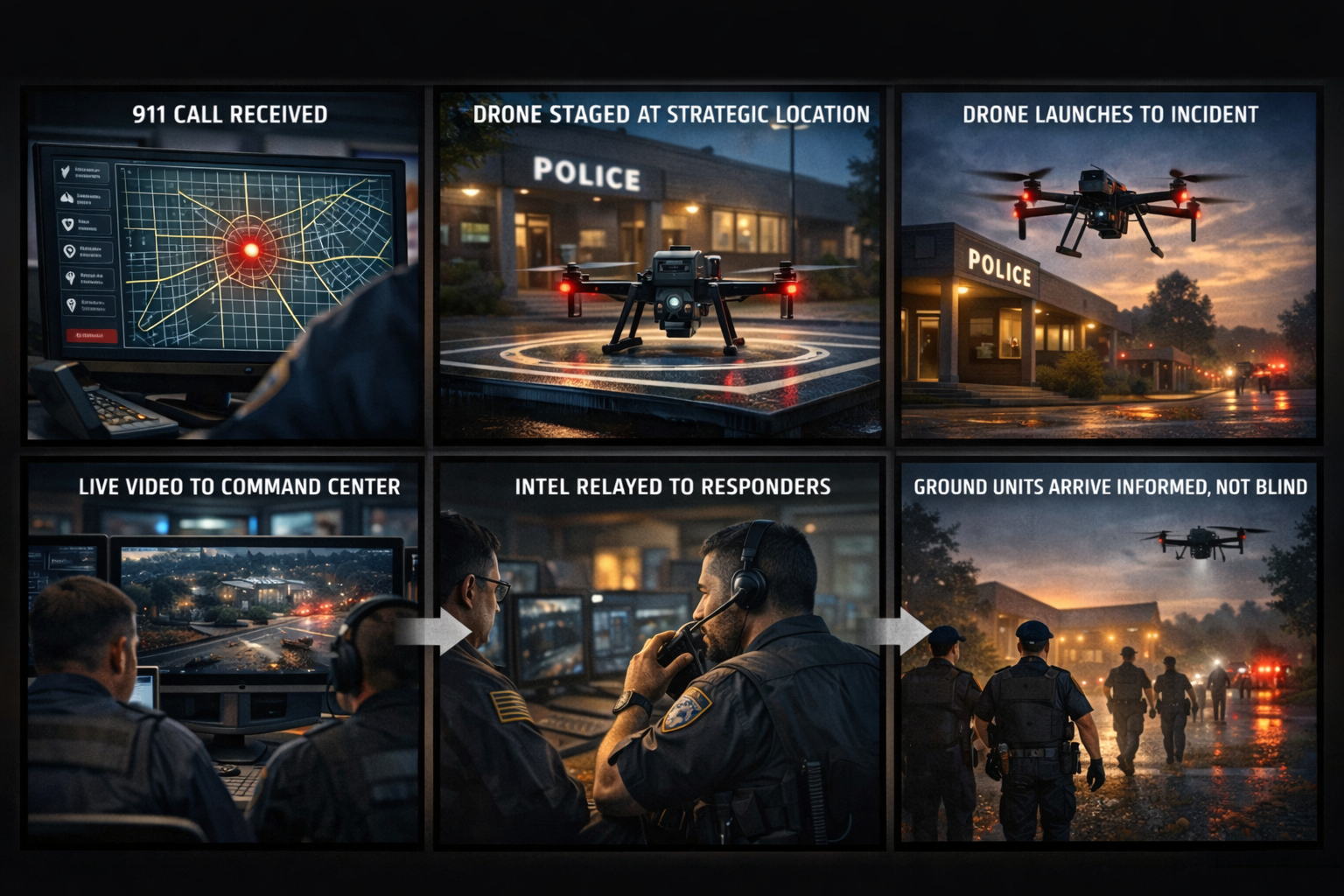
In this stage, agencies operate under an FAA Shielded Operations waiver, which allows drone pilots to fly beyond visual line of sight (BVLOS) by using buildings, terrain, or other structures as a shielding buffer between the aircraft and non-participating people and vehicles. This enables pilots to expand their operational coverage area significantly without the full infrastructure requirements of a traditional DFR program.
A trained pilot can launch from a nearby location and operate throughout a defined area, using the surrounding environment to maintain the required level of safety under the waiver framework.
Typical characteristics:
BVLOS operations enabled through FAA Shielded Operations waiver
Pilot operates from a fixed or mobile launch point within the shielded environment
Coverage radius typically 1–3 miles
Expanded operational area without full DFR infrastructure
Live video streamed to command staff or dispatch
This approach significantly reduces response time and allows agencies to reach scenes before ground units arrive, while still maintaining a relatively simple operational structure.
Highest – Automated DFR Launch (Rooftop or Drone-in-a-Box)
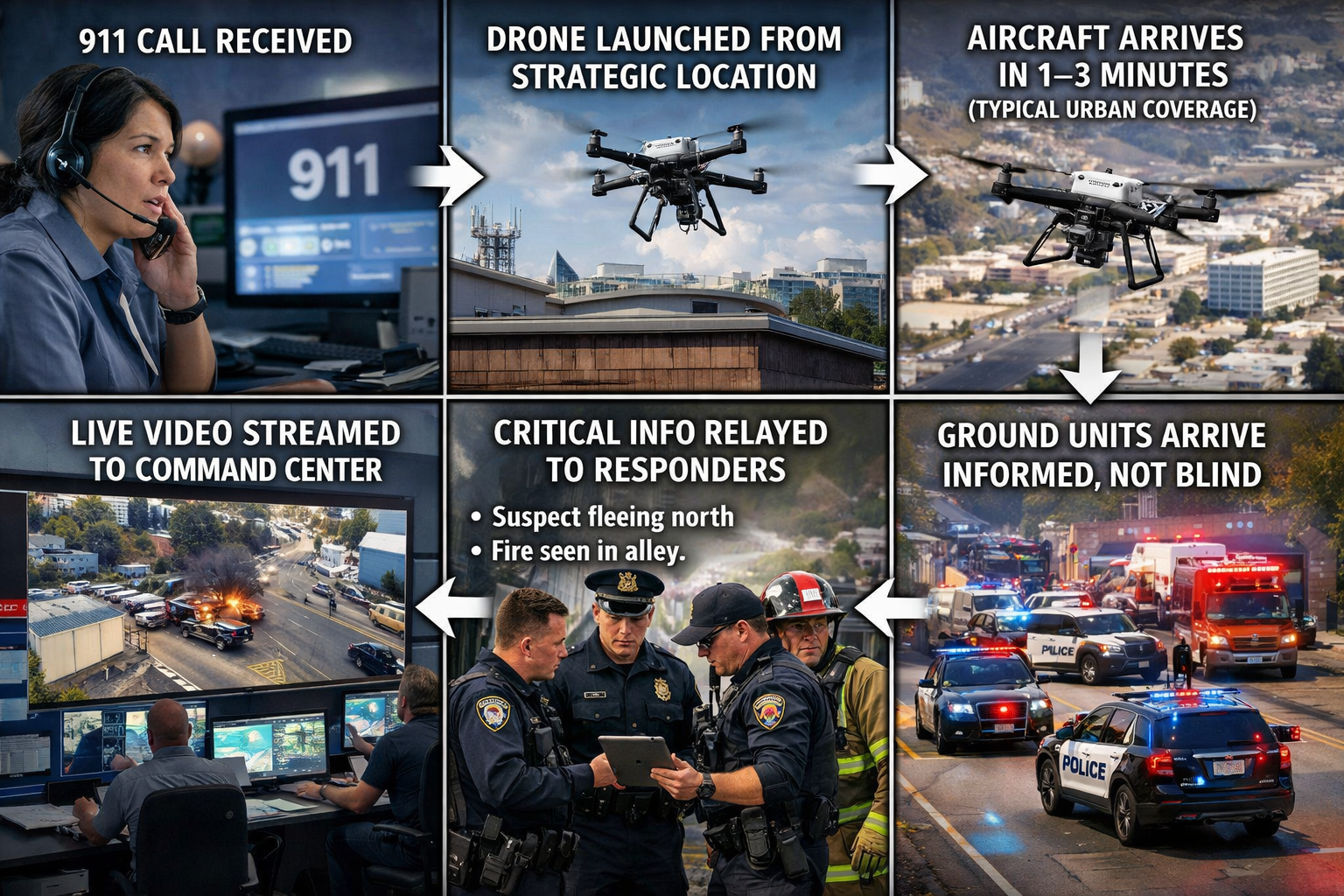
The most advanced model involves automated drone deployment from rooftop stations or drone-in-a-box systems, integrated with dispatch systems and operated by trained teleoperators under a DFR waiver.
This approach allows drones to launch automatically when certain call types are dispatched, providing near-instant aerial intelligence.
Typical characteristics:
• Automated rooftop or drone-in-a-box launch sites
• Integrated dispatch and teleoperation systems
• Coverage areas designed for urban response
• Aircraft arrives in 1–3 minutes (typical urban coverage)
• Live video streamed directly to command staff, dispatch, or teleoperators
This model is typically implemented by larger departments with dedicated drone units and advanced operational infrastructure.
Why Agencies Are Adopting DFR & Shielded Operations
Public safety agencies adopt DFR programs to reduce uncertainty, improve officer and firefighter safety, and make faster, better-informed decisions during high-risk calls.
Key outcomes agencies see:
Improved officer safety through early threat and hazard assessment
Faster response times compared to patrol-only deployment
Fewer unnecessary unit dispatches to low-risk or unfounded calls
Better de-escalation and tactical planning
Clear documentation for after-action review, training, and public transparency
For chiefs and municipal leaders, DFR is not about replacing personnel—it is about giving responders better information earlier, when decisions matter most.
DFR & Shielded Operations Require More Than FAA Approval
A DFR or Shielded Operations waiver gives an agency legal authority to operate in a specific way, but the waiver alone does not create a safe, scalable program. Agencies still need trained personnel, clear SOPs, crew coordination, emergency procedures, risk management, recurrent proficiency, and documentation. Jason Damman, V1DroneMedia’s Chief Pilot and former airline pilot, explains this aviation-first approach in his Police1 article on how public safety agencies can strengthen Drone as First Responder programs before scaling operations.
Read the Police 1 article on aviation-minded DFR program development
Common DFR & Shielded Operations Use Cases by Agency Type
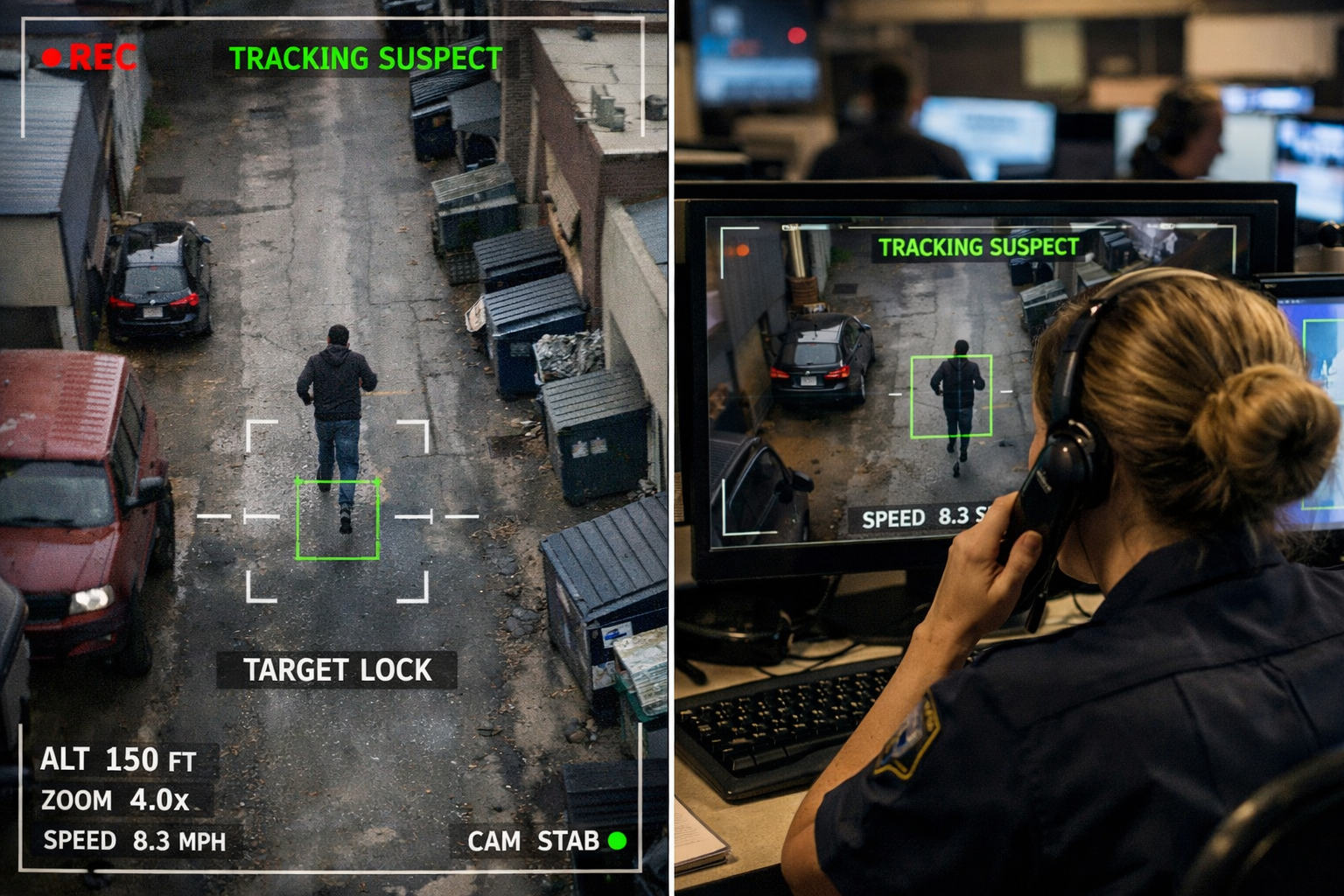
Law Enforcement & Sheriffs
Crimes in progress and unknown trouble calls
Perimeter containment and suspect tracking
Officer assistance and high-risk warrant support
Missing persons and search operations
Traffic incidents and major event monitoring
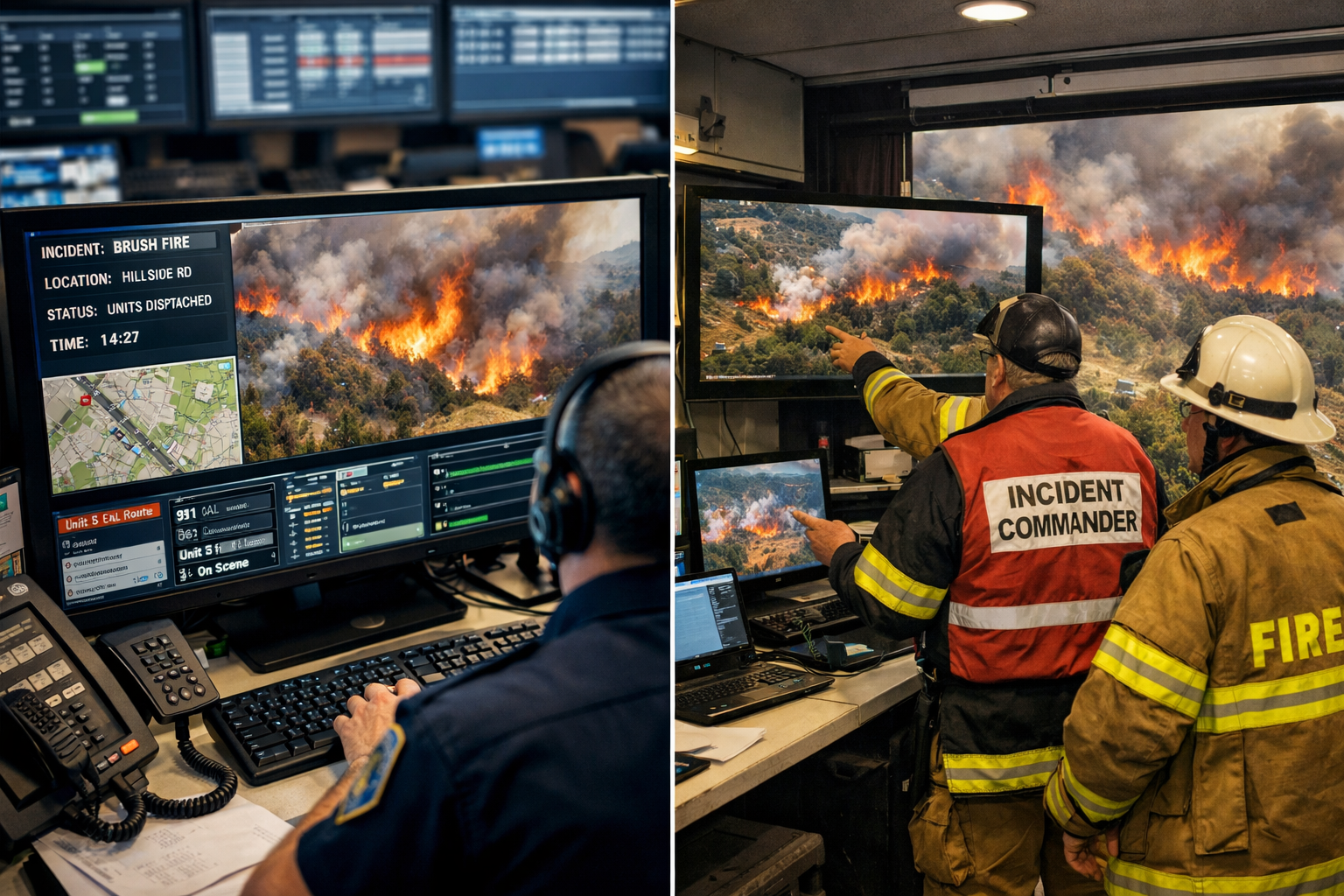
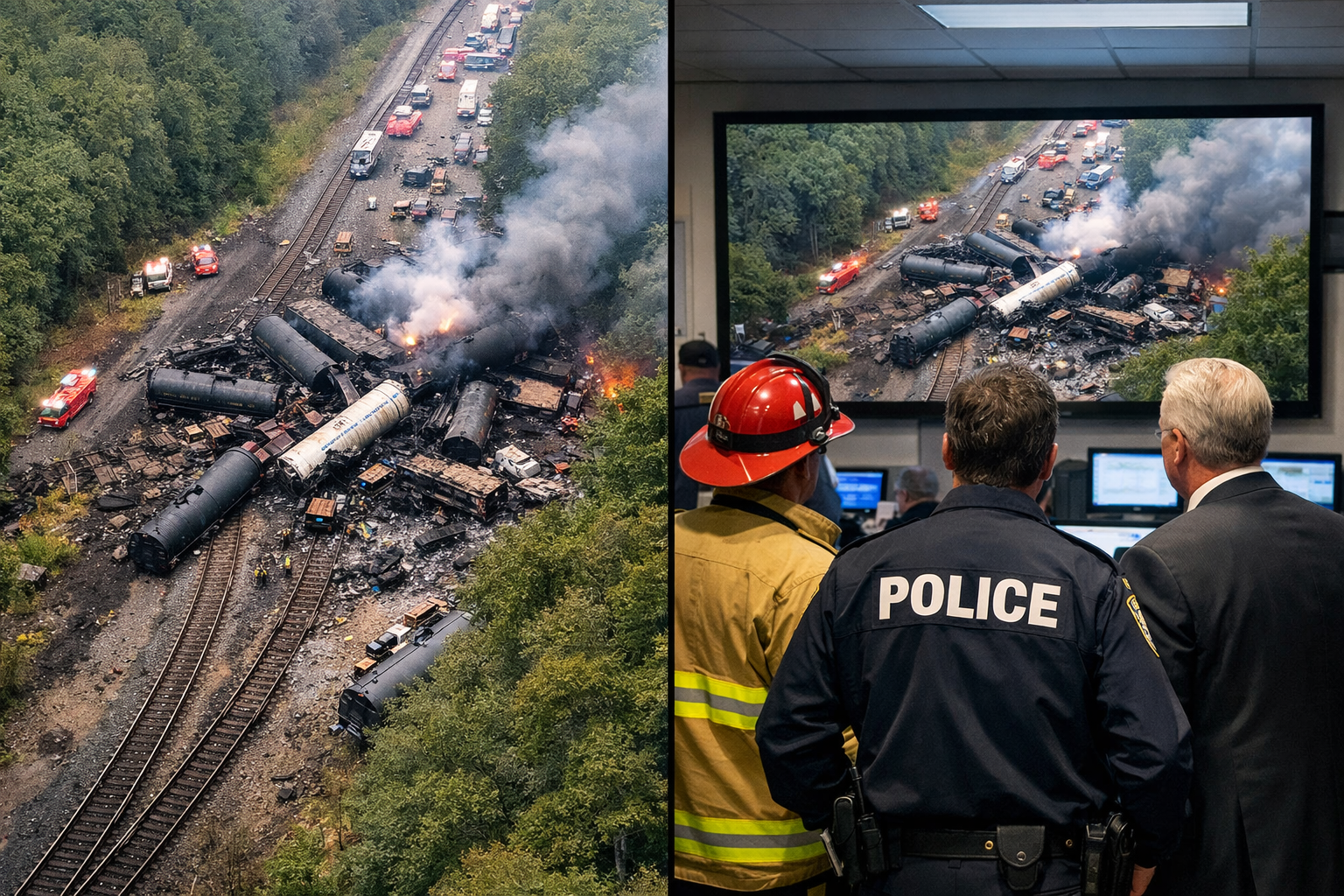
Fire, EMS & Emergency Management
Structure fire size-up before entry
Wildland or brush fire monitoring
Search and rescue operations
HAZMAT and disaster assessment
Post-incident documentation
Municipal & County Leadership
Faster response with lower risk exposure
Data-backed decision-making
Clear policies supporting transparency and public trust
V1DroneMedia DFR Program Offerings
Shielded Operations & DFR Implementation Course
Build and advance a real-world, regulatory-compliant DFR program
This course is designed for agencies evaluating or advancing a Drone as First Responder (DFR) program. We break down the operational and regulatory pathways - Part 107-PSO, Shielded Operations BVLOS waiver or full automated DFR deployment.
This course walks your team through the operational and regulatory differences between each model so you can make informed decisions about where your agency is today and where it needs to go.
What’s included:
Overview of DFR operational models (Part 107-PSO, Shielded Ops, Automated DFR)
FAA regulatory pathways and waiver requirements
BVLOS and Shielded Operations framework explained
Coverage considerations and deployment models
SOP structure and key components (with templates provided)
Pilot workflows and dispatch coordination overview
Equipment categories and system requirements
Policy, safety, and public transparency considerations
DFR Program Starter Kit (templates + decision framework)
Best for: Agencies that want the benefits of flying beyond visual line of sight — without the infrastructure investment of a fully automated DFR program — and need to understand which FAA regulatory pathway is the right fit for their jurisdiction, staffing, and operational goals.
Format:
Half-Day Onsite
Next Session: TBD
Time: 8:30-12:30
Cost: $129
Location: Ohio Drone Repair
Shielded Ops & Implementation Support Options
For agencies that want to implement DFR internally, but need expert guidance, structure, and review before submitting to the FAA.
Guided:
Review the appropriate regulatory path for your department
Provide template and review/edit before submission
Standard Operating Procedures review (SOPs)
Advisory calls
Full Service:
Draft waiver package
Build ConOps (Concept of Operations)
Assist with
FAA Forms
Waiver checklist
Public declaration guidance
Submission Support
FAA follow-up support
Advisory calls
Best for:
Agencies that want active guidance and assistance with the regulatory and operations documentation
Format:
Custom engagement (remote + onsite)
DFR Program Development & Advisory
For agencies developing a long-term DFR strategy, including expansion to advanced automated deployment models.
We work with command staff and UAS leaders to create a scalable, compliant, and operationally effective program.
What’s included:
Full DFR roadmap (expansion from current to automated)
Strategic site planning (stations, coverage zones)
Technology and platform evaluation
Equipment and setup recommendation
Policy, governance, and public transparency guidance
Phased rollout planning
Ongoing advisory support
Format:
Custom engagement (remote + onsite)
Planning a DFR Program? Start with the Operating Model
Before selecting hardware or filing a waiver, agencies should define how the program will actually operate: who launches, who monitors, who communicates with responding units, what happens during lost link or GPS degradation, and how recurrent training will be documented. For a deeper look at this aviation-based approach, read Jason Damman’s Police1 article on DFR training and risk management. If you are not sure what type of waiver you need or what would work best for your agency or municipality to build, learn about a variety of operation models in our Part 91 COW vs. Part 107 for Public Safety Drones blog post, or Request a Consultation with us.
FAQs
-
Yes—DFR operations are legal when conducted under the correct regulatory framework.
Public safety agencies may operate DFR programs under either Part 91 (Public Aircraft Operations) or Part 107 with a Public Safety Organization (PSO) Shielded Operations waiver to allow BVLOS (Beyond Visual Line of Sight), depending on eligibility and mission type.The key is selecting the correct pathway and complying with waiver provisions, training documentation, and airspace authorization requirements.
-
Yes - if you intend to fly Beyond Visual Line of Sight (BVLOS) which applies to Level 2 and Level 3 of DFR programs.
BVLOS operations for DFR require either:A Part 91 BVLOS waiver, or
A Part 107 PSO Shielded Operations waiver
Without a waiver, BVLOS operations are not permitted, even for emergency response.
-
Part 91 applies to qualifying government agencies operating as a Public Aircraft Operator (PAO) and Public Safety Organization (PSO). Pilots are agency-certified, and the agency assumes operational responsibility.
Part 107 applies to organizations that do not qualify as public aircraft (including many volunteer, nonprofit, or contracted providers). Pilots must hold FAA Part 107 certification, and BVLOS operations require a PSO Shielded Operations waiver.
Choosing the wrong pathway can delay or invalidate a program. You can learn more about these pathways in our blog post Part 91 vs. Part 107 for First Responder Agencies or Contact Us for a consultation on the right path for your department
-
It depends on the pathway:
Part 91: Pilots are agency-trained and certified; Part 107 is not required but often used as a best practice and we recommend it
Part 107: Pilots must hold a Part 107 Remote Pilot Certificate.
Many agencies maintain both to support mixed operations.
-
Typical requirements include:
Aircraft under 55 lbs total weight
Standard Remote ID
Anti-collision lighting visible from 3 statute miles
ADS-B In detection (978 + 1090 MHz) for Shielded Ops
Pre-programmed Return-to-Home
FCC-compliant communications
Additional equipment may be required for operations over people. V1DroneMedia partners with equipment distributors that work with first responders to recommend the best equipment for your operational needs.
-
Timelines vary, but most agencies follow a phased approach:
Assessment & planning: 30–60 days
Regulatory & waiver process: 30-120 days (varies)
Training & deployment: 30–90 days
Starting with Level 1 and Level 2 DFR programs allows for shortest timelines