
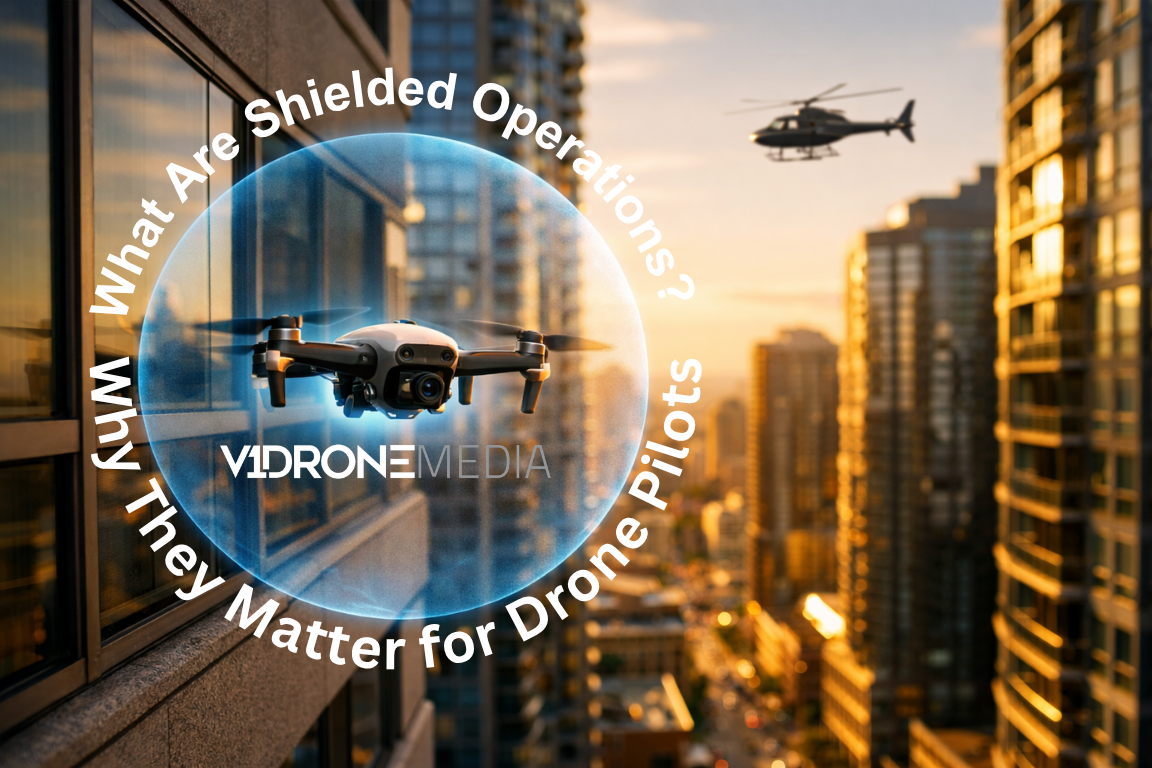
What Are Shielded Operations? (And Why They Matter for Drone Pilots in 2026)
If you’ve been following recent FAA updates—or hearing terms like BVLOS, Part 108, or DFR programs—you’ve probably come across something called “shielded operations.”
But what does that actually mean?
And more importantly:
👉 Does it change how you can legally fly your drone today?
Let’s break it down in plain English.
What Are Shielded Operations?
Shielded operations refer to flying a drone in areas where structures naturally block risk to other aircraft.
Think:
Near buildings
Under rooftops or overhangs
Along walls or inside urban corridors
The idea is simple:
👉 If a drone is flying in a space where manned aircraft physically cannot go, the risk of collision is dramatically reduced.
So instead of relying only on visual line of sight (VLOS) rules, the FAA is starting to recognize that: “The environment itself can provide protection.”
Simple Example of Shielded Operations
Imagine this:
You’re flying a drone along the side of a 5-story building
Your drone stays below the roofline
A helicopter physically cannot occupy that same space safely
That’s a shielded environment.
Now compare that to:
Flying 200 feet above an open field → NOT shielded
Flying over rooftops → NOT shielded
Why Shielded Operations Are Getting Attention Now
This concept is becoming important because of:
BVLOS (Beyond Visual Line of Sight) expansion
Drone as First Responder (DFR) programs
The upcoming Part 108 regulatory framework
Historically:
Under Part 107, most operations required visual line of sight
You needed waivers for anything beyond that
Some public safety agencies used:
COAs (Certificates of Authorization) → which allowed more flexibility, including limited BVLOS with extra paperwork
Now public agencies are transitioning toward:
COW (Certificates of Waiver) → which allows for BVLOS operations and is designed specifically to streamline public safety drone operations, allowing to scale DFR programs a lot faster
Now, the FAA is moving toward risk-based operations, where environment matters—not just distance.
Shielded Operations vs Part 107 Rules
Here’s the key distinction:
Under current Part 107:
You must maintain visual line of sight
BVLOS requires a waiver
There is no formal “shielded operations” rule yet
But…
The FAA is actively working toward rules where:
👉 Shielded environments may allow expanded operations without traditional BVLOS restrictions
This is where things are heading—not fully here yet.
Why This Matters for Commercial Drone Pilots
Even if the rules aren’t fully implemented yet, this is a big deal for your future as a pilot.
Shielded operations could unlock:
Safer urban drone inspections
More scalable construction monitoring
Expanded public safety response (DFR)
Reduced regulatory friction in cities
In other words:
👉 More real-world jobs become easier to execute legally
Shielded Operations and Public Safety (DFR Programs)
This concept is especially important in Drone as First Responder (DFR) programs.
In many cases:
Drones launch from rooftops
Fly along streets and buildings
Stay within shielded corridors
This allows agencies to:
Reduce risk to manned aircraft
Expand operational range
Respond faster to incidents
Shielded Operations can make BVLOS more practical for public safety agencies, but the waiver does not remove the need for operational discipline. Agencies still need documented training, SOPs, airspace awareness, crew coordination, go/no-go criteria, emergency procedures, and recurrent proficiency. Jason Damman, our Chief Pilot, explains this aviation-based approach in his Police1 article on strengthening Drone as First Responder programs.
Important: Surveillance Laws Still Apply (Example: Ohio HB 77)
Even as operations evolve, privacy laws still matter.
For example:
In Ohio House Bill 77, law enforcement must obtain a warrant for certain types of drone surveillance
So even if:
The flight is shielded
The operation is technically safe
👉 You still must comply withstate-level legal restrictions
How This Connects to Your Part 107 License
Here’s where most people get this wrong:
They jump ahead to advanced topics like BVLOS and shielded operations…
👉 …without mastering the fundamentals.
To even operate legally today, you still need to understand:
Airspace classification
Weather and visibility
Regulations under Part 107
Operational limitations
If you’re still preparing, start here:
👉 [How to Get Your FAA Part 107 License (2026 Guide)]
What You Should Focus on Right Now
If you're a new or aspiring drone pilot:
1. Get your Part 107 certification
This is your foundation—non-negotiable.
2. Understand current rules (not future ones)
Shielded operations are coming—but you still operate under Part 107 today.
3. Practice real-world scenarios
You need to think like a pilot, not just memorize answers. Hands on flying is the foundation of becoming a professional drone pilot. Practicing those flying skills in real world scenarios will make you proficient and ready for a real mission.
If you you are not proficient with hands on flying yet, start practicing. There is no substitute for experience here.
👉[Check out our Hands On Drone Operations Course]
Train for the Real Test (and Real Flying)
If you’re studying right now, this is where most people struggle:
They memorize questions
But don’t understand why
That’s exactly why we built our system:
300+ FAA-style questions
Real 65-question test simulations
Study guides tied directly to each concept
Progress tracking so you know when you're ready
👉 [Try the Part 107 Practice Test System]
The Bottom Line
Shielded operations are part of a bigger shift in drone regulations:
➡️ From rigid rules
➡️ To risk-based operations
But today:
If you are a commercial operator (not a public safety agency) and fly under Part 107 you cannot fly under BVLOS or Shielded Operations without additional waivers
If you fly under Part 107 and are public safety agency, you may be eligible to apply for Shielded Operations or fly BVLOS under Part 91
If you’re exploring a right path for your department’s Drone as a First Responder program or if your agency is evaluating Shielded Operations, the first question is not just “Can we get approved?” It is “Are we ready to operate safely, consistently, and defensibly once approved?”
👉 Request DFR & Shielded Operations Support
Part 91 COW vs. Part 107 for Public Safety Drones
Updated February 2026
This post replaces our June 2025 article “COA vs. Part 107: Which Path Is Best for Police and Fire Drone Operations?” to reflect major FAA regulatory changes.
How to Choose the Right Path for a DFR Program (2026 Guide)
If you're looking into launching a Drone as First Responder (DFR) program—or expanding one—you’re stepping into a regulatory landscape that has changed quickly.
Not long ago, public safety drone operations were built around two main paths:
Part 91 (Public Aircraft Operations), typically using the COA (Certificate of Authorization) framework
Part 107, where agencies could apply for waivers to expand beyond standard limitations
Both paths worked—but neither was simple when it came to scaling DFR.
If you wanted to fly beyond visual line of sight (BVLOS):
Under Part 91, you typically needed a COA with significant coordination and documentation
Under Part 107, you had to stack multiple waivers, often with long approval timelines
In most cases, approvals could take 6–10+ months, and operational flexibility was limited.
That system has now been replaced.
The FAA has shifted to a Certificate of Waiver (COW) framework, designed specifically to streamline public safety drone operations.
What that means in practice:
Approvals now often take weeks instead of months
Some DFR waivers are being approved in days—or even hours
Many operations no longer require visual observers
Agencies are scaling DFR programs much faster
👉 Bottom line:
DFR is no longer experimental—it’s operational.
Which brings us to the question most agencies are trying to answer now:
👉 Do we operate under Part 91 or Part 107—and which one is right for us?
The Two Paths (Without the Jargon)
At a high level, every public safety drone program falls into one of these two frameworks:
Part 107 (Where Most Agencies Start)
This is the most common entry point, especially for:
Volunteer fire departments
Nonprofits and search & rescue
EMS providers
Agencies working with contractors
You’re operating under FAA rules as a civil drone operator with a waiver.
In practice:
Pilots must hold a Part 107 certificate
You apply for a waiver (typically Shielded Operations for DFR)
It’s the fastest and most accessible way to launch
👉 If you’re just getting started, this is usually the path.
➡️ Learn more: How to get your Part 107 license
Do DFR pilots need a Part 107 certificate?
If you're operating under Part 107, yes—it’s required.
Under Part 91, technically no. But most agencies still require it anyway.
Why?
Because it:
Creates a standardized knowledge baseline
Reduces liability exposure
Makes your program more defensible
Part 91 (Public Aircraft Operations)
This is typically available to:
Police departments
Sheriff’s offices
Government agencies
Here, you’re operating as a public aircraft operator, which gives you more flexibility—but also shifts more responsibility to your agency.
Key difference:
The FAA does not require Part 107 certification
Your agency defines training, standards, and oversight
👉 More flexibility—but also more accountability.
Do volunteer fire departments qualify for Part 91?
In most cases, no.
Volunteer departments, nonprofits, and private EMS providers usually do not meet the federal definition of a public aircraft operator.
That means they operate under Part 107 instead.
Quick Reality Check
Not a government entity? → You’re almost certainly operating under Part 107
Government agency? → You may qualify for Part 91, depending on structure
Getting this classification right early is critical.
Where Advanced DFR Programs Fit: Shielded Operations
Most DFR programs today want to be structured around Shielded Operations.
That simply means:
Flying low (typically ≤200 ft)
Using buildings and terrain as natural separation from aircraft
The drone is being operated Beyond Visual Line of Sight (BVLOS)
This model is what makes DFR scalable:
Safer operations
Faster approvals
Lower equipment costs
👉 For most agencies, this is the practical starting point.
➡️ Read more:What are Shielded Operations?
Do we need a waiver to run a DFR program?
Yes.
DFR programs rely on BVLOS (Beyond Visual Line of Sight) operations—and those require a waiver under current FAA rules.
Does a waiver mean we can fly anywhere?
No.
A waiver allows how you operate—not where.
You may still need additional airspace authorization, especially near airports or controlled airspace.
Part 91 vs. Part 107 — What Actually Matters
Instead of getting buried in regulations, here’s what matters operationally:
Pilot Requirements
Part 107 → FAA-certified pilots required
Part 91 → Agency-defined training
Operational Flexibility
Part 107 → More structured
Part 91 → More flexible
Liability
Part 107 → FAA sets the standard
Part 91 → Your agency defines (and defends) the standard
That flexibility is powerful, but it also creates responsibility. Under Part 91, the agency is not just operating a drone program — it is building an aviation operation with its own training standards, SOPs, documentation, risk management, crew coordination, and recurrent proficiency expectations. Jason Damman, V1DroneMedia’s Chief Pilot who is also a former airline pilot, expands on this in his Police1 article, How an aviation mindset can strengthen Drone as First Responder programs, which explains why DFR and Shielded Operations programs need aviation-level structure before they scale.
👉 This is one of the biggest strategic differences between the two paths. However since there is no written standard, the agency needs to document and implement these standards. We now offer DFR Implementation Support for any first responder agency in the US to help you customize and define the operational standards.
Is DFR considered surveillance?
No—and it’s important to be clear about that.
DFR programs are designed for:
Emergency response
Real-time situational awareness
Officer and community safety
They are not intended for general surveillance.
That said, state laws still apply.
For example, in Ohio:
👉 House Bill 77 requires law enforcement to obtain a warrant for most drone-based surveillance activities.
➡️ Read more here: Ohio New Drone Law HB 77
What equipment is required for DFR and Shielded Operations?
At a high level:
Remote ID compliant aircraft
Anti-collision lighting
ADS-B detection capability
Reliable communications
Your exact setup depends on your waiver and program scale.
Where Most Agencies Should Start
For most departments, the best path is:
👉 Start with Part 107 → expand into Part 91 (if eligible)
How long does it take to launch a DFR program?
A realistic timeline:
Planning: 30–60 days
Waiver: a few weeks to a few months
Training + deployment: 30–90 days
👉 Most agencies can be operational in 2–4 months.
The Most Common Mistake
It’s not technical—it’s strategic.
👉 Agencies choose the wrong regulatory path at the beginning.
How do we know if DFR will work for our agency?
You need to evaluate:
Regulatory eligibility
Airspace complexity
Call volume
Staffing
Budget
👉 This is exactly what a DFR readiness assessment is designed to answer.
➡️ Start here: Request DFR Implementation Support
Final Takeaway
There isn’t one “best” path—only the right one for your agency.
Part 107 → fastest way to launch
Part 91 → expanded capability (if eligible)
The agencies that succeed with DFR:
Make the right decision early
Build training and policies correctly
Scale intentionally
🚀 Ready to Build Your DFR Program?
We help agencies:
Determine Part 91 vs Part 107 eligibility
Prepare waiver applications
Design scalable DFR programs
Train pilots for real-world operations
👉 Request a DFR Implementation Consultation
👉Explore Public Safety Drone Training Basic and Advanced Courses (Part 107, Hads-On Drone Operations, Search & Rescue, Tactical Operations)
Need Help Getting Trained?
Additional Public Safety Resources: :
Advanced Public Safety Drone Training: Search & Rescue and Tactical Drone Operations
For a deeper look at why waiver approval is only the beginning, read our Chief Pilot’s Police1 article, How an aviation mindset can strengthen Drone as First Responder programs. The article explains why DFR and Shielded Operations programs need structured training, SOPs, crew coordination, risk management, and recurrent proficiency before they scale.
Our instructors combine aviation and real-world police operational expertise
👉 Request Drone Training Consultation
👉 Subscribe to our First Responder Newsletter