

Careers in the Drone Industry
Drone industry is developing at a rapid pace around the world, and even faster in United States since the FAA made it easier to obtain FAA Drone pilot license (Part 107 Certificate) in 2016. What’s more, drone hardware and software companies are continuously innovating to develop new tools, driving the demand for certified pilots in the industries that find them useful.
The world is embracing drones because their value proposition is clear – they can accomplish many tasks faster, safer, and cheaper. Benefits of drone use differ for each industry. However, the common thread runs through all those industries: drones increase productivity, making operations more efficient. They also help with site visualization and digitization, benefits of which go far beyond productivity (internal communications, project planning and documentation, etc.). All these benefits are very attractive to not only corporations in various industries that are constantly looking to increase productivity (i.e. cut costs and increase profits), but also to companies looking to increase public safety and first responder safety (police and firefighters, disaster response, insurance, asset inspections, etc.).
Commercial drone use has increased dramatically especially in construction, agriculture, public safety, land surveying, insurance, real estate, land development, agriculture, military, and entertainment industries, to name a few.
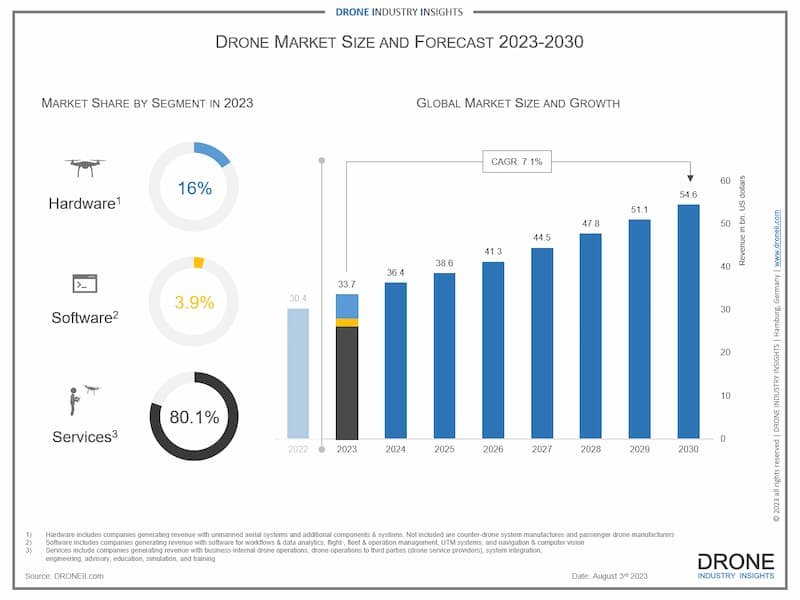
Whether you are in high school or college, just starting your professional career or are retiring, it is never too early or late to enter the drone industry. The opportunity is enormous (the overall drone market is set to grow to $54.6 Billion according to Drone Industry Insights, although other sources cite figures even higher), as the demand in all the drone industry segments and the industries that are using drones are growing. And there are many ways to participate in all of them. We will cover the major ones.
In this blog post we will answer questions that are asked most frequently by those interested in the drone industry careers:
What drone jobs are available?
What drone industry sectors are hiring?
How much do drone pilots and other drone professionals make?
What experience do I need to get hired in the drone industry?
What training and certifications do I need for drone industry jobs?
How do I become a drone pilot?
Drone Industry Sectors
There are 3 main segments in the drone industry: Drone Hardware, Drone Software and Drone Service Providers (DSPs). Drone Services occupies the largest share in the market (80%) due to so many industries embracing drone use, with Hardware and Software rounding out the rest.
Drone Manufacturing Companies (Drone Hardware)
The days of drone building in a garage (except for the FPV drones, maybe) are mostly gone, thanks to the extensive market offering of a wide range of drones at different price points and functions available within reach to both consumer and professional users.
Yes, there are still some opportunities for highly specialized drones to be made in smaller batches by startups or to be modified for specialized uses (like drones made for carrying and releasing specific payloads, power-washing, indoor industrial inspections or military uses, etc.), but at this point the world market has several established companies that produce commercial and recreational drones on a mass scale. Recently there have been some US regulations introduced that may change the market share of these companies (most notably DJI use ban by a government entity bill that has been introduced multiple times), but a lot of newcomers are not expected.
Here is a look at the market share of the main consumer and commercial drone manufacturers as of 2023. It is no surprise to see that DJI leads the pack with at least 70% share (although losing share YOY due to mostly political discourse), with Skydio and others following with much smaller shares, but growing vs. 2022.

While there are still new companies coming onto the market building drones, they tend to be for highly specialized industries and applications (agricultural spraying, military, drones for delivery, public safety, etc.).
If you are more of an engineer and builder/tinkerer you might find working for a drone manufacturer is up your alley, and you can investigate one of the companies that are in drone hardware manufacturing. The skills and education they look for range from aeronautical and aviation engineering to robotics, electronic, mechanical engineering, drone maintenance, test flying, software programming, and more. Here are a few sample jobs and published salaries.
Jobs and Salaries for Drone Hardware Manufacturers
1. Drone Engineer
Main Skills: Engineering knowledge (electrical, mechanical, aerospace), programming (C++, Python), hardware design, systems integration, CAD software proficiency.
Years of Experience: 3-5 years.
Salary Range: $70,000 - $104,723 per year.
Sample Job Link (if job is expired, search job boards for similar positions).
2. Drone Technician
Main Skills: Technical proficiency, troubleshooting, soldering and assembly, knowledge of drone components, tool usage.
Years of Experience: 1-3 years.
Salary Range: $35,000 - $55,000 per year.
Sample Job Link (if job is expired, search job boards for similar positions).
3. Drone Pilot
Main Skills: Remote piloting, knowledge of regulations (FAA), photography/videography, situational awareness, mission planning.
Advanced Skills: UAV systems knowledge, data collection and analysis, test flying.
Years of Experience: 1-4 years.
Salary Range: $40,000 - $120,000 per year.
Search Job boards for multiple available positions
These ranges reflect typical salaries in the U.S. and can vary depending on factors such as location, company size, and specific job responsibilities
Drone Software Companies
Most drones are equipped with cameras that are designed to collect visual data in the form of aerial photographs and high-definition video that are valuable for many industries. The collected aerial data than is imported into 3rd party software to create outputs that were traditionally produced by the survey industry or produce new types of outputs for asset documentation, digital visualization and situational awareness: geo-referenced maps, 3D models of structures and current environments, geospatial insights, volumetric measurement, track site progress and inventory, crop mapping & yield analysis, agricultural disease detection, and more.
Drone Software companies that are most known and used in this space are Pix4D and Drone Deploy, with several less known and some with niche industry applications, such as Propeller Aero, Raptor Maps, Precision Hawk, Skycatch, Agisoft, AgEagle Aerial Sys, Trimble, Bentley Systems, Esri, and more.
Drone-related jobs in these companies outside of administrative and sales jobs are directly related to programming and testing the software, uncovering and developing new “uses” with drone users in various industries. So, software programming, engineering, product design and implementation, various programming languages, test flying, drone technician skills are the ones that these companies look for the most. Below you will find some job descriptions and salaries for jobs in this sector.
Sample Job Titles for Drone Software Manufacturers
Drone Software Engineer
Embedded Systems Developer
UAV/Drone Software Developer
Most desired programming languages: Python, C/C++, Java, MATLAB, Rust
Most desired degrees: Bachelor's or Master’s degree in Computer Science, Electrical, Mechanical or Aerospace Engineering, Robotics Engineering, Mathematics and Physics
Drone Software Companies Sample Job Descriptions, Skills, and Pay Ranges
Drone Software Engineer
Main Skills: Proficiency in software development languages (C++, Python, Java), experience with drone communication protocols, understanding of UAV hardware integration, knowledge of robotics and AI.
Typical Experience: 3-5 years in software development, with a focus on robotics or aerospace.
Salary Range: $90,000 - $130,000 per year.
Search Jobs Boards for Drone Software Engineer Jobs
Embedded Systems Developer
Main Skills: Expertise in embedded systems, low-level programming, real-time operating systems (RTOS), microcontroller programming, and sensor integration.
Typical Experience: 2-4 years in embedded software development.
Salary Range: $80,000 - $120,000 per year.
Search Job Boards for Embedded Systems Developer
UAV/Drone Software Developer
Main Skills: Software engineering principles, software development for autonomous systems, cloud computing for drones, drone data processing, machine learning, knowledge of flight control algorithms, and more.
Typical Experience: 3-7 years in UAV/drone software development or a related field.
Salary Range: $85,000 - $150,000 per year.
Sample Real Job (if job is expired, search job boards for similar positions).)
Drone Services Sector
The Drone Services sector represents the largest and most dynamic segment of the commercial drone industry. While hardware and software companies build the tools, service providers apply drone technology directly within real-world industries to deliver measurable value. This sector of the drone industry is also the biggest and is poised to grow the most because this is where the drone industry is expected to bring the most measurable value for other real-world industries: providing services that make the workflows faster, more productive, safer, and other added value that is unlocked by this technology.
Drones are now embedded into daily operations across agriculture, infrastructure, construction, utilities, surveying, and public safety. As organizations move from experimentation to fully integrated drone programs, demand continues to grow for skilled professionals who combine certified flight capability with industry-specific expertise.
Within Drone Services, several high-growth sub-sectors are shaping career opportunities today.
Agriculture Drone Careers
Agriculture has become one of the most transformative drone service sectors through precision farming and data-driven crop management.
Drone applications in agriculture include:
Crop health monitoring (NDVI and multispectral imaging)
Irrigation analysis
Yield forecasting
Field mapping
Agricultural spraying (with additional licensing requirements)
Sample Jobs in Agricultural Drone Services
1. Agricultural Drone Pilot
Description: Operates drones to capture crop imagery, perform field mapping, and support precision agriculture initiatives. Works closely with farm operators to provide actionable field insights.
Qualifications: FAA Part 107 certification, familiarity with multispectral imaging, understanding of agricultural workflows preferred.
Salary Range: $55,000 – $95,000 per year (varies by region and scale of operation).
2. Precision Agriculture Data Analyst
Description: Processes aerial data into reports that assist farmers with crop optimization, irrigation planning, and yield improvement.
Qualifications: GIS or data analysis background, experience with agricultural software platforms, strong analytical skills.
Salary Range: $60,000 – $110,000 per year.
Agricultural drone roles often combine fieldwork with data processing responsibilities.
Search Job Boards for Agricultural Drone Pilot
Infrastructure & Energy Utilities
Infrastructure inspection is one of the most stable and high-paying areas of drone services. Utility companies and energy providers increasingly rely on drones to inspect critical assets safely and efficiently.
Common drone applications include:
Power line inspection
Solar farm and wind turbine inspection
Oil and gas pipeline monitoring
Cell tower inspection
Bridge and transportation infrastructure assessments
Sample Jobs in Infrastructure & Energy
1. UAS Infrastructure Inspection Pilot
Description: Conducts aerial inspections of industrial assets using high-resolution and thermal imaging equipment. Ensures safe flight operations around sensitive infrastructure.
Qualifications: FAA Part 107 certification, comfort operating in industrial environments, safety compliance training preferred.
Salary Range: $65,000 – $120,000 per year.
2. Utility Asset Data Specialist
Description: Analyzes drone-collected imagery and integrates findings into asset management systems. Works alongside engineers and maintenance teams.
Qualifications: GIS experience, data processing skills, familiarity with engineering or asset management systems.
Salary Range: $70,000 – $130,000 per year.
This sector values precision, safety awareness, and technical reliability.
Search Job Boards for Utility Inspection Drone Pilot
Surveying & Mapping
Surveying and mapping remain among the most technically demanding and lucrative drone service fields. Drones significantly increase efficiency in data collection for topographic mapping, volumetric calculations, and 3D modeling.
Drone applications include:
Construction site mapping
Land development planning
Earthwork volume calculations
LIDAR mapping
Photogrammetry-based 3D modeling
Sample Jobs in Surveying & Mapping
1. Drone Survey Technician
Description: Collects aerial imagery and data for mapping projects. Works alongside licensed surveyors and engineers to support site analysis.
Qualifications: FAA Part 107 certification, GIS or surveying education preferred, photogrammetry software experience.
Salary Range: $60,000 – $100,000 per year.
2. UAS Mapping Project Manager
Description: Oversees drone mapping projects from mission planning through final deliverables. Ensures data accuracy and project timelines.
Qualifications: Part 107 certification, project management skills, advanced GIS or mapping software experience.
Salary Range: $80,000 – $140,000 per year.
3.Aerial Surveyor
Description: Uses drones for mapping, surveying, and 3D modeling, collaborating with land surveyors and engineers.
Qualifications: FAA Part 107 certification, background in surveying or GIS, experience with photogrammetry software, LIDAR, CAD.
Salary Range: $60,000 - $150,000 per year.
Higher-level surveying roles may require formal surveying licensure or advanced degrees.
Search Job Boards for Aerial/Drone Surveyor Jobs
Media & Creative Drone Services
Although one of the earliest commercial drone applications, media and creative production remains competitive and opportunity-rich, including some specialized skills and applications.
Outside of regular drone flying, such applications as FPV drones have opened a new niche within media production by enabling dynamic, immersive footage that traditional camera drones cannot capture. These drones are manually piloted through goggles, allowing for high-speed, indoor, and complex environment flying.
Drone light shows have become a rapidly growing alternative to traditional fireworks displays. These shows use coordinated fleets of synchronized drones to create aerial animations for sporting events, festivals, corporate events, and large-scale public celebrations.
Drone services in this sector include:
Real estate photography
Film and television production
Commercial advertising
Event coverage
Sports broadcasting
Drone Shows
Sample Jobs in Media Drone Services
1. Drone Videographer/Cinematographer
Description: Captures aerial footage for films, commercials, and branded content. Collaborates with directors and production teams to achieve creative objectives.
Qualifications: FAA Part 107 certification, videography experience, editing software proficiency.
Salary Range: $50,000 – $100,000 per year (high variability depending on project scale).
2. Real Estate Drone Specialist
Description: Produces aerial imagery and video for property marketing campaigns.
Qualifications: Part 107 certification, photography skills, marketing understanding.
Salary Range: Often freelance-based; income varies by market and client base.
3. FPV Drone Pilot
Description: Operates FPV drones to capture dynamic, close-quarters, and high-speed footage for commercial and creative projects. Often collaborates closely with production teams and directors to choreograph flight paths and camera movement. Learn more about FPV drone flying in our blog post A Guide to becoming an FPV drone pilot
Qualifications: FAA Part 107 certification (required for commercial work), strong manual flight control skills, experience with FPV drone builds and tuning, understanding of safety and risk mitigation.
Salary Range: Highly variable — often freelance-based; experienced FPV pilots on commercial productions can earn $500–$2,000+ per project depending on scope.
4. Drone Show Pilot / UAS Show Operator
Description: Assists in programming, testing, and operating synchronized drone fleets for live aerial light shows. Responsible for launch coordination, system checks, and flight safety oversight during performances.
Qualifications: FAA Part 107 certification, experience with coordinated flight systems preferred, understanding of airspace planning and event safety management.
Salary Range: $60,000 – $110,000 per year (varies by company and travel requirements).
This sector often favors entrepreneurial professionals or freelancers.
Search Job Boards for Drone Cinematographer Jobs
Public Safety & Emergency Response
Public safety agencies across the United States are rapidly expanding drone programs. Many departments now view drones as essential tools for improving officer safety, accelerating response times, and enhancing situational awareness.
Our blog post Drone as a First Responder explains the role that drones are increasingly playing in emergency response, with beyond visual line of site (BVLOS) flying and automated drone flying at the highest levels of those DFR programs. If you work within a public safety agency now and are looking for drone training, check out our Public Safety Drone Training page and our Police Drone Training blog post.
In 2025 a major funding bill was passed to allocate $500M to equipping public safety agencies with advanced operational tools like drones, with its spending projected through 2027. Half of that funding is being spent during the 1st half of 2026 for public safety agencies located around the USA FIFA 2026 World Cup hosting venues.
Drone applications in public safety include:
Search and rescue missions
Fire scene monitoring
Accident reconstruction
Tactical operations support
Drone-as-First-Responder (DFR) programs
Sample Jobs in Public Safety Drone Operations
1. Public Safety Drone Operator
Description: Operates drones during active incidents and investigations for law enforcement or fire departments.
Qualifications: FAA Part 107 certification, department training, familiarity with incident command systems. Advanced flight training may be needed for Search & Rescue or Tactical Drone Operations.
Salary Range: Typically aligned with department pay scales.
2. UAS Program Coordinator (Public Safety)
Description: Manages a department’s drone program, including policy compliance, pilot training, equipment management, and operational readiness.
Qualifications: Part 107 certification, program management experience, regulatory and safety knowledge.
Salary Range: $75,000 – $130,000 per year depending on agency size and structure.
Public safety drone programs are expanding nationwide, creating great opportunities and long-term career paths within government agencies for those that are interested and capable in using these tools in emergency response.
Drone Industry Jobs Qualifications
The Drone Services sector demonstrates that drone careers are not limited to piloting alone. Most high-paying roles combine certified flight capability with industry-specific knowledge. While specialization varies by sector, most commercial drone careers in the United States share foundational requirements — beginning with FAA Part 107 certification and practical flight proficiency.
There are some basic requirements that many of these jobs have in common, and some highly specialized skills you may want to develop to make yourself more marketable.
Basic drone certifications and skills for most drone industry jobs
1. Part 107 Certificate (aka FAA Drone License)
Any company that is associated with the drone industry will most likely want you to be familiar with drone regulations and operations. You can prepare for that by becoming a licensed drone pilot – obtaining your Part 107 license that enables you to fly drones commercially, which signals that you know the FAA regulations that govern drone operations. You can read about how to earn your drone license in our Drone Pilot License blog post.
You should find Part 107 Prep Course that best suits your learning style, as there is a variety available out there. If you learn in-person better and need a quick immersion course that will let you study and get your license quickly, check our our in-person 2-day course that takes place3-4 times a year in Cleveland, Ohio - learn more on the Drone Training page. Taught by a professional airline and drone pilot, V1DroneMedia classes get rave reviews from its students, and have trained hundreds of drone pilots across a variety of industries. In 2026 we also launched Part 107 Practice Test System that helps anyone to get exam-ready.
2. Drone Flying Experience
Of course, getting the Part 107 Remote Pilot Certificate will not automatically make you a pilot, you will also need to get skilled in flying your drone. For this you will need to get out there and practice! If you don’t feel confident you can get started on your own, we have recently started offering 1:1 and small group flight skill sessions to help you do just that. Check out our Hands-On Drone Flight Training for more details.
While with these basics you will be well on your way to lay a path for yourself in the drone industry, there is other specialized training that may be required to get most lucrative jobs. Some of these jobs will also require college degrees, as outlined before, depending on the field. Below are ranges for most lucrative drone service market jobs.

Most Lucrative Drone Services Jobs Pay Ranges
Specialized training
Engineering
If you are looking to get into an engineering position or company, then you will most likely need to earn an engineering degree (software, mechanical, electrical, aerospace, etc.) at an accredited college or university.
Surveying
If you are looking to get into surveying, you will most likely need additional training, certification or a degree in Geographic Information Systems (GIS), with specialized drone mapping courses that focus on capturing and processing data via available software platforms.
Photography/Cinematography
If you are looking to become a drone pilot that has excellent video production skills that can be applied across many industries and lead to high-paying cinematography jobs, you should take specialized aerial photography training that focuses on teaching how to get a variety of shots, and how to edit photos and videos, along with learning at least one editing software platform if you want to go beyond just capturing imagery.
Agriculture
Agriculture drone jobs are growing rapidly, and there are specialized training courses available depending on your interest in the industry and the drone you are operating (such as drone spraying, remote imaging and sensing, precision agriculture applications, etc.).
Emergency Response
If you are a police officer or a firefighter, work or want to work for one of the emergency/disaster response agencies, you may want to add drone flight skills to your list of skills. Advanced scenario-based training such as Search & Rescue and Tactical Operations is usually done at the department level after a certain level of drone program implementation within the agency.
Fire and police departments are currently actively pursuing adding drones as one of the tools to use in their operations, which means getting your drone pilot license will give you better career prospects at any first responder job, including at disaster response agencies that often contract pilots from outside of law enforcement.
Conclusion
All in all, there are abundant career opportunities in the drone industry, and it is up to an individual where they want to start and finish, depending on their goals.
If you are interested in getting your drone pilot license or get hands-on flight experience, check out our drone training page for regularly scheduled classes, subscribe to drone training newsletter, or contact us with any questions. You can also download our free Drone Equipment and Drone Training Guide: From Beginner to Pro that can help you with choosing a drone to buy, and to create your drone training path depending on the goals you want to achieve within the drone industry.