
How Much Does a Part 107 Drone License Cost? (Full 2026 Breakdown)
If you're thinking about getting your FAA Part 107 drone license, one of the first questions is straightforward:
How much does it actually cost?
The short answer is that most people spend between $175 and $400 or more, depending on how they choose to prepare.
That range, however, doesn’t tell the full story.
Some people spend more than they need to on expensive courses. Others try to study entirely for free and end up failing the test, which costs more in the long run. And there’s another factor that rarely gets discussed but often matters just as much as money:
Time.
In many cases, especially for professionals, time is money. If you need your license for a new role, a promotion, a contract requirement, or to expand your services, the speed at which you can get certified becomes just as important as the cost itself.
This guide breaks down the real costs involved, what is required, what is optional, and how to choose the most efficient path to getting licensed.
Total Cost Breakdown (Quick Answer)
Here’s what most people can expect:
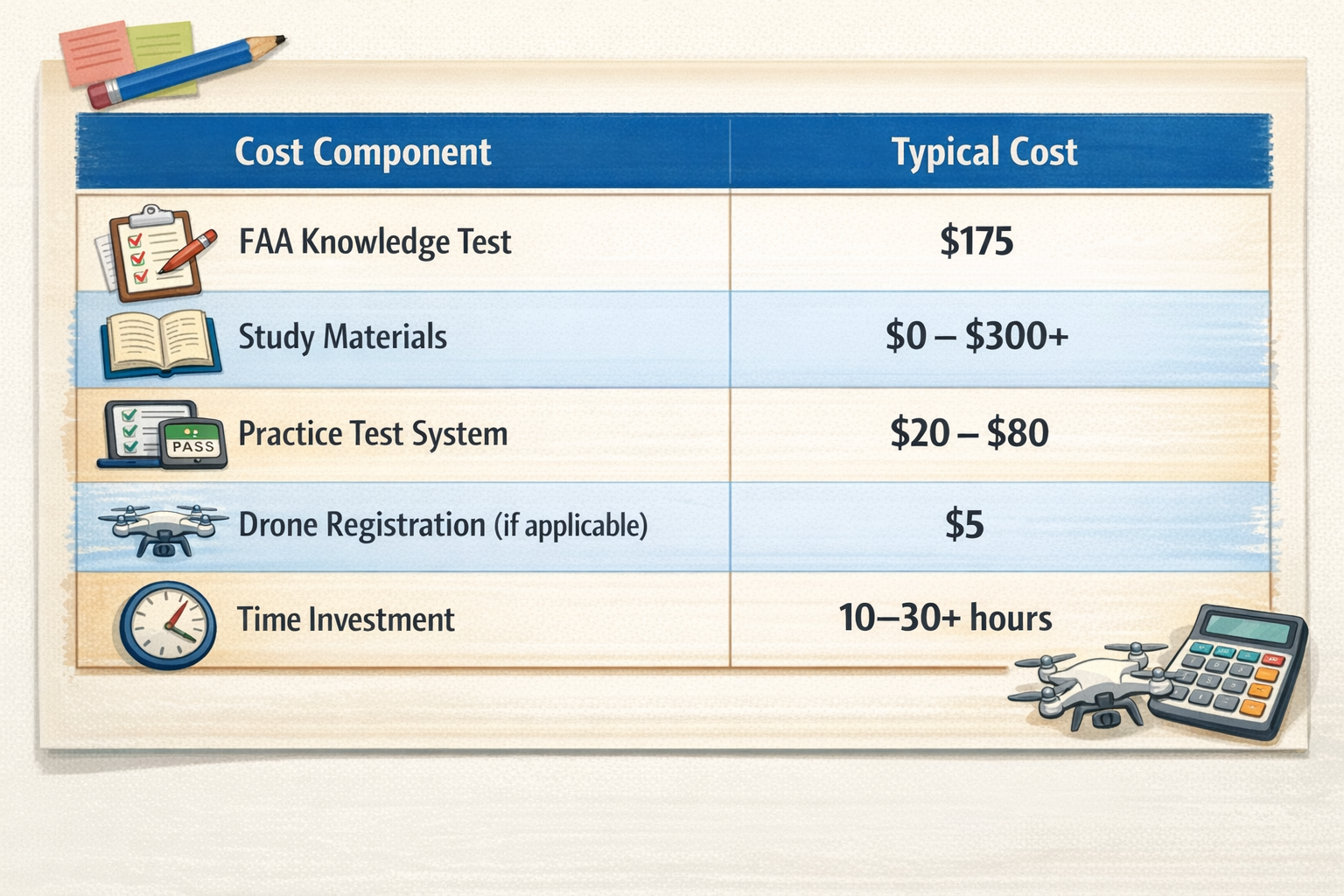
Cost Breakdown of Part 107 Test Prep
A realistic total falls between $175 and $400 or more, plus your time.
Reduce Your Part 107 Prep Cost
The FAA exam fee is only one part of the cost. The bigger risk is spending too much time studying inefficiently — or paying to retake the test if you are not ready.
Our Part 107 Practice Test & Study System helps you prepare more efficiently with realistic timed exams, 300+ FAA-style questions, weak-area tracking, study guides, and an Exam Readiness Tracker that shows when you are consistently scoring at a safer test-ready level.
Use code SPRING26 coupon code to save $10 on full access.
Unlock Full Access & Save $10 Now
Required Cost: FAA Part 107 Knowledge Test
The only mandatory cost to obtain your Part 107 license is the FAA knowledge test.
Cost: $175
Location: PSI testing centers
Format: 65 multiple-choice questions
Passing score: 70 percent
This test must be taken in person, and there is no way to bypass this requirement.
👉 If you are just getting started and want a step-by-step overview of the process, refer to our full licensing guide below
How to Get Your FAA Part 107 License (Complete 2026 Guide)
Where Costs Actually Vary: How You Prepare
The biggest differences in both cost and time come down to how you choose to study.
Free Self-Study (No Cost, Highest Time Investment)
It is entirely possible to prepare for the exam using free resources such as:
FAA Remote Pilot Study Guide
FAA Test Supplement (charts and figures)
YouTube videos
Free quizzes and flashcards
This approach works for some people, but it comes with tradeoffs. There is no structured learning path, no feedback on weak areas, and no clear way to know when you are ready to take the test. As a result, it often becomes the most time-intensive option.
Many candidates underestimate how much they need to understand topics like weather, airspace, and sectional charts until they begin practicing.
Online Part 107 Courses (Higher Cost, Moderate to High Time Commitment)
Online courses are one of the most common paid preparation options.
They typically provide structured video lessons and a guided curriculum, which can be helpful for those who prefer a step-by-step approach. However, they also come with some limitations.
The cost is usually between $150 and $300 or more. The learning is largely passive, and completing the course requires consistent time investment over days or weeks. Many students start but struggle to maintain the pace needed to finish efficiently.
While these courses can provide a solid foundation, they do not always translate directly into test readiness.
👉 If you’re comparing formats, this breakdown is helpful:
FAA Part 107 Online Course vs In-Person: Which Actually Gets You Licensed?
In-Person Part 107 Training (Higher Cost, Faster Timeline)
In-person training offers a different approach, especially for those who want to move quickly and learn in a more interactive setting.
This format is often preferred by beginners, hands-on learners, and organizations training multiple team members. It allows for direct instruction, real-time questions, and a more focused learning environment.
It is particularly effective for professionals such as first responders, construction teams, inspectors, and others who need to become certified on a defined timeline.
The tradeoff is a higher upfront cost and the need to attend scheduled sessions, but it often reduces total study time significantly.
👉 Explore available options:
Drone Training Programs
Public Safety Drone Training
Practice-Based Test Preparation (Lower Cost, Most Efficient Use of Time)
An alternative approach focuses on active learning through practice.
Instead of primarily consuming content, this method emphasizes taking realistic practice exams, reviewing detailed explanations, identifying weak areas, and tracking performance over time.
This type of preparation is typically more efficient because it concentrates effort on the areas that need improvement, rather than re-covering material that is already understood.
For many aspiring drone pilots, this becomes the fastest path to building confidence and reaching test readiness.
If you want to keep prep costs low while still getting structured feedback, use code SPRING26 for $10 off full access to our Part 107 Practice Test & Study System.
You can start with the free practice test first, then upgrade when you are ready for full timed simulations, weak-area practice, score tracking, and study guides.
👉 Try a realistic practice test and see how you score:
Part 107 Practice Test & Study System
A More Efficient Study Approach
A practical strategy for many students combines free learning with targeted practice.
Start by using free FAA materials and free videos (YouTube) to understand the core concepts. Then transition to practice-based preparation to test knowledge, identify gaps, and simulate the actual exam.
This approach keeps costs low while significantly improving efficiency and reducing overall study time.
Cost and Time Comparison
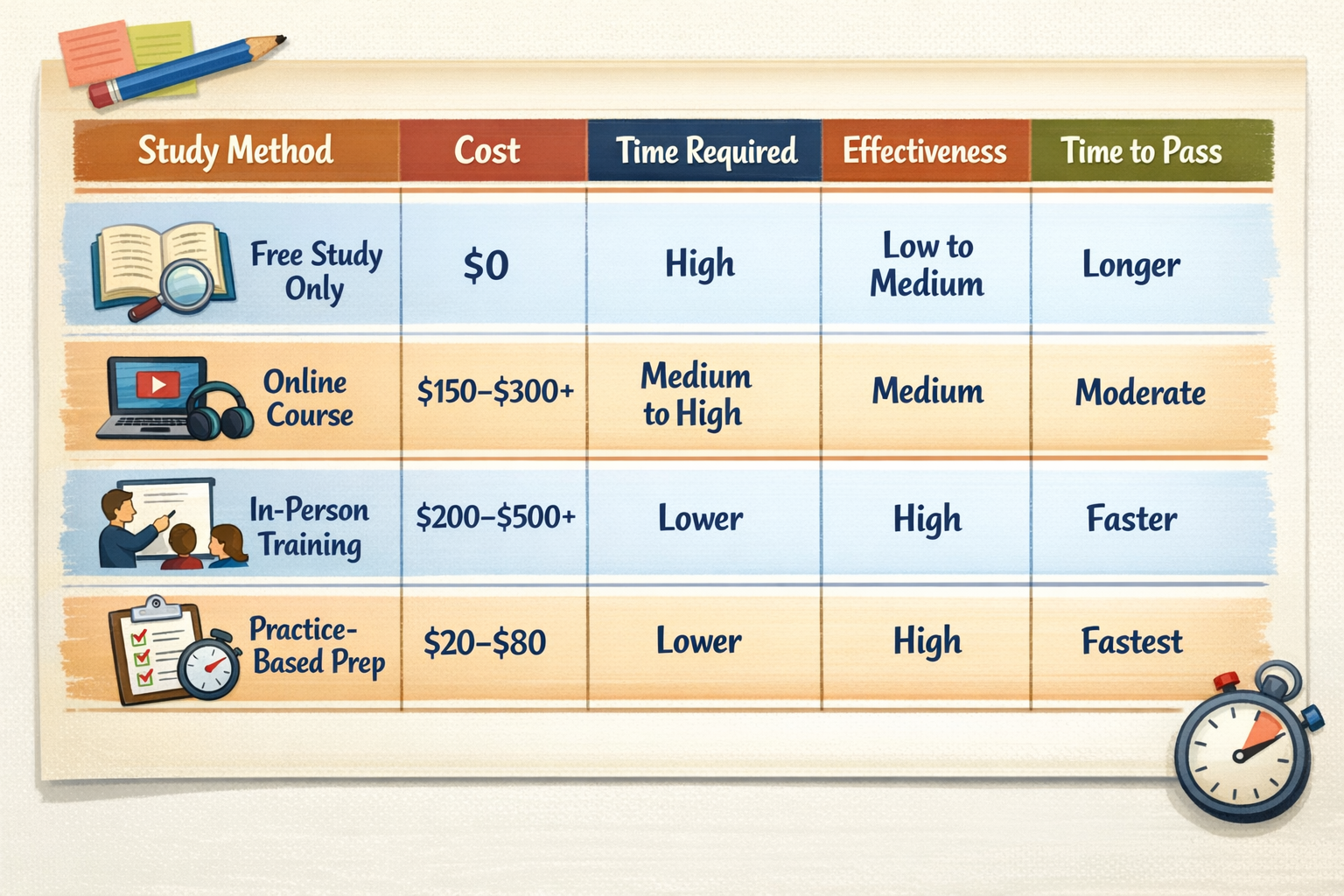
Part 107 Study Method Cost Comparison
For most people, time becomes the deciding factor. A lower-cost option that takes significantly longer may not actually be the most efficient path.
The Lowest-Cost Path Is Usually the One That Gets You Ready Faster
The FAA knowledge test costs real money, but your time matters too. Studying randomly for weeks, guessing when you are ready, or failing and having to retest can make the process more expensive than it needs to be.
Start with the free Part 107 practice test and see where you stand.
If you decide to continue, use code SPRING26 to save $10 on the full Part 107 Practice Test & Study System.
Who This Matters Most For
The importance of time and efficiency increases for those pursuing certification for professional use.
This includes:
media and content creators
construction and project management teams
surveyors and inspectors
agriculture and mapping professionals
marketing and production teams
public safety and first responders
In these cases, delaying certification can mean delayed revenue, missed opportunities, or slower project timelines.
How to Know You’re Ready
The FAA requires a score of 70 percent to pass. In practice, most instructors (us included) recommend consistently scoring in the 80 to 85 percent range on practice exams before scheduling the real test.
This provides a buffer for variations in question wording and difficulty, and it increases confidence on test day.
👉 You can test your readiness here - Free Demo Available:
Part 107 Practice Test & Study System
Additional Costs to Consider
There are a few smaller costs that may apply depending on your situation.
Drone registration is required for commercial use and costs $5. If you do not pass the test on your first attempt, retesting requires paying the $175 exam fee again.
These factors reinforce the importance of preparing efficiently and avoiding unnecessary delays.
How Long Is the License Valid?
The Part 107 certificate itself does not expire. However, pilots must complete recurrent training every 24 months to remain current.
This recurrent training is completed online and does not require paying for another in-person test.
What Should You Expect to Spend on Part 107 Test Prep and Exam?
At a minimum, you will spend $175 for the FAA test.
From there, the total depends on how you choose to prepare and how quickly you want to become certified.
A cost-conscious and efficient path often combines self-guided free materials with targeted practice, resulting in a total cost of roughly $200 to $250.
A more structured path, such as an online or in-person course, may bring the total closer to $300 to $500 or more.
Final Takeaway
The cost of getting a Part 107 license is not just about dollars. It is also about time.
The longer it takes to prepare and pass the test, the longer it takes to begin using your certification for work or business.
An efficient approach focuses on understanding key concepts, identifying weak areas, and confirming readiness before scheduling the exam.
Next Step
If you want to understand where you stand before booking your test, the most useful step is to take a realistic practice exam, review your performance, and identify the areas that need improvement.
👉 Start here:
Part 107 Practice Test & Study System
Best Way to Pass the FAA Part 107 Test (2026)
Self-Study vs Online vs In-Person Training
Getting your FAA Part 107 Remote Pilot Certificate is one of the fastest ways to unlock commercial drone work — from media and marketing to construction, inspections, and public safety.
But once you decide to get licensed, the next question is where most people get stuck:
How should you actually prepare for the test?
In reality, there are three distinct paths to getting certified — each with different tradeoffs in cost, time, and effectiveness.
This guide breaks them down so you can choose the most efficient path based on your goals.
Your 3 Real Options for Passing the Part 107 Exam
1. Self-Study (Free Resources)
This is where many candidates begin.
The FAA provides all of the core material you need to pass the test, including:
The Pilot’s Handbook of Aeronautical Knowledge
The Airman Certification Standards (ACS)
Sectional charts and chart supplements
There is also no shortage of free content online — YouTube videos, blog posts, and study guides that break down key topics.
For highly disciplined learners, this path can work. But it comes with a few important challenges.
First, there is no structure. You are responsible for figuring out what to study, in what order, and how deeply to go into each topic.
Second, there is no feedback loop. It is difficult to know what you actually understand versus what feels familiar.
And third, this approach often takes the most time. Without a clear framework, many candidates spend weeks or months studying without feeling confident enough to schedule the test.
This matters more than it may seem. If you are pursuing your Part 107 certificate for professional use — whether in media, construction, inspections, agriculture, or public safety — the longer it takes to get licensed, the longer it takes to start using that credential.
Self-study can be effective, but it requires consistency, discipline, and a way to validate your readiness before test day.
2. Online Courses
Online courses are the most common structured option.
They typically include:
Pre-recorded video lessons
Organized modules by topic
Quizzes and occasional practice tests
This format provides a clear learning path, which is especially helpful if you are new to aviation concepts. Many students prefer the flexibility of being able to learn on their own schedule and revisit content as needed.
However, online learning has its own tradeoffs.
It requires consistent time investment. Without a set schedule, it is easy to fall behind or passively watch content without fully retaining it. In many cases, students complete the course but still don’t feel confident walking into the test. That’s because watching material is not the same as applying it under test conditions.
Online courses are a strong foundation — but they are often most effective when paired with deliberate practice.
3. In-Person Training
In-person training offers a different type of learning experience.
Instead of working through material on your own, you are guided by an instructor who can explain concepts in real time, answer questions, and adjust based on how students are progressing.
This tends to accelerate understanding — especially for more complex topics like airspace and sectional charts.
Students often leave with a much clearer grasp of how the material fits together, rather than just memorizing isolated concepts.
In-person training is particularly valuable for:
First responders and public safety teams
Construction, inspection, and engineering professionals
Media and content teams adopting drones into their workflow
Organizations training multiple operators at once
The main tradeoff is cost and scheduling. These programs require a larger upfront investment and are offered on specific dates.
But for many professionals, the efficiency gained — both in time and confidence — outweighs those constraints.
Learning to Think Like a Pilot
What does in-person training look like beyond test prep? Watch Jason, our Chief Drone Pilot and instructor, explain how we help students connect what they’re learning to the decisions they’ll make on real drone flights.
Passing Part 107 Test Doesn’t Equal Understanding
Breaking Down the Part 107 Test: What You're Up Against
Taking the FAA Part 107 test without preparation is like playing chess when you only know checkers. Test-takers score 79.95% on average with an 84.2% overall pass rate. A good grasp of what you're up against will help you prepare better.
Test format and passing requirements
The "Unmanned Aircraft General - Small (UAG)", or Part 107 knowledge test, has 60 multiple-choice questions. You get 120 minutes to complete it, and you need 70% to pass, which means you need 42 correct answers. Each test pulls questions randomly from a bigger question bank, so everyone gets a different version.
A successful test-taker warns, "Cramming two hours before the test is really not enough to pass". Based on what you already know and how you study, you should spend at least a weekend to learn the material well.
The FAA states, "Unless you have been flying drones for some time or have previously taken the knowledge test, you will need to spend time studying for the exam”. Aviation knowledge isn't something most people use daily, so you face a steep learning curve.
You have a choice: study these complex topics by yourself through a part 107 online course, or learn from an instructor who can explain things clearly and answer your questions? But this choice is really personal for each and every learner. Your learning style and career goals can make the most important difference in getting licensed and starting to earn money quickly or use your certificate as a way to advance an existing career in an industry that is adopting drone use.
The financial upside of getting licensed quickly
A certified Part 107 drone pilot certification opens many profitable opportunities. Full-time salaried positions range from $35,000 to $200,000 annually in this growing industry, while starting your own drone services business or using your skills as a side gig can also be very lucrative. So, if you are interested in getting licensed quickly to get into this growing industry and start getting real experience to increase your pay rate over time, then getting licensed quickly is in your best interest.
The path you choose— self-study, online course or classroom instruction—should match your timeline to start earning and your best learning environment. Getting your certification keeps you legally compliant and ready to take advantage of the expanding commercial drone market’s services sector, which is predicted to grow to $57.8B by 2030 with the largest share of the being drone services at 78% of that (or $45B).
If you're exploring long-term earning potential, you can read our full breakdown in this Drone Pilot Career & Industry Guide.
The Self-Study Experience
Self-study is often the starting point for many Part 107 candidates — and in some cases, it can be enough.
The FAA provides all of the foundational material required to pass the exam, including the Pilot’s Handbook of Aeronautical Knowledge, sectional charts, and the Airman Certification Standards. In addition, there is a wide range of free content available online, from YouTube videos to independent study guides.
On the surface, this makes self-study the most accessible and cost-effective option.
But the experience itself is very different from structured learning.
There is no defined path. You are responsible for deciding what to study, how deeply to study it, and when you are ready to move on. Some topics — like regulations — may feel straightforward, while others, such as airspace or weather reports (METARs and TAFs), can take significantly more time to understand without guidance.
Another challenge is retention. It is easy to consume content and feel like you understand it, but much harder to apply that knowledge in a test format where questions are designed to assess interpretation, not just recall.
Perhaps the biggest limitation is the lack of feedback. Without a structured way to measure your progress, it can be difficult to identify weak areas or know when you are truly ready to schedule the exam.
For disciplined learners who are comfortable navigating technical material independently, self-study can be effective. But for many, it becomes a longer and less predictable path to getting licensed.
Remember this: getting licensed faster means earning money sooner. Even if you pay $300-500 more for an in-person course, a couple of drone jobs will cover that cost. Plus, your classmates might become your support group or partners—something you won't get studying alone online.
The part 107 test isn't impossible, but you need solid preparation. Your learning style and career plans should guide you to pick the training method that works best for you.
Should You Use a Part 107 Practice Test to Prepare?
Reading about regulations and watching training videos is only part of the preparation process. The FAA Part 107 exam is not just about recognizing information — it’s about applying aviation concepts under time pressure. Many students underestimate this.
The Part 107 test gives you 120 minutes to answer 60 questions, and while 70% is the passing score, most experienced instructors recommend consistently scoring 85% or higher on realistic practice exams before scheduling your test. That margin provides confidence and reduces the risk of paying another $175 retake fee.
A high-quality FAA Part 107 practice test system should include:
Timed exam simulations that mirror the real 60-question testing experience
Weighted category distribution (just like the actual exam)
Built-in FAA figures and sectional charts
Detailed answer explanations with regulation references
Progress tracking to identify weak areas
Practice testing bridges the gap between learning and passing. Whether you choose self-study, an online course or in-person training, structured exam simulation is what tells you when you’re truly ready.
👉 If you want to see how a realistic exam simulator works, you can explore our FAA Part 107 Practice Test & Exam Readiness System here.
Online Part 107 Courses: The Self-Paced Option
Looking for an FAA part 107 online course feels like stepping into a buffet with countless choices. The digital world has options that fit any budget, from basic subscriptions to deluxe packages. Your choice buys more than just knowledge - it's about finding a learning style that clicks with you.
Top online courses and their price points
Online Part 107 course prices range widely. Most respected providers charge $125-$250 for unlimited access (Drone Launch Academy, Drone Pilot Ground School, Pilot Institute, etc.). Many online courses tend to be more budget-friendly than in-person courses, which run usually $500+.
These online courses come with money-back guarantees - evidence of their quality and recognition that self-study isn't right for everyone. The fine print matters though. Most refunds require you to finish the course and fail your exam.
What you actually get for your money
Each price point offers different value. Most online courses include:
· Video lessons (typically 80+ videos across all knowledge areas)
· Practice exams with 300-400 questions from real FAA tests
· Study guides or "cram sheets" for last-minute review
· Unlimited access to materials for future reference
Premium packages stand out with weekly live Q&A webinars, mobile apps, and direct instructor help. Some courses add flight skills training for extra payment - valuable if you are looking for hands-on training, since the Part 107 exam doesn't test your flying abilities.
These courses now feature custom study plans to guide your learning. Whatever provider you pick, self-paced learning lets you study when time allows. This works great with family duties or odd work hours.
The real completion timeline (not what they advertise)
Marketing claims often stretch the truth. Many online drone training courses promise quick licensing "in just a few weeks", but success depends on your dedication and background knowledge.
Drone courses need 15-20 hours to complete. Some providers claim 10 hours is enough. Most students work full-time, so finishing usually takes 2-3 weeks of steady study.
Self-paced learning brings freedom but also challenges. Students often rush their studies right before test day without classroom deadlines pushing them forward.
This raises a key question: Do you finish online courses once started? A classroom setting might work better if you have unused exercise equipment at home. While online courses cost less upfront, landing one or two paid drone jobs could cover in-person training costs. Getting market-ready faster might save money and study scheduling conflicts long-term.
In-Person Part 107 Training: The Guided Experience
A classroom environment for Part 107 training creates a unique experience compared to late-night laptop studying. Students find themselves surrounded by fellow future drone pilots who could become their partners or collaborators.
Available classroom options across the country
Drone enthusiasts can choose from several in-person training providers. Companies like DARTdrones and Dronegenuity run classroom-based Part 107 study courses in major U.S. cities, while V1DroneMedia services the Midwest and Northeastern states in Cleveland, Ohio, and offers group courses for organizations and first responder agencies nationwide. All of these providers keep class sizes small (10-15 students) to maximize individual attention.
Most training providers release their schedules about 3 months ahead, and popular spots disappear quickly due to limited in-person class availability. Some companies even blend online pre-work with in-person teaching to create hybrid solutions that give students dual benefits.
Typical course structure and duration
Most classes complete Part 107 test prep in a single or couple of full 8-hour days, from 8:30 a.m. to 5:00 p.m. with breaks for lunch. This focused approach helps students finish their classroom training much faster than online learners who often take weeks. However there is a lot of information covered in that 1 or 2 days courses, so you have to choose the best structure for you.
The curriculum covers essential topics:
· Drone regulations and FAA rules
· Airspace classifications and sectional charts
· Weather and micrometeorology
· Flight operations and emergency procedures
· Loading and performance calculations
Students get detailed guided breakdown of complex topics like sectional charts or airspace restrictions. Many courses also include practical drone operations instruction - something online videos can't match.
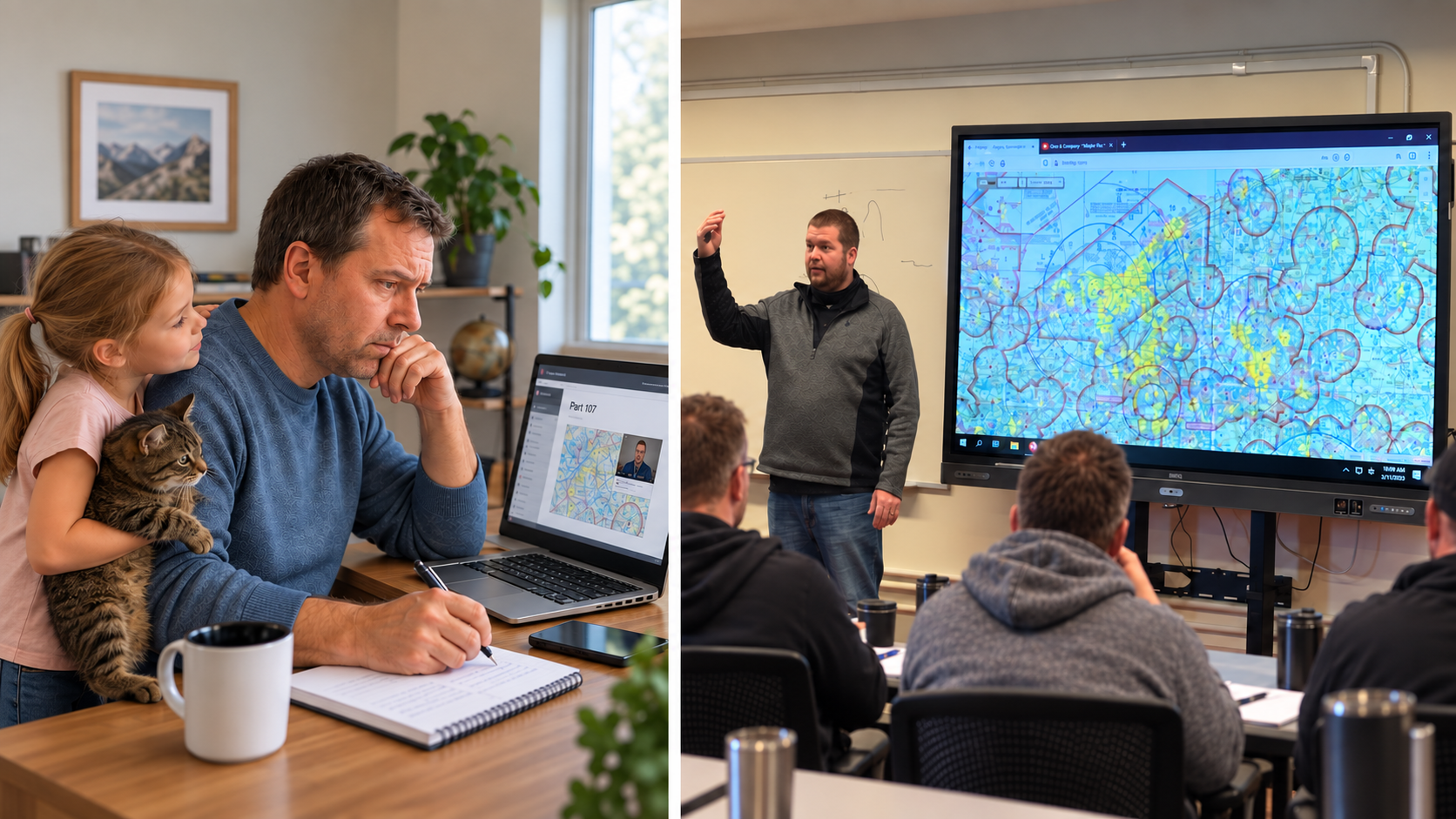
Most first-timers find sectional charts and airspace classifications the toughest parts: “I tried an online course and got lost at the aviation chart section. After researching “in person” classes I decided to go with V1DroneMedia’s course. The instructor was extremely knowledgeable and his teaching method stuck. I am happy to announce I passed my Part 107 exam just this afternoon with an 85%. Something that seemed so difficult to achieve yet actually happened.” Understanding such challenging topics works better with in-person teaching where you can ask questions and get help—something you can't do with online videos. See an example of an aviation sectional chart below and try to make sense of it without someone walking you through it!

V1DroneMedia’s instructor explains an aviation sectional chart during FAA Part 107 Exam Prep Course
The true course cost breakdown
The numbers tell an interesting story. Self-Study is free. In-person courses range from $595 (V1DroneMedia) - $1500 (DARTdrones), while online options average $200-$300. This price difference often pushes pilots toward self-study or online training initially.
The extra investment brings valuable returns. Quick material comprehension and networking with future commercial pilots make the cost worthwhile. A couple of paid drone jobs can offset the additional expense - jobs that could even come from classroom connections.
There are other factors to consider. For example, Dronegenuity's package combines online prep materials with in-person training. Students can also benefit from group rates, military/first responder discounts, and packages that include test fees. Whereas V1DroneMedia’s course is taught by a commercial airline pilot with decades of professional aviation experience in US national airspace, who also runs his own drone services business, thus offering real world drone operations expertise to their students.
Classroom training motivates students to schedule their FAA Part 107 exam within days of completion, unlike online courses where procrastination can delay licensing. The structured setting helps students overcome common self-paced learning challenges.
Hands-on learners and those who struggled with online courses benefit from classroom accountability and structure. Success rates increase when students match their learning style to the training format.
The classroom environment proves invaluable for students who learn through discussion and demonstration. Direct access to expert instructors and the fastest way to pass Part 107 creates benefits beyond test day.
The Learning Experience: How Your Brain Actually Processes This Stuff
Your brain works differently than a computer storing drone information—it processes knowledge based on your personal learning style. Studies show that your choice of Part 107 study method affects not just passing the test, but how soon you can start making money from your certification.
Visual learners vs. hands-on learners
People learn differently. Video demonstrations and online tutorials work great for visual learners, who find charts and diagrams help them grasp complex ideas. However, students who prefer hands-on learning often find digital-only instruction challenging and need physical practice with direct guidance to understand concepts.
"The supervision of an expert instructor ensures that students get their questions answered immediately, and don't end up developing bad habits that they will need to unlearn later on," notes Jason Damman, V1DroneMedia’s Part 107 instructor. This becomes vital when learning essential skills like reading sectional charts or interpreting weather data—areas where many test-takers struggle.
Here's something to think about: hands-on drone training lets you practice proper responses with expert guidance—something you can't get through a screen. Online courses give busy professionals the flexibility they need, with round-the-clock access to materials and online communities.
The accountability factor: finishing what you start
Let's face it: online courses have terrible completion rates. Procrastination becomes your worst enemy without scheduled sessions and face-to-face accountability.
Students taking faa part 107 online courses need at least 15-20 hours of studying for the test. This might seem manageable until you try carving out time between work, family, and daily life. Classroom settings create built-in accountability—you've invested more money and committed to specific dates.

Online Part 107 Prep Students can face many distractions throughout learning process
The structure of in-person training mirrors real-life drone operation, where planning and preparation are essential. This well-laid-out approach helps students get licensed and start billing clients faster.
Retention rates: what you'll remember on test day
Studying means little if you can't remember the information when it counts. Different learning methods produce vastly different retention rates. This isn't just about memorizing facts—you need to understand aviation concepts well enough to use them.
Flashcards and simple knowledge questions might work for basic concepts. But the challenging sections—making up over 50% of the test—need an instructor who can explain ideas different ways until you understand them completely.
The fastest way to pass Part 107 matches your learning style perfectly. Self-disciplined visual learners might do well with self-study or online courses. Hands-on learners who need structure find classroom training more effective and economical—because getting licensed faster means earning money sooner. Those first couple of drone jobs don't just cover extra training costs; they launch your business or career while online learners might still puzzle over sectional charts.
Time-to-License Comparison: Which Gets You Flying Faster?
Your drone income clock starts ticking as soon as you decide to get licensed. The difference between successful commercial pilots and hobbyists often boils down to how fast they turn their knowledge into cash flow. Your choice between self-paced online study or classroom training will shape how quickly you become a legal commercial drone operator.
Average study hours required for each method
The numbers show that proper Part 107 test prep needs serious dedication. The FAA suggests 20 hours of study time to pass the Part 107 exam.
Many self-study students stretch this time to months and struggle to understand concepts, or finding the right material that helps them understand what they are learning.
Online courses pack about 15 hours of lessons spread across 80+ videos that can take them weeks and months to get through depending on their studying consistency. These courses also include more than 300 practice questions to get you ready for test day.
Some online courses promote their "14-day challenge" - claiming you can become a commercial drone pilot by studying just 1 hour daily for two weeks. The truth is, these quick schedules work for very few people. Most students who learn online spend 15-20 hours total preparing for the test.
Classroom training condenses everything. These courses pack the same material into full 8-hour days with practice tests in between, and wrap up the whole curriculum in just 1-2 days. Students usually take their tests right after finishing the course, and usually have access to study materials and extra practice tests to gain more confidence if they feel they need it.
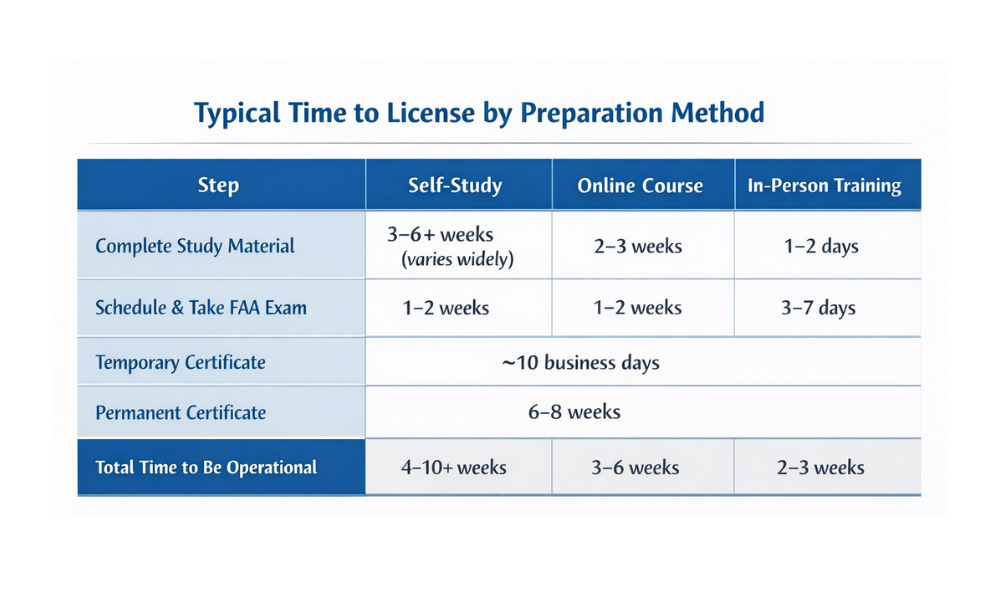
Time to Part 107 License By Study Method Comparison
From first lesson to passing the test: realistic timelines
Here's how long it takes to go from deciding to get licensed to flying commercially:
Self-Study learners typically need:
· 3-6+ weeks to get through course materials
· 1-2 weeks to schedule and take the FAA exam
· 10 business days to get their temporary certificate
· 6-8 weeks to receive their permanent certificate
Online learners typically need:
· 2-3 weeks (or more) to finish course materials if being consistent
· 1-2 weeks to schedule and take the FAA exam
· 10 business days to get their temporary certificate
· 6-8 weeks to receive their permanent certificate
Classroom learners need:
· 1-2 days to complete intensive training
· 3-7 days to schedule and take the FAA exam
· 10 business days to get their temporary certificate
· 6-8 weeks to receive their permanent certificate
The big difference? Self-Study students can take months to learn the material. Online students stretch their 15-20 study hours over weeks or months. Classroom students finish in days. Those extra weeks mean lost income or a career potential.
Here's a practical way to look at it: classroom training might cost $300-500 more than online options, but one or two paid drone jobs could make up that difference. Getting your license three weeks earlier could mean booking your first commercial flight while online students still work through practice questions.
Scheduling realities and procrastination factors
Here's what online course ads don't tell you: procrastination kills drone careers quietly. Research shows that over 50% of students regularly put off their academic work.
Students taking an FAA part 107 online course battle their own habits. Without a fixed schedule, many future pilots keep pushing their lessons to "tomorrow." Classroom settings create built-in accountability - you've paid more money upfront and committed to specific dates.
One expert in the field says, "With an in-person class, all the information hits you at once and you can't set your own pace". This limitation actually helps because it makes you focus and learn the material quickly instead of putting off your studies.
The Hidden Benefits of Classroom Training
Classroom training delivers major benefits beyond learning the basics. These hidden advantages make the real difference between passing a test and starting a thriving drone business.
Networking with future clients and collaborators
A classroom filled with aspiring drone pilots becomes your first professional network. Many training providers help students land their first paying jobs. Your classmates could become business partners, referral sources, and even clients. This personal connection doesn't happen through a computer screen.
Direct access to expert knowledge
A classroom setting lets you ask questions right away when complex topics like airspace restrictions confuse you. Online videos can't give you tailored explanations.
The instructors aren't just teachers - they run their own drone businesses and have backgrounds as aircraft pilots. Their knowledge helps students succeed.
Here is another student’s experience described in a Google Review: “I needed to get my Part 107 Certification for work and scheduled my exam in advance of studying to motivate me. I wasn’t having as much luck self-studying online this completely new material and decided an in-person class would suit me better. Long story short, I flew from Texas to Ohio, on a whim, to take this [Part 107 Prep] class over the weekend. It was an amazing class and quelled so much of my anxiety around taking this test. And I passed! In 3 days, I became certified from his teachings.”
The motivation of learning among others
People often quit online courses halfway through. Learning face-to-face creates natural accountability. The classroom environment creates healthy competition and support. Seeing others master difficult concepts pushes everyone to improve. The cost difference between online and in-person training pays off quickly - just one or two paid drone jobs cover the extra investment within weeks of certification.
Making the Financial Case: Is the Extra Cost Worth It for In-Person and Online training?
The math tells the story. Your investment versus returns needs more than just price comparison.
How drone jobs quickly cover your training investment
The real numbers paint a clear picture. Freelance drone pilots earn between $25-$200 per hour. One or two gigs can easily make up the cost difference between self study, online or classroom training. Most drone pilots see returns on their drone investment within 1-3 projects. This makes the original price gap seem much smaller afterward.
Drone pilots who apply their skills within an industry they’re already trained in often gain more than just a salary increase—they open the door to promotions and new career opportunities.
Time it takes to get certified should also be considered when you are choosing your training path. Time, as we all know, is the most scarce modern resource.

Drone Pilot Salary Ranges by Specialty
The cost of failing and retaking the test
The numbers get interesting here. A failed Part 107 test means paying another $175 to try again. You'll need to wait 14 days before the next attempt. Those two weeks could have been spent earning money instead of studying more.
Some online courses will pay back your test fee if you fail after scoring 85% on their practice exams. Classroom training students tend to pass on their first try, which makes retake fees less common.
Hands-on learners find classroom training a smart investment. The benefits show through faster licensing, better knowledge retention, and valuable industry connections.
Conclusion
The choice between self-study, online and classroom Part 107 training depends on your learning style. Students who are self-disciplined and excel with digital content might find self-study or online courses worth $0-299. But classroom training's $500+ price tag proves to be a smart investment for most aspiring pilots who want to get licensed quickly.
Classroom students usually finish their training and take the test within 1-2 weeks. Online learners tend to spread their studies over 2-3 months. This faster timeline means you'll start earning sooner, which makes the extra cost minimal. A couple of drone service jobs will easily cover the difference in training costs.
Your learning style should guide your decision more than your budget. Students who learn by doing pick up complex topics like sectional charts and airspace rules much faster with an instructor's guidance. The classroom environment creates accountability that keeps you on track. The in-person Part 107 Prep Course gives you expert instruction, networking opportunities and the quickest path to your commercial drone license.
However, learning the material is step one, but practicing taking the test to get to 85%+ score consistency is key to passing the test. Try out a free demo of our Part 107 Practice Test & Exam Readiness System to get a feel for the questions and the focused study our system offers.
Each week spent studying alone means lost potential income. Classroom training costs more upfront, but getting licensed faster and connecting with future collaborators makes it worthwhile for most pilots. Cementing those learning by practicing taking the test will ensure you will pass it on the first try. But success in the drone industry goes beyond passing a test - it's about practicing your drone flight skills, getting specialized skills if you are trying to get into a certain industry, building relationships, getting a foot in the door with an employer, or launching your business quickly if you are an entrepreneur.
FAQs
Q1. How long does it typically take to prepare for the FAA Part 107 exam?
Most people spend 15-20 hours studying for the Part 107 test. Online courses usually take 2-3 weeks to complete if you consistently dedicate a few hours a day to studying, while in-person training can be finished in 1-2 intensive days, such as V1DroneMedia’s FAA Part 107 2-day in-person course.
Q2. What are the main differences between online and in-person Part 107 training?
Online courses offer flexibility and lower costs, typically around $200-$300. In-person training costs $595-1500 but provides hands-on instruction, networking opportunities, and often results in faster completion and higher pass rates.
Q3. How hard is the Part 107 test?
The Part 107 exam is challenging for people without aviation experience, particularly in areas like sectional charts, airspace classification, and weather interpretation. While the national pass rate averages around 80%, most students benefit from structured study and realistic practice testing before attempting the exam.
Q4. How much can I expect to earn as a licensed drone pilot?
Entry-level drone pilots can earn around $35,000-42,00 annually, while experienced pilots (5+ years) can command $88,000 or more. Freelance rates range from $25 to $200 per hour depending on the job and experience level. Professionals in a variety of industries (media, construction, agriculture, etc.) that are also drone pilots could earn significantly more.
Q5. What happens if I fail the Part 107 exam?
If you fail the exam, you'll need to wait 14 days before retaking it and pay another $175 fee. Some online courses offer to reimburse your test fee if you fail after scoring well on their practice exams, while in-person training often results in higher first-time pass rates.
Q6. What is the best Part 107 practice test?
The best practice tests simulate the real FAA experience — including timed sessions, weighted question distribution, and built-in sectional charts. Look for systems that include detailed explanations and progress tracking rather than simple flashcard-style quizzes. You can try out 15 free questions in our Part 107 Practice Test and Exam Readiness System that does exactly that.
Q7. What score should I get on practice tests before taking the real exam?
Although 70% is the passing threshold, many instructors recommend scoring 85% or higher on realistic practice exams before scheduling your test. This reduces anxiety and increases first-time pass probability.