
How Much Does a Part 107 Drone License Cost? (Full 2026 Breakdown)
If you're thinking about getting your FAA Part 107 drone license, one of the first questions is straightforward:
How much does it actually cost?
The short answer is that most people spend between $175 and $400 or more, depending on how they choose to prepare.
That range, however, doesn’t tell the full story.
Some people spend more than they need to on expensive courses. Others try to study entirely for free and end up failing the test, which costs more in the long run. And there’s another factor that rarely gets discussed but often matters just as much as money:
Time.
In many cases, especially for professionals, time is money. If you need your license for a new role, a promotion, a contract requirement, or to expand your services, the speed at which you can get certified becomes just as important as the cost itself.
This guide breaks down the real costs involved, what is required, what is optional, and how to choose the most efficient path to getting licensed.
Total Cost Breakdown (Quick Answer)
Here’s what most people can expect:
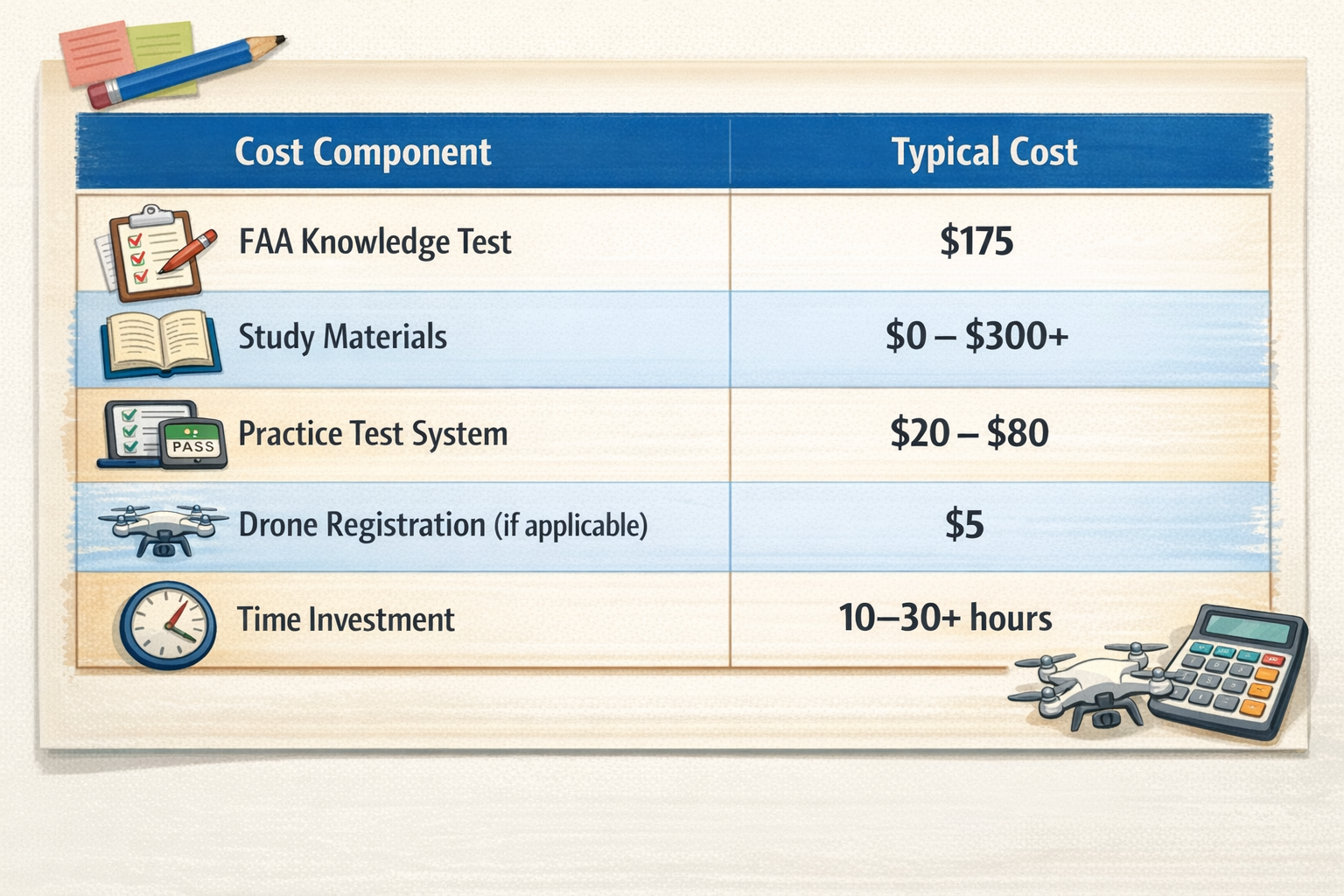
Cost Breakdown of Part 107 Test Prep
A realistic total falls between $175 and $400 or more, plus your time.
Reduce Your Part 107 Prep Cost
The FAA exam fee is only one part of the cost. The bigger risk is spending too much time studying inefficiently — or paying to retake the test if you are not ready.
Our Part 107 Practice Test & Study System helps you prepare more efficiently with realistic timed exams, 300+ FAA-style questions, weak-area tracking, study guides, and an Exam Readiness Tracker that shows when you are consistently scoring at a safer test-ready level.
Use code SPRING26 coupon code to save $10 on full access.
Unlock Full Access & Save $10 Now
Required Cost: FAA Part 107 Knowledge Test
The only mandatory cost to obtain your Part 107 license is the FAA knowledge test.
Cost: $175
Location: PSI testing centers
Format: 65 multiple-choice questions
Passing score: 70 percent
This test must be taken in person, and there is no way to bypass this requirement.
👉 If you are just getting started and want a step-by-step overview of the process, refer to our full licensing guide below
How to Get Your FAA Part 107 License (Complete 2026 Guide)
Where Costs Actually Vary: How You Prepare
The biggest differences in both cost and time come down to how you choose to study.
Free Self-Study (No Cost, Highest Time Investment)
It is entirely possible to prepare for the exam using free resources such as:
FAA Remote Pilot Study Guide
FAA Test Supplement (charts and figures)
YouTube videos
Free quizzes and flashcards
This approach works for some people, but it comes with tradeoffs. There is no structured learning path, no feedback on weak areas, and no clear way to know when you are ready to take the test. As a result, it often becomes the most time-intensive option.
Many candidates underestimate how much they need to understand topics like weather, airspace, and sectional charts until they begin practicing.
Online Part 107 Courses (Higher Cost, Moderate to High Time Commitment)
Online courses are one of the most common paid preparation options.
They typically provide structured video lessons and a guided curriculum, which can be helpful for those who prefer a step-by-step approach. However, they also come with some limitations.
The cost is usually between $150 and $300 or more. The learning is largely passive, and completing the course requires consistent time investment over days or weeks. Many students start but struggle to maintain the pace needed to finish efficiently.
While these courses can provide a solid foundation, they do not always translate directly into test readiness.
👉 If you’re comparing formats, this breakdown is helpful:
FAA Part 107 Online Course vs In-Person: Which Actually Gets You Licensed?
In-Person Part 107 Training (Higher Cost, Faster Timeline)
In-person training offers a different approach, especially for those who want to move quickly and learn in a more interactive setting.
This format is often preferred by beginners, hands-on learners, and organizations training multiple team members. It allows for direct instruction, real-time questions, and a more focused learning environment.
It is particularly effective for professionals such as first responders, construction teams, inspectors, and others who need to become certified on a defined timeline.
The tradeoff is a higher upfront cost and the need to attend scheduled sessions, but it often reduces total study time significantly.
👉 Explore available options:
Drone Training Programs
Public Safety Drone Training
Practice-Based Test Preparation (Lower Cost, Most Efficient Use of Time)
An alternative approach focuses on active learning through practice.
Instead of primarily consuming content, this method emphasizes taking realistic practice exams, reviewing detailed explanations, identifying weak areas, and tracking performance over time.
This type of preparation is typically more efficient because it concentrates effort on the areas that need improvement, rather than re-covering material that is already understood.
For many aspiring drone pilots, this becomes the fastest path to building confidence and reaching test readiness.
If you want to keep prep costs low while still getting structured feedback, use code SPRING26 for $10 off full access to our Part 107 Practice Test & Study System.
You can start with the free practice test first, then upgrade when you are ready for full timed simulations, weak-area practice, score tracking, and study guides.
👉 Try a realistic practice test and see how you score:
Part 107 Practice Test & Study System
A More Efficient Study Approach
A practical strategy for many students combines free learning with targeted practice.
Start by using free FAA materials and free videos (YouTube) to understand the core concepts. Then transition to practice-based preparation to test knowledge, identify gaps, and simulate the actual exam.
This approach keeps costs low while significantly improving efficiency and reducing overall study time.
Cost and Time Comparison
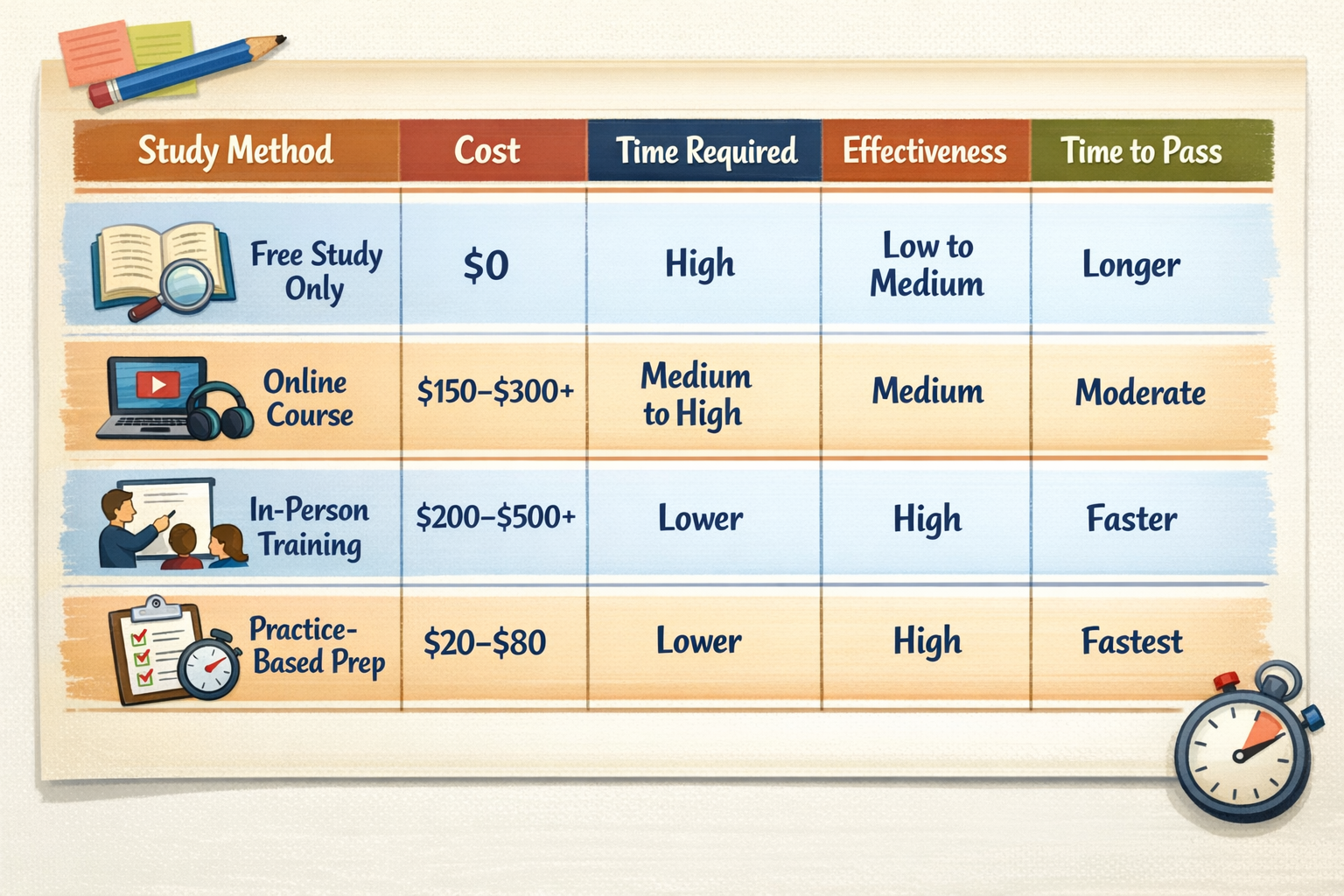
Part 107 Study Method Cost Comparison
For most people, time becomes the deciding factor. A lower-cost option that takes significantly longer may not actually be the most efficient path.
The Lowest-Cost Path Is Usually the One That Gets You Ready Faster
The FAA knowledge test costs real money, but your time matters too. Studying randomly for weeks, guessing when you are ready, or failing and having to retest can make the process more expensive than it needs to be.
Start with the free Part 107 practice test and see where you stand.
If you decide to continue, use code SPRING26 to save $10 on the full Part 107 Practice Test & Study System.
Who This Matters Most For
The importance of time and efficiency increases for those pursuing certification for professional use.
This includes:
media and content creators
construction and project management teams
surveyors and inspectors
agriculture and mapping professionals
marketing and production teams
public safety and first responders
In these cases, delaying certification can mean delayed revenue, missed opportunities, or slower project timelines.
How to Know You’re Ready
The FAA requires a score of 70 percent to pass. In practice, most instructors (us included) recommend consistently scoring in the 80 to 85 percent range on practice exams before scheduling the real test.
This provides a buffer for variations in question wording and difficulty, and it increases confidence on test day.
👉 You can test your readiness here - Free Demo Available:
Part 107 Practice Test & Study System
Additional Costs to Consider
There are a few smaller costs that may apply depending on your situation.
Drone registration is required for commercial use and costs $5. If you do not pass the test on your first attempt, retesting requires paying the $175 exam fee again.
These factors reinforce the importance of preparing efficiently and avoiding unnecessary delays.
How Long Is the License Valid?
The Part 107 certificate itself does not expire. However, pilots must complete recurrent training every 24 months to remain current.
This recurrent training is completed online and does not require paying for another in-person test.
What Should You Expect to Spend on Part 107 Test Prep and Exam?
At a minimum, you will spend $175 for the FAA test.
From there, the total depends on how you choose to prepare and how quickly you want to become certified.
A cost-conscious and efficient path often combines self-guided free materials with targeted practice, resulting in a total cost of roughly $200 to $250.
A more structured path, such as an online or in-person course, may bring the total closer to $300 to $500 or more.
Final Takeaway
The cost of getting a Part 107 license is not just about dollars. It is also about time.
The longer it takes to prepare and pass the test, the longer it takes to begin using your certification for work or business.
An efficient approach focuses on understanding key concepts, identifying weak areas, and confirming readiness before scheduling the exam.
Next Step
If you want to understand where you stand before booking your test, the most useful step is to take a realistic practice exam, review your performance, and identify the areas that need improvement.
👉 Start here:
Part 107 Practice Test & Study System