

Maximizing Drone Battery Life: Essential Care Tips for LiPo Batteries
In this comprehensive guide, we'll delve deep into the world of LiPo batteries, exploring essential care tips to maximize their lifespan and optimize your DJI drone's performance. We also have a YouTube Video on this topic for those who prefer visual learning.
Are you a passionate drone pilot like me who is a drone hobbyist or a drone professional who uses drones almost daily, and has spent a fair amount of money on drone equipment over the years, including batteries? I fly drones for a living now, and my biggest concern is to have equipment that I can rely on during a professional shoot, which I want to conduct in the most efficient and productive manner. So, if you're an owner of DJI drones like me (Inspire, Mavic Pro, Mini, Phantom series, etc.), you know that your drone's performance heavily relies on its LiPo (Lithium Polymer) batteries. These batteries power your drone flights, but they aren't immortal. As the battery's capacity decreases, the runtime of devices that use the battery will be reduced and the battery will eventually need to be replaced. Since my goal as a drone pilot and a business owner is to maximize my drone flight time per battery, and minimize my battery replacement cost, prolonging the life of the batteries is of utmost importance to me.
In this comprehensive guide, we'll delve deep into the world of LiPo batteries, exploring essential care tips to maximize their lifespan and optimize your drone's performance. We also have a YouTube Video on this topic for those who prefer visual learning.
Understanding LiPo Drone Batteries
LiPo batteries have transformed the drone industry, thanks to their outstanding energy density. These batteries excel at storing a significant amount of energy in a lightweight and compact package. This incredible power-to-weight ratio makes LiPo batteries the perfect choice for powering DJI drones. Whether it's capturing stunning aerial shots, performing rapid ascents, or compensating for challenging weather conditions during flight, LiPo batteries are the backbone of your drone's capabilities.
Fun Fact: LiPo batteries can typically endure between 200-400 charge cycles if they receive proper care.
Factors Affecting Drone Battery Life
To ensure your DJI LiPo drone batteries remain in prime condition and serve you faithfully for an extended period, it's essential to understand the various factors that can influence their lifespan:
Overcharging/Over Discharging
Arguably the most critical aspect of LiPo battery care is avoiding overcharging or leaving your batteries fully charged for prolonged periods. Overcharging places undue stress on your batteries, leading to capacity loss and potential safety hazards. To maintain optimal battery health, it's crucial to store your LiPo batteries at around 50-60% charge in a cool, dry environment.
Monitoring Cell Voltage
Modern DJI drones are equipped with advanced technology that allows you to monitor individual cell voltages through the DJI GO flight app. This feature empowers you to land your drone promptly if any cell voltage approaches an unsafe level, ensuring the longevity of your batteries.
Smart Batteries
DJI's "smart batteries" come equipped with technology that monitors various battery parameters, such as temperature, voltage, and capacity. While these built-in safeguards enhance safety, they should never be fully trusted. It's imperative never to leave LiPo batteries unattended while charging to mitigate potential failures.
Overheating/Over Cooling
Extreme temperatures can wreak havoc on your battery's internal components and pose safety risks. For optimal performance, ensure your batteries are at the right temperature (around 70 degrees Fahrenheit or 21 degrees Celsius) before launching your drone. This is particularly critical when flying in cold weather.
Physical Damage
Batteries displaying any signs of physical damage, such as punctures, swelling, or cracks, should never be used. Such damage compromises the integrity of the battery's internal components and heightens the risk of accidents.
Safe Storage
For safe storage, always keep your LiPo drone batteries in a cool, dry place away from flammable materials. Consider investing in a fireproof container designed explicitly for battery storage to enhance safety further.
For those who prefer visual learning, here's an informative YouTube VLOG that delves deeper into the topic of maximizing drone battery life:
Essential tips to maximize the lifespan of your DJI drone Lipo batteries
Advanced Tips for Extending Drone Battery Life
If you're a committed drone pilot looking to take your battery care to the next level, consider implementing these advanced tips:
Optimize Charging Practices
Select a charger explicitly designed for LiPo cells when charging your batteries. Avoid using chargers not meant for LiPo batteries, as they can lead to overcharging and other issues.
Battery Maintenance
Incorporate regular battery inspections into your routine. Even if your batteries appear to be functioning correctly, early detection of issues can prevent more significant problems down the line.
Storage Voltage
For extended storage periods, maintain your batteries at a storage voltage of around 3.8 volts per cell. Many DJI drones offer a storage mode that automatically sets the batteries to this level.
Transportation
When traveling with your drone, always remove the batteries and transport them in a fire-resistant bag explicitly designed for LiPo batteries. This extra precaution can mitigate risks during transportation.
Manufacturers' Guidelines
Always adhere to the manufacturer's guidelines and recommendations regarding battery care and usage. These guidelines are meticulously crafted to ensure safety and optimize battery life.
Battery Cycle Management
Keep meticulous records of the number of charge cycles each of your LiPo batteries has undergone. This knowledge will help you plan for replacements as batteries approach the end of their lifespan.
Conclusion
Your DJI LiPo drone batteries are more than mere power sources; they are key to the reliable performance of your drone while capturing breathtaking aerial shots and should be cared for accordingly. By understanding their characteristics, and limitations, and diligently following the tips and best practices outlined in this guide, you can significantly extend the life of your batteries.
Maximizing drone battery life isn't just about saving money on replacements; it's also about ensuring the safety and reliability of your drone flights. With proper care, your LiPo batteries can serve you faithfully for several years, delivering countless hours of flight time, capturing unforgettable experiences, and increasing your drone business customer satisfaction.
I hope you found this drone battery care guide helpful, consider commenting, subscribing to our Drone Training newsletter, and following us on YouTube and Instagram channels. If you are in the Cleveland, Ohio, area keep an eye on drone meetups for North Coast Drone Alliance which I also attend as one of the board members and founders, during which members share their drone experiences and tips, and come together to fly at local parks.

A Guide to Becoming an FPV Drone Pilot
If you're looking for an exciting and unique hobby that combines technology, creativity, and adrenaline, then becoming an FPV drone pilot might just be the perfect fit for you. FPV, or first-person view, drone piloting involves using a remote-controlled drone equipped with a camera and goggles that allow you to see the drone's perspective in real-time. It's like being a bird in flight, soaring through the skies and experiencing the world from a whole new perspective.
FPV drones came into popular culture in a big way a few years ago with a viral video of an FPV drone flying through a bowling alley, and since then FPV drones have soared in popularity. V1DroneMedia also produces videos using FPV drones to bring a new aerial perspective distinctly different from a traditional drone shot. Check out a few of our videos below.
DJI FPV Drone Video with GoPro
Ohio Wheat Harvest Drone Video using DJI Inspire 2, DJI FPV, and DJI Mavic 2
But before you can take to the skies as an FPV drone pilot, there are a few things you need to know. In this guide, we'll walk you through the process of getting started, mastering the basics, building your skills, and joining the community of FPV pilots.
Getting Started: Familiarize yourself with the FAA rules and get your TRUST Certificate
While this may seem mundane, you don’t want to get in hot water with the FAA just as you start to fly your drone, so learning the rules for operating unmanned aerial vehicles in the national airspace is important. If you are just starting out with drones flying them for fun (as a hobby), you should study for and pass the FAA TRUST Test (The Recreational UAS Safety Test) to get your free TRUST certificate, required to have on hand for any person operating drones as a hobbyist. You can read and watch our blog/vlog post-FAA TRUST Test for Drone Pilots Explained to learn more.
Onto the fun part: Choosing Your First Drone
If you are motivated and handy (you don’t have to be an electrical engineer), you can build your own drone. Check out an FPV drone building guide from a local Cleveland FPV drone pilot, Elliot Spaudie.
There are also a wide variety of FPV drones available to buy, ranging from simple toy models to high-end racing drones. For beginners, I recommend starting with a basic model that is easy to fly and affordable. A couple of options for beginners, depending on your budget, would be the Emax Tinyhawk II Freestyle RTF Kit, the BetaFPV Cetus Pro, DJI Avata, or DJI FPV.
Learning to Fly: Mastering the Basics
Once your drone is set up and ready to go, it's time to start practicing your flying skills. There are a few fundamental skills you'll need to master before you can start doing more advanced maneuvers. These include:
Throttle control: Learning how to control the speed and altitude of your drone.
Pitch and roll: These controls allow you to move your drone forward, backward, left, and right.
Yaw: This control allows you to rotate your drone left or right.
To practice these skills, find an open and safe location to fly your drone. Often you can do this at a local park, but check the airspace you are in, and then municipal and park regulations to make sure they don’t restrict drone flying there.
Building Your Skills: Advanced Techniques and Maneuvers
Once you've mastered the basics of flying your drone, it's time to start pushing yourself and trying out more advanced maneuvers. Here are a few to get you started:
Flips and rolls: These are basic aerobatic maneuvers that involve flipping your drone forward, backward, or sideways while maintaining altitude.
Power loops: This is a more advanced maneuver that involves flipping your drone upside-down while maintaining forward momentum, then completing a loop before righting the drone.
Racing: If you're interested in competing against other FPV pilots, racing is a great way to test your skills and see how you stack up against the competition.
It's important to remember that these maneuvers can be dangerous if not done correctly, so be sure to practice in a safe and legal manner. If you're not confident in your abilities, consider practicing in a simulator before attempting them in real life.
Joining the Community: Networking and Job Opportunities
One of the great things about becoming an FPV drone pilot is the sense of community that comes along with it. There are a variety of local and online communities of FPV pilots (check out Cleveland FPV Drone Racing Facebook Group), where you can share tips, tricks, and experiences with other enthusiasts. Joining these communities can also open networking and job opportunities.
If you are still a student, one great option for you to meet like-minded people of similar age may be to attend a Drone Racing camp, such as Spire Academy Drone Racing Camp in a Cleveland suburb of Geneva, Ohio.
One growing area where FPV pilots are in demand is in the field of specialized aerial videography. While drone videography has been around for a while, FPV drone cinematography has really caught on in the last couple of years thanks to its stunning aerobatic aerial footage that puts the viewer in the middle of the action (check out the use of FPV drone cinematography in the 2022 movie Ambulance). FPV drones are becoming an increasingly popular tool for filmmakers, ad producers, and content creators. If you have a knack for capturing breathtaking footage and solid FPV drone flying skills, this could be a great career path to explore.
Note that if you are planning to fly your FPV drone for commercial purposes (i.e. get paid to fly your FPV drone), you will need to get your FAA Part 107 Drone Certificate to be compliant with the FAA rules for commercial drone pilots. Learn more about it in our blog post Drone Pilot License, and check out V1DroneMedia’s Cleveland-based drone training classes which include Part 107 License Prep.
Another area where FPV pilots are in demand is in the field of drone racing. As the popularity of drone racing continues to grow, there are more and more opportunities for pilots to compete in local and national races. In addition to the thrill of competing, many drone racers also earn money through sponsorships and endorsements.
Finally, there are opportunities for FPV pilots in the field of drone education and training. As more and more people become interested in drone technology, there is a growing demand for experienced pilots who can teach others how to fly safely and responsibly. Whether through online tutorials, in-person classes, or private lessons, there are a variety of ways that FPV pilots can share their skills and knowledge with others.
Being an FPV drone pilot can be a thrilling and rewarding hobby and a career. Whether you're interested in racing, videography, or just flying for fun, there are a variety of opportunities to explore So what are you waiting for? Grab your drone, don your goggles, and take to the skies – the adventure awaits!
V1DroneMedia is a Cleveland-based drone services provider, including producing aerial cinematography and drone fly-through videos (we also fly FPV drones!) for a variety of industries, and providing drone training for groups and individuals. Contact us if you are need a consultation!

How to Build a Business Case to Use Drones in Your Construction, Engineering, or Architecture Operations
So, you've heard and read that drones are being increasingly used in the construction industry to realize multiple benefits: they are utilized to complete some tasks in commercial real estate development and construction workflows faster, cheaper, safer, and in many cases, more accurate than using traditional methods. The latest construction industry reports show that drone use cases in construction are expanding, and the number of flights is increasing.
At this point, you may be already convinced that bringing drones, or at least testing the inclusion of drones in your operations is the right thing to do. The main problem you are facing is that you know that trying this technology will take additional resource allocation from your organization (it may be time, budget, manpower, or all the above). And if you don't control any of these resources but see the opportunity and are eager to bring this to your managers, you will need to build a business case and present it to your superiors.
At the end of the day, you also want to keep yourself relevant and further your career in your organization or even create a new position job for yourself, so proposing using cutting-edge technology to make your company's operations more efficient will promote your reputation as forward-thinking and innovative. If you do control the decision-making and resources in your organization, you can contact V1DroneMedia today, and we can help you find the right drone solution and help incorporate drones into your operations.

Building a business case
Steps on how to build a business case to incorporate drones into your operations:
1. Understand the gaps that your organization must fill to build up this capability. They are:
· Knowledge of national airspace regulations to gauge your ability to fly at any given site (resource allocation and cost – can be a drone pilot or drone operations manager)
· Part 107 licensed staff or contractors that can legally and skillfully operate drones to accomplish required tasks (staff allocation and training cost, or cost to hire pilots)
· Purchase drones that are suitable for your use cases (know-how and the cost)
· Drone equipment maintenance (know-how and the cost)
· Purchase Drone Insurance (unless your pilot contractors have it and can add your organization as an additional insured)
· Establish Drone Operating procedures on work sites
· Photogrammetry software (cost to purchase, human resources, and the know-how to process the data)
2. Establish use cases in current workflows that can bring value to your organization and translate them into cost savings, a competitive advantage, new added value, or other benefits.
See our blog posts Photogrammetry, Top 4 Drone Uses in Construction, Drone Use in Construction Marketing, Drone Mapping: Unleashing the Full Potential of Aerial Data, What is Drone Mapping, and Drone Mapping Advantages vs. Conventional Mapping Methods for information on a variety of ways to incorporate drones into your operations. Benefits of these use cases include, but are not limited to:
· Saving time in accomplishing tasks faster (translate that into saving $ as well)
· Providing more accurate data for some use cases (translate into $ savings)
· Potential for safety increase (can be one of the organizational goals, or translate it into insurance savings, or other $)
· Add new value to your operations (translate that into a new product/service offering as a new stream of revenue, new customer benefit to differentiate you from the competition, etc.)
3. Establish a budget range and other resources (like labor) necessary to acquire this capability.
You will also have to decide if you want to grow this capability from within, or outsource the data gathering and processing – i.e. Make or Buy decision)
4. Run financial analysis with multi-year scenarios to show the Return on the Investment (ROI) of implementing drone technology into your workflows
5. Develop a business case presentation that includes:
· Industry trends with drone adoption data
· Case studies of organizations that have adopted this technology (for example, see the article Ohio Department of Transportation Makes a Good Case for Their Drone ROI)
· Pros/cons of not adopting drones
· Outline your plan to build this capability for your organization
1. How your organization will use the drones
2. How drones will incorporate into workflows
3. What resource investment is required (budget and timeline for labor, hardware, software, insurance, etc.)
4. Financials with ROI. If you didn't have a financial professional from your workplace develop this model, make sure you can explain your assumptions. I recommend bringing a trusted finance team member on board to help you make the business case with concrete numbers
5. Present risks of adopting drones into your organization and plans to mitigate them
6. Finally, present your business case to your decision-makers.

Present your drone use business case
We hope you found this step-by-step guide on building a business case to include drones in your operations valuable.
V1DroneMedia is a Cleveland-based drone services company that was founded by an airline pilot with a background in remote control aviation and electrical engineering, and a marketing professional who has a couple of decades of experience in developing and pitching business cases to leadership (read more about V1DroneMedia here).
If you are looking for a consultant to help you include drones into your operation, help you train your employees to fly drones, build a business case, or are looking to outsource drone flying to a reputable company, contact us today, and learn more about our AEC Drone Services.

Drone Mapping: Unleashing the Full Potential of Aerial Data
Drones have revolutionized the way we capture and process data. Their ability to capture high-quality imagery and 3D models from the air has made them an indispensable tool for many industries, from construction to agriculture to environmental conservation.
While cost and time savings are two of the most commonly cited benefits of drone mapping, the technology offers so much more. Here are some of the other main advantages of drone mapping:
Precision and Accuracy: Drone mapping captures high-resolution imagery and precise location data, making it a game-changer for tasks that require precision and accuracy. For example, drones can capture detailed 3D models of a construction site, allowing architects and engineers to design with greater accuracy and detail.
Safety and Accessibility: Drones can access areas that are difficult or dangerous to reach, making them ideal for tasks like inspecting bridges or mapping disaster zones. By keeping human workers out of harm's way, drones can help save lives and prevent accidents.
Efficiency and Speed: Drones can cover large areas in a fraction of the time it would take a team of humans to do the same job (which is why many mention time and cost savings as the main benefit of drone mapping). For example, a drone can survey a large plot of land in a matter of hours, allowing construction companies or farmers to make decisions based on real-time data.
Real-time Data: Drone mapping can provide real-time data that can be used to make decisions quickly and accurately. This is particularly useful in emergency situations where time is of the essence, and drones are now a very useful tool for disaster response.
Environmental Monitoring: Drones can be used to monitor environmental changes over time. For example, they can capture images of forests to monitor tree density and detect signs of deforestation. This information, delivered in a timely manner, can be used to inform conservation efforts.
Planning and Design: Drone mapping provides architects, engineers, and urban planners with highly detailed and accurate data that they can use to plan and design more effectively. For example, a drone can capture a 3D model of a building site, which can be used to optimize the placement of equipment and materials.
As you can see, drone mapping is an incredibly powerful tool that can help organizations save time, improve safety, and make better decisions. With their ability to capture highly accurate and detailed data, drones can transform your workflows and allow a business to add more value to its operations, improving profitability and many other business metrics. Whether you're an architect, engineer, construction manager, or environmental scientist, drone mapping has the potential to unlock new possibilities and drive innovation in your field.
Please be aware that you should not fly drones or hire someone to fly them for commercial purposes without that person holding an FAA-issued Part 107 Certificate. If you want to learn if drone mapping is the right solution for your design problem or how it can add value to your business, contact V1DroneMedia for a consultation and demo today! We also offer drone training classes, and consultations on how to set up a drone program, if you are looking to bring this into your organization.
V1DroneMedia is a drone services provider based in Cleveland, Ohio, but we provide services anywhere in the United States. We service a variety of industries including construction, architecture, engineering, video production, marketing, and more!
V1DroneMedia's Chief Drone Pilot is a former commercial airline pilot and trained electrical engineer. Read more about V1DroneMedia.

Drone Mapping Advantages vs. Conventional Mapping Methods
Drone mapping is becoming a popular use case for drones, or unmanned aerial vehicles. There are several reasons why it is getting so much traction with various industries:
1. Cost-effectiveness: Drones can cover large areas quickly and at a lower cost than traditional survey methods, such as using manned aircraft or ground surveys.
2. High-resolution imagery: Drones can capture high-resolution images and data that can be used for detailed mapping and analysis.
3. Safety: Drones can access areas that are difficult or dangerous for humans to reach, such as steep terrain, hazardous sites, or structures.
4. Speed: Drones can cover large areas quickly, reducing the time required to complete a mapping project.
5. Flexibility: Drones can be easily deployed and controlled, allowing for mapping in a wide range of conditions and environments.
6. Data collection: Drones can be equipped with a variety of sensors, such as cameras, LiDAR, and thermal imaging, to collect a wide range of data for various mapping applications.
7. 3D mapping: Drones can generate 3D models of landscapes and structures, providing more accurate and detailed information than traditional 2D maps.
8. Regular updates: Drones can be used for regular monitoring and updating of maps at a fraction of the time and cost vs. traditional methods, which enables tracking changes over time possible for organizations that couldn’t afford it before.
9. Accuracy: Drone mapping can provide just as accurate maps as traditional methods, as it can use GPS and other technologies (such as including ground control points) to ensure precise GIS information.
Most of the drone mapping can be performed using drone photogrammetry, but other technologies such as lidar can also be used with the drone technology for certain use cases.
If you want to learn more about drone mapping, its uses, how much it costs, and how it is performed, read more details in our What is Drone Mapping blog post, and view V1DroneMedia drone services for AEC industries.
V1DroneMedia is a drone services provider in the Cleveland, Ohio, area. We service midwestern states, and our drone services include drone mapping, drone videography (including FPV drones), drone photography, full video production, virtual tours, drone construction services, and drone training.
V1Dronemedia’s Chief Drone Pilot has 20+ years of experience in commercial airlines, and 30+ years in remote control aviation. If you are interested in contracting drone mapping services and are looking for a quote, contact us!

What is Drone Mapping
Drone mapping, also known as aerial mapping or unmanned aerial vehicle (UAV) mapping, is the process of using drones equipped with cameras and other sensors to capture and process aerial imagery and data to create detailed maps, 3D models, and other visualizations.
How is drone mapping performed?
The drone flies over the area of interest and takes multiple overlapping images. These images are then processed using specialized software to create a detailed map or 3D model of the area.
Typically the process of drone mapping involves several steps: planning the flight, capturing the data, processing the data, and analyzing the data. Some of the key technologies used in drone mapping include photogrammetry (see our drone photogrammetry post to learn more), lidar, and thermal imaging. The outputs are usually in the form of Orthomosaic maps, 3D models, point clouds, and other forms of data that can be used for various purposes.
What can drone mapping be used for?
The maps and models created by drone mapping can be used for a wide range of applications, such as land surveying, construction planning and management, crop monitoring, and environmental conservation.
What are the advantages of drone mapping vs. traditional mapping methods?
Drone mapping can provide a cost-effective and efficient way to collect detailed data and imagery of large areas, including hard-to-reach places, and can provide a high level of detail not possible with traditional mapping methods. Read our Drone Mapping Advantages vs. Conventional Mapping methods blog post for more details (especially if you need to make a business case to use drones for mapping). See more details in our blog post Drone Mapping advantages vs. Conventional Mapping Methods.
How much does it cost to contract drone mapping services?
The cost of drone mapping can vary depending on a variety of factors, such as the size of the area being mapped, the level of detail required, and the equipment and software used. Typically V1DroneMedia charges for time on site, processing time, and software use, which varies on a project basis. This cost can range from a few hundred dollars for a small project to several thousand dollars for a large or complex project.
Who can use drone mapping services?
1. Agriculture: Drones can be used to create detailed maps of crops and fields, which can help farmers optimize crop yields and make better-informed decisions about planting, fertilizing, and harvesting.
2. Construction: Drones can be used to create detailed maps of construction sites, which can help contractors plan and execute projects more efficiently.
3. Real estate: Drones can be used to create detailed maps and 3D models of properties, which can help real estate agents market properties more effectively. Drones are also used to make informative listing videos and photos - you can read more about it in our Why Use Drone In Real Estate Photography and Video blog post
4. Surveying: Drones can be used to create detailed maps of land and structures, which can help surveyors and engineers plan and design projects more accurately.
5. Environmental monitoring: Drones can be used to create detailed maps of environmental features such as wetlands, forests, and wildlife habitats, which can help conservationists and scientists monitor and protect these areas.
6. Emergency response: Drones can be used to create detailed maps of disaster-stricken areas, which can help emergency responders plan and execute rescue and recovery operations more effectively.
7. Inspection: Drones can be used to create detailed maps of industrial plants, power lines, and other infrastructure, which can help organizations identify and address potential safety and maintenance issues.
These are just a few examples - drone mapping can be used for many other applications as well. V1DroneMedia provides drone mapping services and more AEC Drone Servies in Ohio and other Midwest states. Read about our founders who brought a combined 40 years of aviation and business experience to start V1DroneMedia.
Contact us if you are looking for a drone mapping project consultation or a quote. Don’t forget that in order to perform drone mapping one has to hold FAA Part 107 commercial drone certificate, and be aware of and comply with the FAA airspace regulations for the area where the drone mapping missions are flown.

DJI Mavic 3 Waypoints: definition and flight planning tutorials.
The drone community has been wondering for a long time: will Mavic 3 consumer drones have waypoints as an option? Finally, on December 9th (an early Christmas present to all of us drone pilots), DJI released a firmware update in the DJI Fly App, which included waypoints.
What are Waypoints
Waypoints are points (or stops) on a route or line of travel that can be used to program a drone where to fly. Waypoint missions for drones also allow for setting altitude, speed, and gimble tilt among many other things. Using waypoints to plan where/how a drone will (and what you would like the drone to do) fly is like having an autopilot for your drone.
Why is it important to have waypoints on a drone?
Creating (and saving) waypoint missions allows a drone to repeat the same flight path without having to try to recreate the flight manually every time. This allows for replicating a shot for video purposes or taking photos from the same point in space (lat/long and altitude), say, for a construction project.
Waypoints have uses in a variety of tasks, ranging from aerial video production to drone mapping. Here are a few ways we have used them when providing drone services to our clients:
1. Re-creating the same video shot. Very useful if you use your drone for video production where you must do several takes that need to look exactly the same (usually a must for any type of commercial video work such as shooting a commercial, or on a TV or Film production set)
2. Creating a hyper lapse video that allows showcasing changes in the environment quickly, but in reality, these shots are taken during different times (seasons) of the year along the same path of flight and are later stitched together to quickly show changes of the site over time making it look seamless.
3. Capture photos of subjects and objects from the same vantage point repeatedly.
4. Program the flight path to create a map of a site or create a video of a pre-determined path.
Previously we have programmed our other DJI drones to fly on an automated path (Phantom 4 Pro or Mavic 2 Pro) using the Litchi app. We have created hyper lapses for our company's social media content and for construction progress monitoring videos and photos for our clients, as well as programmed automated flight paths for commercial video production shoots.
The fact that DJI released the waypoints with the firmware update for Mavic 3 makes this drone a lot more useful (previously you couldn’t even use Litchi to program the waypoints with the Mavic 3 because DJI has not yet released an SDK (Software Development Kit) allowing it to be used with third-party applications.
Which DJI Mavic 3 drones support waypoints?
All DJI Mavic 3 Drones now support waypoints through the DJI FLY app (DJI Mavic 3 Classic, Mavic 3, and Mavic 3 Cine).
How to use DJI Mavic 3 Waypoints: 2 ways with step-by-step tutorials
In order to use the new waypoints feature with the DJI Mavic 3 you must be on the latest firmware (aircraft, remote, and DJI Fly app) that was released on December 9, 2022.
There are a couple of methods that can be used in order to create a waypoint mission:
1) Create the waypoint mission as you fly your drone to where you want the waypoints to be – this requires the drone to be powered on and in flight.
2) Pre-planning a waypoint mission with the DJI Fly App – this can be done without even powering on the drone and before you even arrive at the site you intend to fly!
We have created a video detailing a step-by-step process for both workflows. Our waypoint video tutorial also includes an overview of waypoint settings and customizations and shows some examples of missions we have set up, and the drone flying them. We also cover how you can save your waypoint missions in order to use them again at a later date/time.
Watch this video to learn a couple of different ways to program your DJI Mavic 3 Drone waypoints, download the firmware update, and start practicing creating waypoint missions! Happy flying, and please subscribe to our channel if you find this useful and would like to get updated when new tutorials and other informative content coming out!
We hope you found this video tutorial useful. Browse more content on our YouTube channel and Blog, and subscribe to those resources, and check out more of our channels to see more useful content in the future.
V1DroneMedia is a drone services provider in the Cleveland, Ohio, area. We provide aerial photography, videography, photogrammetry (drone mapping, 3D modeling), and full video production services. V1DroneMedia Chief Drone Pilot, Jason Damman, is also an airline pilot with 20+ years of aviation experience and is a drone flight instructor at several educational institutions, besides running his own drone classes with groups and individuals. We service Ohio, and other Midwest states, and can travel to other areas as needed.
Contact V1DroneMedia for your drone services, drone training, or video production needs!

Façade Inspections in Cleveland by Drone
Why Building Façade Inspection is Needed
A municipal ordinance was passed in 2016 in Cleveland, Ohio, to require façade inspections for buildings of certain age and height to be completed every 5 years – see the detailed ordinance here. Since this ordinance was passed in Cleveland, 2 other major Ohio cities, Columbus, and Cincinnati followed with passing similar ordinances the same year.
As with most ordinances, Cleveland's ordinance passing was a direct consequence of an accident: a parapet wall of an 1890s-era building in downtown Cleveland crumbled, releasing several bricks onto the sidewalk and the road, thankfully without human casualties this time (a parked minivan without passengers was damaged).
The ordinance that was passed requires buildings that are at least 5 stories or 75 feet in height above grade and are of a certain age (between 30-50 years old), to be initially inspected and re-inspected every 5 years.
How was the building façade inspections performed in the past
In the past, this type of inspection was done by inspectors needing to get close to the walls to visually inspect them and document the conditions, which meant erecting and installing the scaffolding, or elevating them by another method, which gets the person close to the source of inspection, but it is not very efficient:
1. It takes time for them to move within the scaffolding, or be elevated by a crane platform to every spot that needs to be inspected and documented
2. It is not the safest for the person involved (a falling accident is a possibility)
3. It can be expensive with the time and equipment involved, plus the addition of insurance costs when performing this work at dangerous elevations.
These types of inspections can be costly to complete when using traditional methods. Facade inspections can run into $10K-$20K, depending on the size of the building. The cost is usually made up by using large equipment or erecting scaffolding structures, inspectors' time that is necessary to visually inspect and document the conditions of the asset, and the report write-up within the guidelines of such inspection.
As one can see, a large proportion of the cost of such inspection is driven up by the resource and time used to visually inspect and document current conditions effectively. The use of autonomous inspection tools that don't require the investment of such resources can cut costs drastically. Drones do just that for such use cases as facade inspections.
Why Use Drone For Building Façade Inspection
A drone allows for the faster and safer acquisition of the visual inspection and documentation data of the current conditions of the façades. Equipment and personnel need is reduced to a drone capable of shooting hi-res photography, and a drone pilot who is qualified to fly safely and legally and can produce such photography.
This photographic output generated by a drone can then be viewed by a qualified design professional on their computer (engineer or architect), certified in the inspection of the specific elements that make up the façade of the structure, and licensed by the State of Ohio, or an inspection agency that is qualified under the Ohio Building Code for Special Inspectors (as per the ordinance).
In addition to basic aerial photography, drone imagery can be set up to be acquired with certain parameters (automated flight path and special photography settings) with an intent of being processed through software to generate point clouds and 3D models, that help capture the building condition overall. Such models allow the inspector to zoom in at any point for a closer look during the inspection, and even produce measurements between points for needed calculations. These models can be stored digitally and updated with a new model at any point in time.
Looking to hire a drone company for a façade inspection in Cleveland?
If a company considers hiring a drone pilot to perform a façade inspection data capture (whether the building facilities management, an inspector or agency), it will need to do its due diligence - see our article Hiring a Drone Pilot for details on how to do that, or contact us to provide you with the quote to perform façade inspection data capture by one of our skilled drone pilots.
If you want to train someone within your organization to fly drones to capture such data, check out our drone training page for drone training classes offered in Cleveland, and contact us to schedule, or sign up for our drone class notification list.

Cleveland Photography Gifts
The holiday season is upon us! And in Cleveland, that means that the Public Square is getting ready to kick it off for us with Downtown Cleveland’s annual WinterLand (formerly Winterfest) celebration on Saturday, November 26th, when the tree lights up and the holiday programming goes into full gear downtown Cleveland. If you want to get into the holiday spirit, watch this video of Cleveland Public Square all dressed up for Christmas - we captured this footage during the 2018 holidays.
We love getting out to the city to enjoy the nighttime downtown Cleveland views, sports events, and visit new dining spots in town, and in general, get away from our daily routine. Since our kids are out of their toddler years, we now get to enjoy going out to an event at one of the sports or theater venues, a dinner at new hip spots on West 25th, East 4th, or in Cleveland’s theater district.

East 4th Street in downtown Cleveland

Cleveland’s Playhouse Square at nighttime
Since we own a commercial drone services and aerial photography and videography business, V1DroneMedia, we also often take our drones out for a spin to get a few spectacular aerial shots of downtown Cleveland (all of course done with proper airspace authorizations filed with the FAA). And since we don’t get out to the city as much as we’d like, we often make our photography into wall art as canvas and prints, and other items (puzzles, coasters, and calendars) so we can enjoy amazing Cleveland views at home or give them as gifts to friends and family (see a few examples of our products below, and visit our shop to see the full assortment).

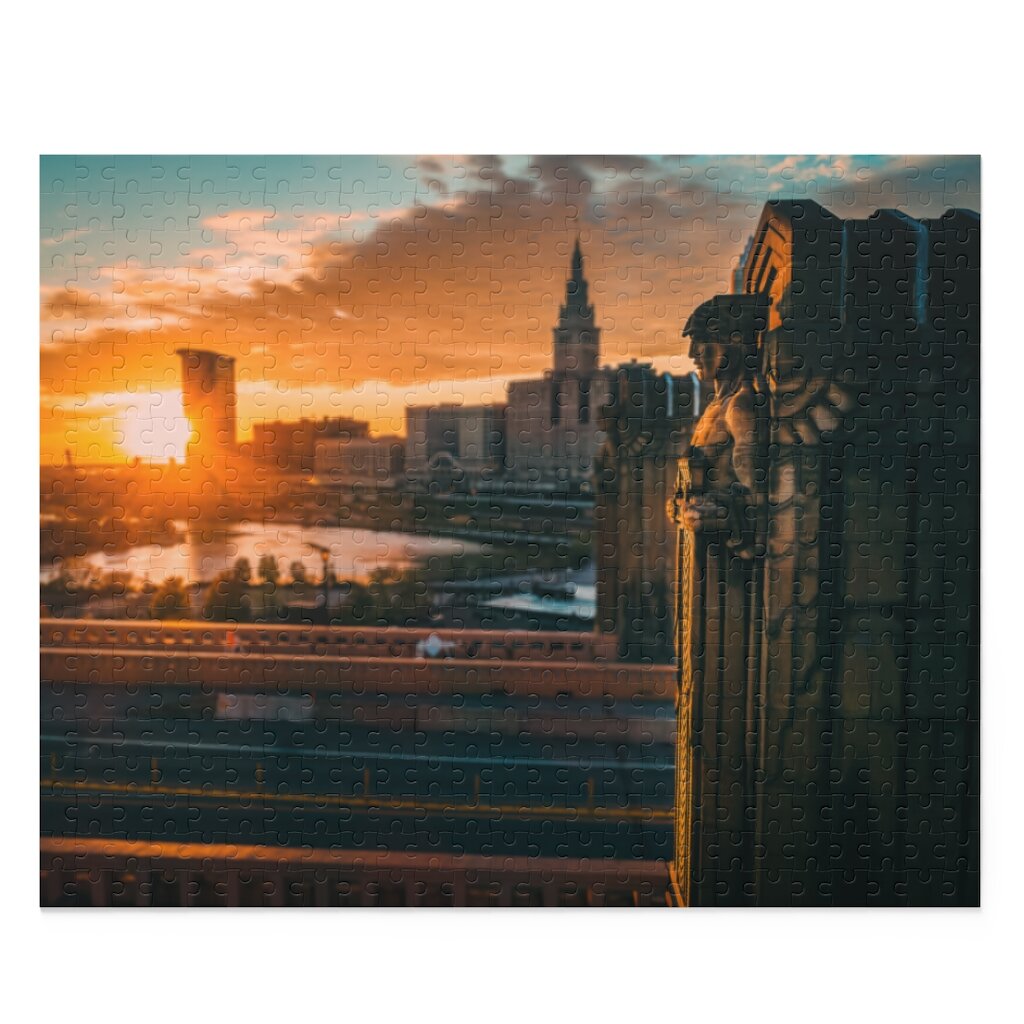
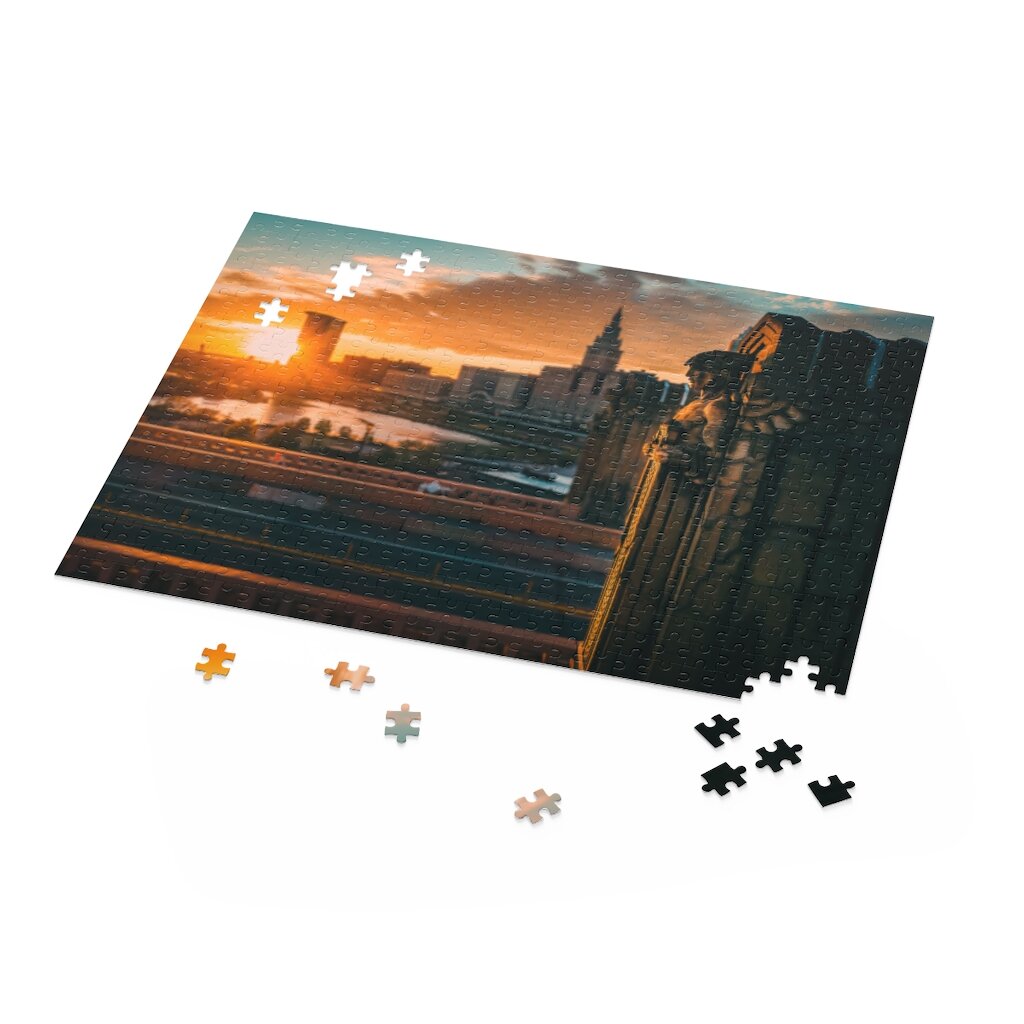
Spend some time with friends and family putting together this puzzle of Cleveland Guardians watching over traffic and its ballpark. They are the iconic landmarks of Cleveland and hold even more significance now for Clevelanders and its baseball fans as inspiration for the new name of the Cleveland Major League Baseball team. Available in 2 sizes: 11x14 with 252pcs or 16x20 with 500pcs.
Guardians of Traffic, towering over Hope Memorial bridge downtown Cleveland, Ohio, have been a Cleveland downtown staple since 1932, becoming a truly iconic symbol of the city. The 8 Guardians of Traffic figures were sculpted in Art Deco style based on designs of a Cleveland architect Frank Walker, and are the only Art Deco style public art in Cleveland. The Guardians hold different traffic vehicles symbolizing the evolution of transportation.
These jigsaw puzzles are made with high-quality chipboard pieces and ship in a gift-ready box which also features the design for extra presentation points.
High-quality chipboard pieces with vibrant sublimated print
Packaged in a gift-ready paper box
Recommended for ages 9 years and older
We hope you have a wonderful holiday season!We leave you with this Christmas tree drone light painting that we did a few years back. Happy Holidays, and as usual, Contact Us if you have any drone services or drone training needs!
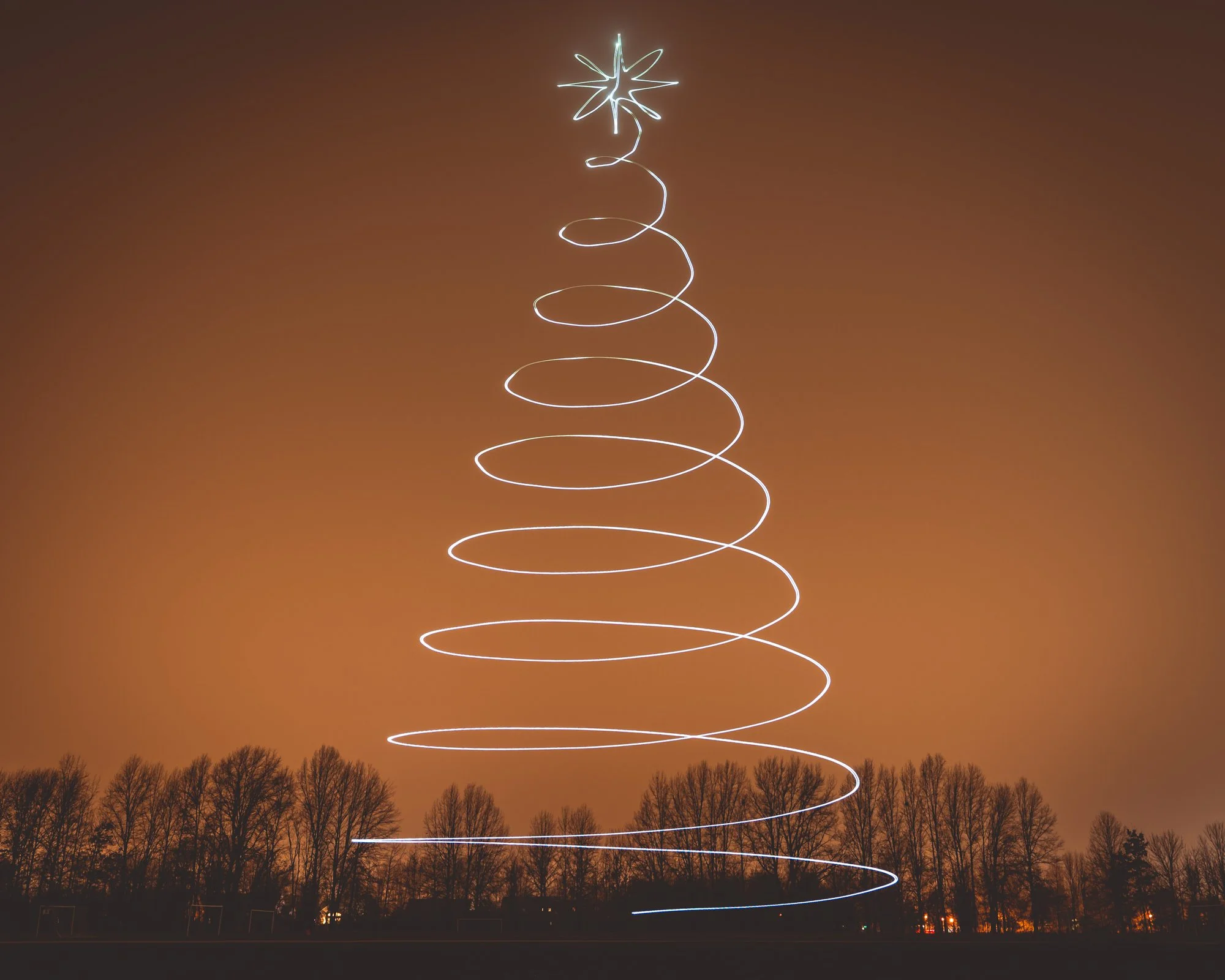
Drone light painting - Christmas Tree

What is DJI Fly Safe? Is unlocking a Geo Zone in DJI Fly Safe the same as getting an FAA Authorization?
I am a commercial drone pilot, drone services provider, and drone educator based in Cleveland, Ohio, and I get a lot of questions concerning drone operations from drone hobbyists, drone training students, and those that read and watch my drone education content. Recently I noticed that there is some confusion concerning DJI Fly Safe Geo Zone Unlocks to remove flying restrictions that prevent the aircraft to fly vs. getting an FAA Authorization to fly in controlled airspace.
I am a commercial drone pilot, drone services provider, and drone educator based in Cleveland, Ohio, and I get a lot of questions concerning drone operations from drone hobbyists, drone training students, and those that read and watch my drone education content. Recently I noticed that there is some confusion concerning DJI Fly Safe Geo Zone Unlocks to remove flying restrictions that prevent the aircraft to fly vs. getting an FAA Authorization to fly in controlled airspace.
In this blog post I explain the following:
· What DJI Fly Safe is
· How unlocking DJI Fly Safe Geo Zones differs from getting FAA Authorization to fly in a certain airspace
· Clear up the confusion between unlocking DJI Fly Safe Geo Zones vs. getting an FAA authorization
· How to unlock DJI Geo Zones through the DJI Fly Safe website
You can also watch my Vlog/Video Tutorial on this topic below if you prefer getting your information audiovisually.
What is DJI Fly Safe?
DJI Fly Safe is a drone flight geofence system implemented by DJI for the drones they manufacture. It uses GPS coordinates to create flight restrictions (Authorization or Restricted Zones) in certain areas to keep everyone safe and compliant with existing FAA flight restrictions for drones. This system will restrict your DJI-manufactured drone from taking off, flying, and landing in such an area.
Is unlocking a DJI geo zone the same as getting FAA Authorization to fly a drone?
No, they are 2 different things and are both necessary to obtain in order to legally fly your DJI-made drone within controlled airspace.
Can I get an FAA Authorization through DJI Flysafe?
No, you can only obtain FAA Authorization to fly in controlled airspace through LAANC or the FAA Drone Zone. Even if you self-unlock your DJI Drone to fly in an area that requires FAA Authorization, you shouldn’t do so until you also receive FAA Authorization to fly there.
How do I know which area requires an FAA Authorization?
There are several ways to check what type of airspace you are intending to fly in. The easiest way is with an app that was developed in conjunction with the FAA, called B4UFLY.
Commercial drone pilots are required to learn all about these airspace restrictions for their planning and decision-making in everyday operations, and such education is included in most Part 107 Test Training for those who want to take the Part 107 Exam, as well as some basic knowledge is included into the FAA TRUST test for recreational drone pilots (hobbyists), see my VLOG on the TRUST Test for more information on this.
There are also many other apps developed by 3rd parties to help plan drone flight missions, and some with the ability to request FAA airspace authorizations (LAANC) through the app (such as Airmap, UASidekick, and Aloft, to name a few).
How to unlock a Geo Zone in DJI Flysafe?
I have step-by-step instructions on how to do this in my Video Tutorial at the beginning of this post. Check out the timestamps in the description below the video (in the YouTube view) to get to the tutorial you are looking for.
Does unlocking a Geo Zone in DJI Flysafe transfer to my drone automatically?
The unlocking license should transfer to the DJI app once you are connected to the internet/wifi with the phone/tablet that you intend to fly with. You may then have to add the license to your aircraft using the DJI App. I show how to do this in my Video Tutorial as well.
How do I apply for an FAA Authorization to fly drones in controlled airspace?
A few years ago, I recorded a video tutorial about how to get FAA flight authorization for controlled airspace through the LAANC and DroneZone. Check it out for step-by-step instructions!
I hope I was able to clear up some confusion and equip you with the knowledge on ‘how-to’ get permissions to fly your DJI-manufactured drone from both FAA and DJI.
As usual, I encourage you to go out and practice flying if you are an aspiring drone pilot, and only to do so safely.
If don’t’ have your Trust certificate yet, please get one before you fly your drone (even if you only intend to fly for recreational purposes). If you want to take the FAA Part 107 Certificate Exam to earn your commercial drone pilot license, or to get more hands-on flight experience, check out drone training classes I teach in the Cleveland area, including Part 107 Prep Class and Drone Operations Class.
Feel free to Contact me if you have any questions or suggestions for more content like this!

Drone Use in Construction Marketing
The use of drones in construction is growing rapidly, with companies in this industry using drones for various tasks throughout the construction process. We count several construction companies as our clients, and here we are breaking down the uses of drones and other tools for construction services marketing.
The most common use of drones in construction is for marketing, because aerial photography and video showcase project site progress, action on the site, and the finished project better from the bird's eye view than from the ground. You can see more from the aerial view and show off the scale of the project, and the best way to get this type of content is to have ongoing construction progress documentation using drones.
How do construction companies use drone photography and video for construction marketing?
Social Media Content
Construction aerial photography and video generate great content to showcase the progress on the construction site to stakeholders and the public. They can also be used as early-stage marketing for the brokers if the building needs to be leased by tenants. Below are some examples: before/during photo and video clip that was posted on social media by our clients.
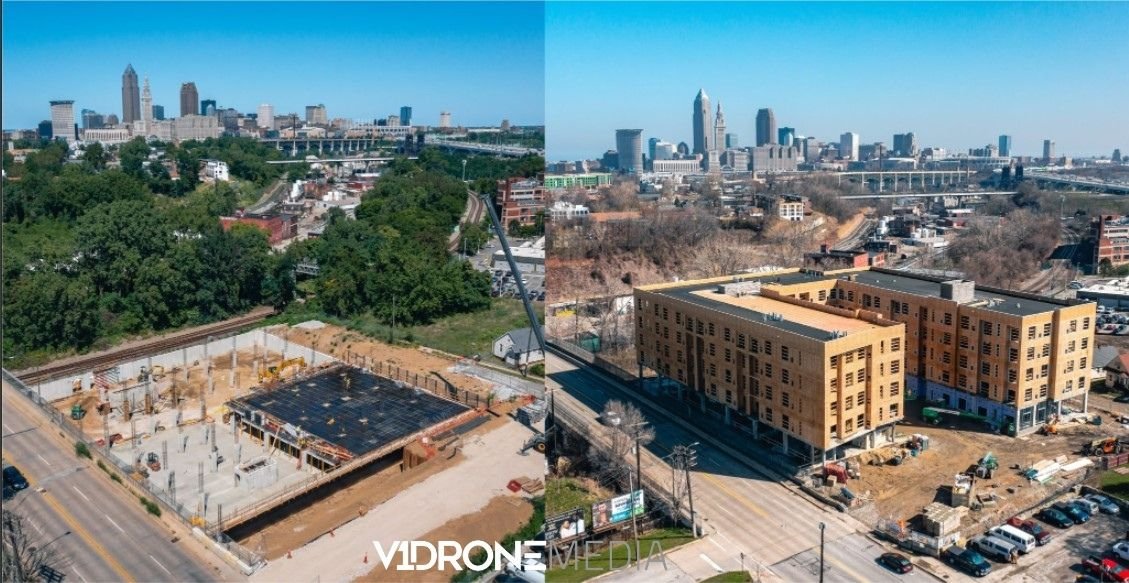
Before/During drone photo of a construction site on West 25th Street in Cleveland
2. Project Portfolio Showcase on Construction Company Website or YouTube Channel
Every construction company should have a section on their website to showcase the projects that they have been involved in. What better way to showcase them than with photos or videos of finished projects, maybe even an impressive hyper-lapse or timelapse video of the building going up during the construction?
3. Customer Proposals, Presentations, Business Development
While not all scopes of work require to have visual updates of the construction site, having this type of deliverable throughout the construction process may enhance your proposal, and even take it over the top all things being equal among the other bidders. Especially if the construction client is not local, which is often the case.
We have a construction client whose building owner is overseas, and having consistent visual updates is very valuable to them. It gives transparency and increases their confidence and trust in the builder.
4. Video Web Banners on Construction Company's Homepage
Have you heard that the website homepage, which is most often the landing page, is the most important page to optimize the content on because it gets the most traffic, and that's where the visitors decide if they want to browse further? A video banner of prominent projects that the construction company has built will impress many viewers and increase their confidence and motivation to take the next step: browse more or contact the builder. Here is an example.
Video is becoming a very important part of marketing strategy for many industries, including construction marketing strategy. If you'd like to know more about the reasons why read our blog post Why Is Video Important For Your Marketing?
What is the Return on Investment (ROI) of construction site progress monitoring and documentation?
Many construction companies leverage drones and other visual technology tools for more than just marketing, such as for enhancing customer communications, internal project updates, construction site security, and re-creating the built environments in BIM (Building Information Modeling) and creating digital twins.
In addition to drones, these tools are time-lapse cameras and 360 virtual tours. The visual output of these tools over the lifecycle of the project can be used and reused for various purposes, which can make the acquisition cost of construction site imagery very efficient, and its Return on Investment (ROI) increases with every use.
These tools are within the digitization trend in construction, facilities management, and other industries. This imagery can be used to re-create the built environment in 3D in BIM (used for construction and design) or as digital twins (usually used for facility maintenance and operations) to give companies a complete 3D visual model of the build. It is a digital documentation record that can be accessed at any time to send information about the building, reflect changes with its physical counterpart, and allow for materials ordering and scheduling (in the design/construction stage or for maintenance and expansions if the building is operational). These types of digital models can replace final building drawings and operations manuals.
We outline more drone uses on construction site on our blog post Top 4 Drone Uses in Construction Site Management.
If you'd like a quote for construction progress monitoring job or consultation on what equipment is best to use on your construction site for a specific purpose or a variety of uses, contact us!

V1DroneMedia Drone Classes
V1DroneMedia offers a set of drone classes that V1DroneMedia’s Chief Drone Pilot (Jason Damman) developed and teaches regularly through local Cleveland community colleges and on-demand for individuals or organizations. Each class is geared toward a specific type of ‘drone’ knowledge need the students or organization is looking for, and we can develop custom classes by request.
Curious about the drone industry?
If you have heard of drones but are not sure how you can take advantage of this innovative technology, would like to learn about it, what it takes to work with drones legally, and what careers are available in the industries that are using drones, our 3-hour Introduction to Drones Class is for you!
What you will learn may spark an interest in a new career, or hobby, or inspire you to use the drone as a tool in your current job and will help you understand what to do if you want to get started. Since this is an in-person class with a drone industry professional, you will also have the ability to ask questions.
Want to learn to fly a drone with expert guidance?
Whether you are a drone hobbyist or an aspiring commercial drone pilot, the essential part of your drone training should be learning to fly the drone. That means being comfortable with operating the drone apps (such as DJI, Litchi, etc.), performing takeoffs and landings, learning to maintain and calibrate the drone, performing routine flight maneuvers, operate the camera to take pictures and video.
We have designed the Drone Operations Class to address this need for anyone who’s never touched a drone, and for those who know their way around a little, but don’t have the full confidence in operating it and want to advance their knowledge and skills.
This class consists of a 3-hour in-class portion that will introduce you to drone apps, how to calibrate, and maintain a drone, design a pre-and post-flight checklist, and introduce you to intelligent flight modes. The outdoor 3-hour portion will allow you to practice this knowledge with the guided expertise of a seasoned drone pilot.
We also have private 2-hour Hands-on Drone Flying Lessons that include only outside flying with hands-on practice, if you just want to practice flying.
While this class will equip you with the ‘know-how’ to operate a drone, it will be up to you to practice and hone your flight skills. That takes time and dedication, but it can pay off. Drone pilots are in demand in a variety of industries (as you can learn from us by taking our Intro to Drones class or watching the Drones for Business Webinar recording), and that demand is growing. A Drone pilot’s hourly pay rate can range from $50 - $250 or even more, depending on their skill set, experience, and the type of work they are doing.
Decided to get your commercial drone pilot license (aka FAA Part 107)?
You will need to get FAA Part 107 license if you intend to use drones for commercial purposes. That means even if you take aerial photographs to market your friend’s real estate listing, or if you want to do a flyover of a building for a roof or home inspection, regardless of the size and weight of the drone. Read my Drone Pilot License blog post for more details on this topic.
If you have decided to take the Part 107 Test, you will need to study FAA Part 107 Knowledge Test Materials and take the Part 107 Test which is similar to a private pilot test in the amount of knowledge covered. It costs $175 to take the test, so having proper preparation is important. You don’t want to have to spend that money again.
Our 2-day in-person FAA Part 107 License Prep Class breaks down the FAA prep materials (they are quite dense and full of aviation lingo) into easy-to-digest concepts for anyone. We cover only the information that is needed to pass the test and operate your unmanned aircraft safely. You will also receive additional resources such as materials to study and access to practice tests.
After that it will be up to you to study, take practice tests, and, when you feel confident enough, schedule and take the Part 107 test in a testing center.
Drone Classes Sign-up
If you’d like to stay up to date on our drone class dates and times, Sign Up to be notified when they get scheduled, and shop our upcoming Drone Classes to register for upcoming drone classes.
Custom Drone Training for Organizations
If your organization wants to train its employees, we can design courses that suit your needs. Contact us for a consultation!

Ohio Drone Laws
As a commercial drone services provider located in Cleveland, Ohio, we know a thing or two about flying in this state. One of the questions we get asked often is whether you can fly at a specific location in Cleveland. See our blog post Where to Fly Drones in Cleveland for that information.
Drone flights in Ohio are subject to FAA regulations for operating in the national airspace. However, Ohio has also introduced a state-level drone law in April 2025 (HB 77) focused on unsafe operations and public safety, which pilots should be aware of in addition to FAA rules. Besides that some municipalities are enacting their own ordinances for drone use, but these should only apply to launching and landing locations, as local municipalities don't control airspace. We recommend checking your city/county for any such drone restrictions.
FAA Part 107 Regulations
Under FAA regulations you must have either a TRUST Test Certificate (for hobbyists) or a Part 107 Drone License Certificate (for commercial drone pilots) to fly drones in Ohio. We offer Part 107 Prep classes locally as a 2-day in-person class that prepares anyone to take and pass the test. See our Drone Training to learn more about available classes and read our student testimonials (over 95% of students pass the Part 107 Test after taking our classes!).
Are There Drone Flight Restrictions in Ohio?
In addition to federal FAA regulations, Ohio now has a state-level drone law that pilots should be aware of.
Ohio House Bill 77 (HB 77) took effect in April 2025 and introduces penalties for unsafe or reckless drone operations within the state. While the FAA continues to control airspace, HB 77 focuses on how drones are used — particularly when public safety or critical infrastructure is involved.
Under HB 77, pilots can face fines or criminal penalties for flying drones in a reckless manner that endangers people or property, interfering with active emergency response operations, or intentionally flying near certain “critical facilities.” These facilities may include police stations, prisons, hospitals with helipads, power plants, utilities, or secure government and military sites.
For most recreational and commercial pilots who already follow FAA rules, HB 77 does not change how you fly day to day. Instead, it reinforces the importance of situational awareness — especially around emergency scenes and sensitive locations — and adds state-level consequences for unsafe behavior.
As always, flying responsibly, maintaining visual line of sight, checking airspace before each flight, and avoiding emergency operations will help ensure compliance with both FAA regulations and Ohio law. You can learn more details about the specifics of this bill in our blog post Ohio’s New Drone Law (HB 77): What Hobbyists, Drone Professionals, and First Responders Should Know.
Besides the state law the federal FAA regulations may require you to gain special authorizations based on the airspace you intend to fly in (Class B, C, D, E). To learn when and how to apply for FAA authorization to fly your drone in a certain restricted airspace, see our blog post Where Can I Fly My Drone that includes a tutorial on how to do this through LAANC.
In addition, you cannot fly over moving traffic, over people, or during a VIP (like a president landing at an airport) or a sporting event where there is a Temporary Flight Restriction (TFR) in place. A TFR is typically active for all open-air stadium NFL, NCAA and MLB games from one hour prior to the game start to one hour after the game ends. These rules do get enforced, see this article about drone pilots pleading guilty to illegal Ohio stadium flights in 2023. And now this type of violation has real legal consequences with the new Ohio HB 77 drone law.
Can You Fly a Drone in Ohio State Parks and Cleveland Metroparks?
As a rule of thumb, national parks do not allow drone use on their properties. Some Metroparks have enacted the same ordinance, so you should check with the specific Metropark system. There are several designated areas where you can fly your drone in the Cleveland Metroparks, see details in their Drone Policy.
Municipal parks don't have the same restrictions usually but check with the specific park and municipality before flying your drone.
Drone Registration
If you want to fly your drone in Ohio (and anywhere else in the United States), you are required to register your drone if it is 0.55 lbs or larger if you fly as a hobbyist, and all drones (regardless of weight) if you operate commercially (under Part 107). You can register your drone on the FAA DroneZone website. The cost for registration is $5 and is valid for three years.
So, if you have checked off all necessary registrations, FAA Airspace Authorizations, and hold an appropriate FAA certificate, you are ready to fly. Now to the fun part, where can you fly your drone in Ohio? We've compiled some of our favorite locations in Cleveland where we frequently fly, see them in the Where to Fly Your Drone in Cleveland blog post.

Where To Fly Drones in Cleveland
Cleveland aerial views are some of the best available in the state of Ohio! OK, we may be a little biased since we are based in the Cleveland area. We are lucky to have an extensive lakefront with Lake Erie spanning much of the Northeast Ohio border, downtown Cleveland, and its suburbs.
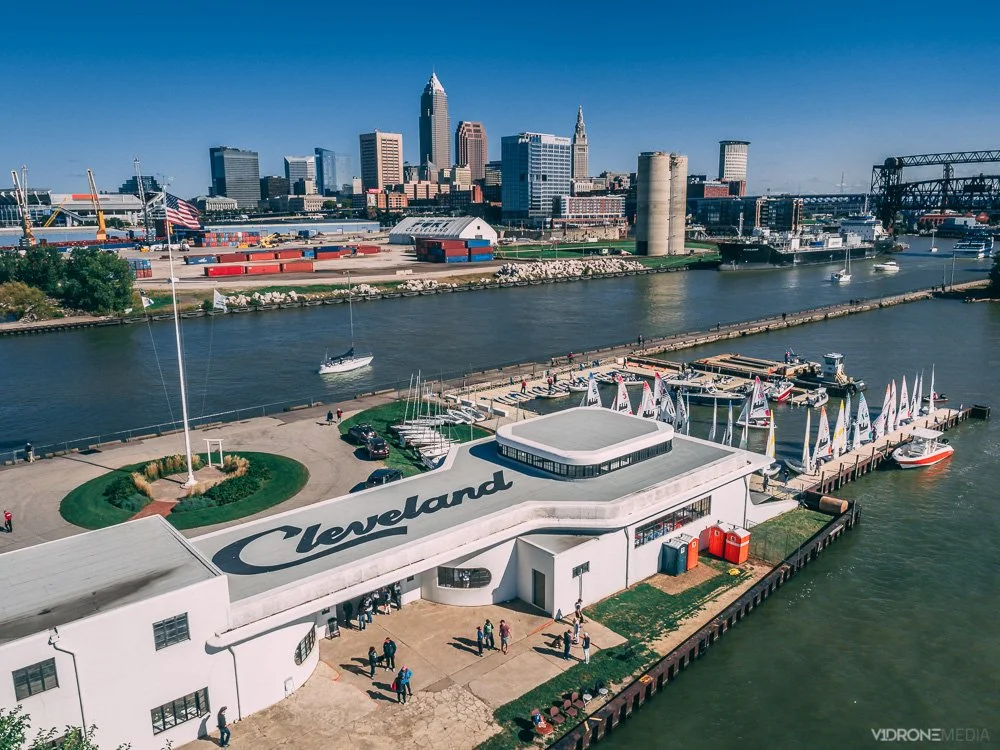
Drone photo of downtown Cleveland skyline and historic Cleveland Coast Guard Station
1. Downtown Cleveland has many scenic locations: Cleveland sports stadiums, Rock and Roll Hall of Fame, Public Square, Playhouse Square, etc. You can't beat the Cleveland skyline aerial view with Lake Erie in the background!
But be aware, if you intend to fly your drone downtown Cleveland, that Burke Lakefront Airport is located there just next to the Voinovich Bicentennial Park. Burke Lakefront Airport is in controlled (class D) airspace, requiring you to obtain FAA authorization to fly your drone within 5 miles of its location (you can read our blog post Where Can I Fly My Drone for detailed information and tutorial on FAA authorizations).

Aerial photo of Rock and Roll Hall of Fame with Burke Lakefront Airport and Lake Erie in the background
In addition, during any major league baseball (MLB) or national football league (NFL) open-air stadium games there is a Temporary Flight Restriction (TFR) that is in effect, which applies to the MLB and NFL games at the stadiums located downtown Cleveland. TFRs can also go into effect for other reasons, such as VIP movement, which prohibits all drone flights in the area.
2. Lakefront locations in Cleveland that offer some scenic lakefront drone photography: Lakewood Park with the Solstice Steps and Cleveland downtown skyline, Lorain Lighthouse in Lorain, and Fairport Harbor Breakwater Lighthouse in Mentor. Make sure you check municipality ordinances when you are choosing where to launch and land your drone.

Aerial view of the Edgewater Park with downtown Cleveland Skyline
3. University Circle neighborhood of Cleveland offers plenty of scenic architectural and natural sites with Wade Oval, Cleveland Museum of Art and its lagoon, Museum of Natural History, Case Western Reserve University campus, and Little Italy nearby. Some of this area is within 5 miles of the Burke Lakefront Airport, so you may need FAA authorization to fly your drone there.

Aerial photo of Cleveland Museum of Art in Fall
4. Unfortunately, you cannot launch and land your drone in most Cleveland Metroparks, including their lakefront locations: Edgewater Park, Wendy Park, Whiskey Island, E 55th Street Marina, East 72nd fishing area, North Gordon Park Boat Ramp, Euclid Beach Park, and Huntington Reservation Beach in Bay Village. There are several designated areas where you CAN fly your drone in the Cleveland Metroparks, see the details in their Drone Policy.
If you have any questions about flying in Cleveland and surrounding areas, need a drone project quote, or are looking for drone training classes that we provide, Contact us!

Event Documentation For Marketing
Whether your business is event management, your company is staging or participating in an event to promote itself and engage existing and prospective customers, or you are in the sports and entertainment industry where events are an everyday business, documenting your event should be a part of your marketing strategy and can help you accomplish several goals:
1. Create event longevity
Once you have documented your event (with video, photos, or even a Livestream feed that you recorded) and published it on your website and social media (including YouTube channels), it will live on the internet forever! That allows showing off the work your company has performed and helps past, current, and prospective clients evaluate your products and services for future consideration.
2. Enhance your credibility
Seeing is believing, and visual content (especially video) engages more people! Showcasing participation and booth space at annual industry events and exhibiting your products/services in the event space, along with seeing the customer interactions will impress beyond any words and enhance your businesses' credibility. If your business is event management, documenting your work is a must to give you credibility and entice prospective clients!
3. Maximize your content production value for marketing
Content marketing is king nowadays, and documenting an event is a perfect opportunity to make more content without thinking hard about what type of content to produce! If you are not familiar with content marketing, Google it! And if you don't know how to approach content creation, here is an article and a PowerPoint deck by Gary Vaynerchuk How To Make 64 Pieces of Content In A Day (with step-by-step instructions).
4. Increase your marketing reach
If you read Gary Vee's article, you know that posting content on multiple platforms (websites, social media, etc.) makes your marketing reach go further. Every media channel and social platform has its niche, and your business is active only on a few that matter to you. If you document your event with visuals (photos, videos), this will cover your basics for multiple media platforms, and you can add and change the copy as needed for various digital asset creation (photos, short-form, and long-form videos).
5. Showcase your work
This is self-explanatory: if you stage events, impress prospective clients with the past events you've put on! If you participate in an event (or are even a talent that is hired to entertain), bring your products, services, or event you are participating in into the spotlight!
6. Promotional content
If your company participates in the event or stages it, chances are you don't do this just once. Documenting your event is a great way to promote your services (especially if you are in the event management industry) or advertise your past and upcoming participation in the relevant industry events, for external (clients, financial markets) and internal (employee) communications!
7. Publicity tool
And finally, documenting events is great for publicity! Generate publicity using this content with available tools in your marketing mix, or piggyback on the existing publicity of the event to get more media mentions and exposure.
V1DroneMedia is an aerial (drone) services company that delivers full traditional and aerial event documentation and video production, including aerial livestreaming. Our work ranges from covering small business events such as Sunnyside Chevrolet Annual Classic Car Show, Chamber of Commerce Golf Outing, Cleveland Haunt Club Halloween in July, to documentation of college graduations, charity events and sports events, including aerial livestreaming of US Sailing Championship on Lake Erie, and aerial coverage for 2016 Cavaliers Parade for local Cleveland news, among others. Contact us today for a quote!