
NIST-Based Drone Flight Training for Police & Public Safety
Why Professional Drone Programs Require Standards-Based Flight Training
Professional drone programs are expected to perform safely, consistently, and under pressure. Whether the mission involves search and rescue, scene documentation, tactical overwatch, or operational support, there is little margin for error when aircraft are deployed in real-world conditions.
One of the most common misconceptions in drone operations is that flight proficiency is permanent once certification is achieved. In reality, flight skills are perishable. Without structured practice and evaluation, even experienced pilots can see skill decay over time. That is why professional aviation — and increasingly professional drone programs — rely on initial and ongoing, standards-based flight training.
This is where NIST-based flight training plays a critical role.
What Is the NIST Drone Flight Training Course?
The NIST (National Institute of Standards and Technology) is an independent federal organization known for developing objective, repeatable standards across technical and operational domains. In the drone space, NIST has developed standardized flight courses designed to evaluate pilot proficiency through clearly defined tasks and measurable outcomes.
The NIST drone flight course is not a certification and it is not academic theory. It is a task-based, hands-on flight skills framework focused on how well a pilot can control an aircraft, maintain situational awareness, and execute precise maneuvers under defined conditions.
Because the course is standardized and repeatable, it allows organizations to evaluate flight performance objectively — something that resonates strongly with police departments, public safety agencies, and operational teams that need defensible training standards.
Borrowed Directly from Airline Recurrent Training Culture
The philosophy behind our drone flight training at V1DroneMedia is borrowed directly from airline recurrent training culture.
The owner and lead instructor of V1DroneMedia is a professionally trained airline pilot with more than 20 years of experience in airline operations (read Jason Damman’s story here). In that world, training does not end once a pilot is hired or certified. Airline pilots undergo mandatory recurrent training once or twice per year to maintain proficiency, reinforce safety standards, and integrate new knowledge.
Recurrent training in aviation includes:
Continuous evaluation of flight skills
Reinforcement of standard operating procedures
Incorporation of FAA guidance and regulatory updates
Lessons learned from accidents and incidents across the industry
This culture exists for one reason: repeatable performance and accident avoidance depend on structured, ongoing training. Pilots are trained not just to know what to do, but to develop automatic responses that hold up under stress.
That same philosophy translates directly to professional drone operations. NIST-based flight training helps agencies move beyond “the pilot has a certificate” and toward measurable proficiency. That distinction matters as agencies move into DFR, Shielded Operations, tactical response, and BVLOS use cases. In his Police1 article on aviation-minded DFR programs, Jason Damman explains why certification is only the starting point and why recurrent training, scenario-based evaluation, SOPs, and abnormal procedure practice are essential for public safety drone teams.
Training Flight “Muscles” and Automatic Responses
In aviation, pilots often talk about training their “flight muscles.” This refers to muscle memory, coordination, and instinctive control inputs that allow pilots to respond correctly without hesitation.
Under stress, cognitive bandwidth is limited. The more a pilot has to consciously think about basic aircraft control, the greater the risk of errors. Structured flight training builds automatic responses that reduce workload and improve safety when conditions are less than ideal.
For airline pilots, this training happens in simulators. For drone pilots, structured and repeatable flight courses like the NIST framework serve the same purpose.
Why This Model Applies Directly to Drone Operations
Many drone programs — particularly in policing and public safety — do not fly every day. Flights may be intermittent, mission-driven, and time-sensitive. When a call comes in, there is rarely time for a warm-up or refresher.
Without structured training, this creates risk:
Skill decay from infrequent flying
Overconfidence in basic maneuvers
Slower or incorrect responses under pressure
Structured flight training matters especially when pilots don’t fly every day — because missions don’t wait for skills to come back.
NIST-Based Drone Flight Training for Learning and Refresher Training
One of the strengths of the NIST flight course is that it works equally well for pilots learning professional flight skills and for experienced pilots who need refresher training.
For newer pilots, the course provides structured flight training beyond hobby-level flying. It introduces professional expectations around precision, control, and consistency in a way that builds a strong foundation for operational use.
For experienced pilots, the same course functions as a refresher. It reinforces fundamentals, identifies bad habits that can develop over time, and restores confidence before real-world missions.
In our classes, we regularly train mixed experience levels together. When group sizes allow, we adjust instruction in real time — breaking into smaller groups when needed — to ensure each pilot is challenged appropriately while still benefiting from a shared training standard.
This approach helps organizations build consistency across their teams rather than relying on individual flying styles.
How NIST-Based Training Improves Flight Skills
Precision and Aircraft Control
Pilots develop tighter control through defined maneuvers that emphasize smooth inputs, controlled altitude changes, and precise lateral movement — skills that directly translate to operational environments.
Situational Awareness
The course reinforces orientation management, aircraft positioning, and multi-axis control while performing tasks, helping pilots maintain awareness beyond simply keeping the drone airborne.
Consistency and Measurable Improvement
Because the course layout is standardized, pilots can repeat the same tasks over time and objectively see improvement. This removes guesswork from training and provides clear feedback for both pilots and leadership.
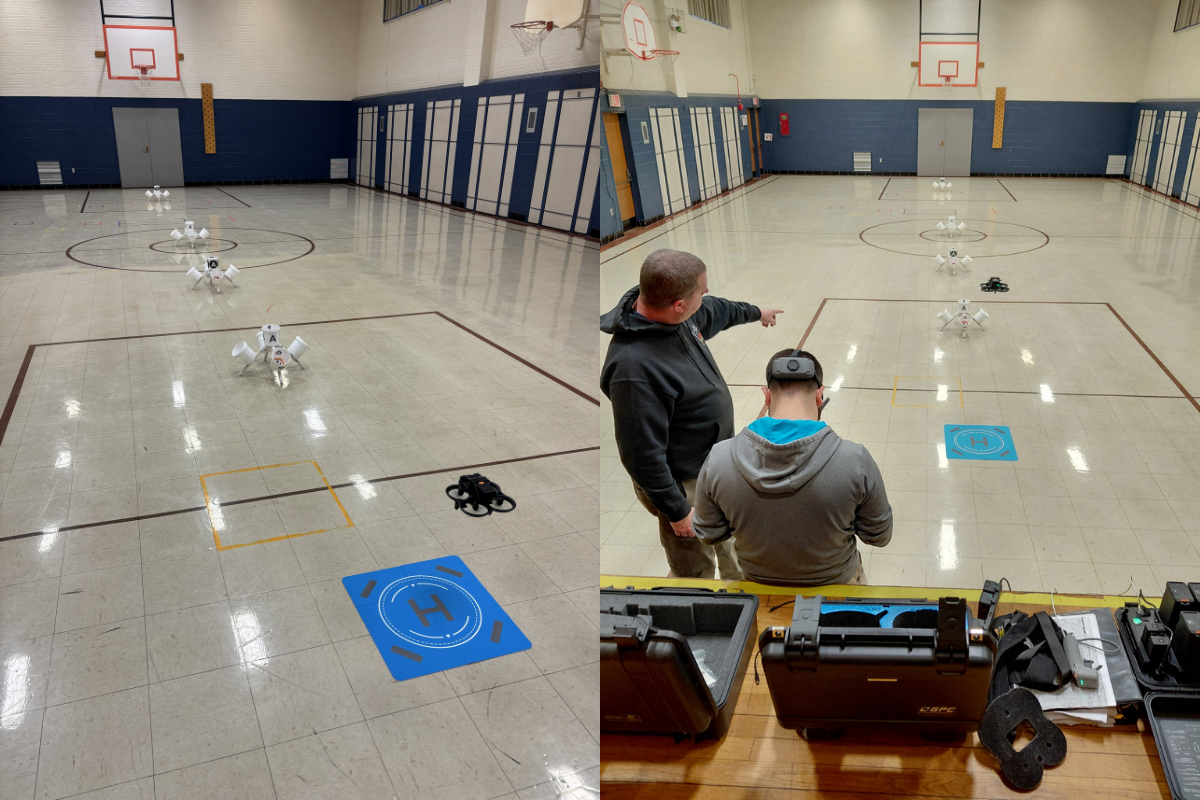
Public safety drone pilots flying standardized NIST flight course
How We Integrate NIST Training into Our 2-Day Drone Operations & Flight Training Class
NIST-based flight exercises are a core component of our Drone Operations & Flight Training (2-day class). The course balances operational context, safety considerations, and hands-on flight proficiency to ensure training is practical and applicable.
Pilots receive instructor-guided feedback throughout the course, with progressive skill building that mirrors real-world operational demands. The emphasis is on standards, repetition, and readiness — the same principles that underpin airline recurrent training.
This approach ensures pilots leave not only with improved skills, but with a clear understanding of what professional flight performance looks like.
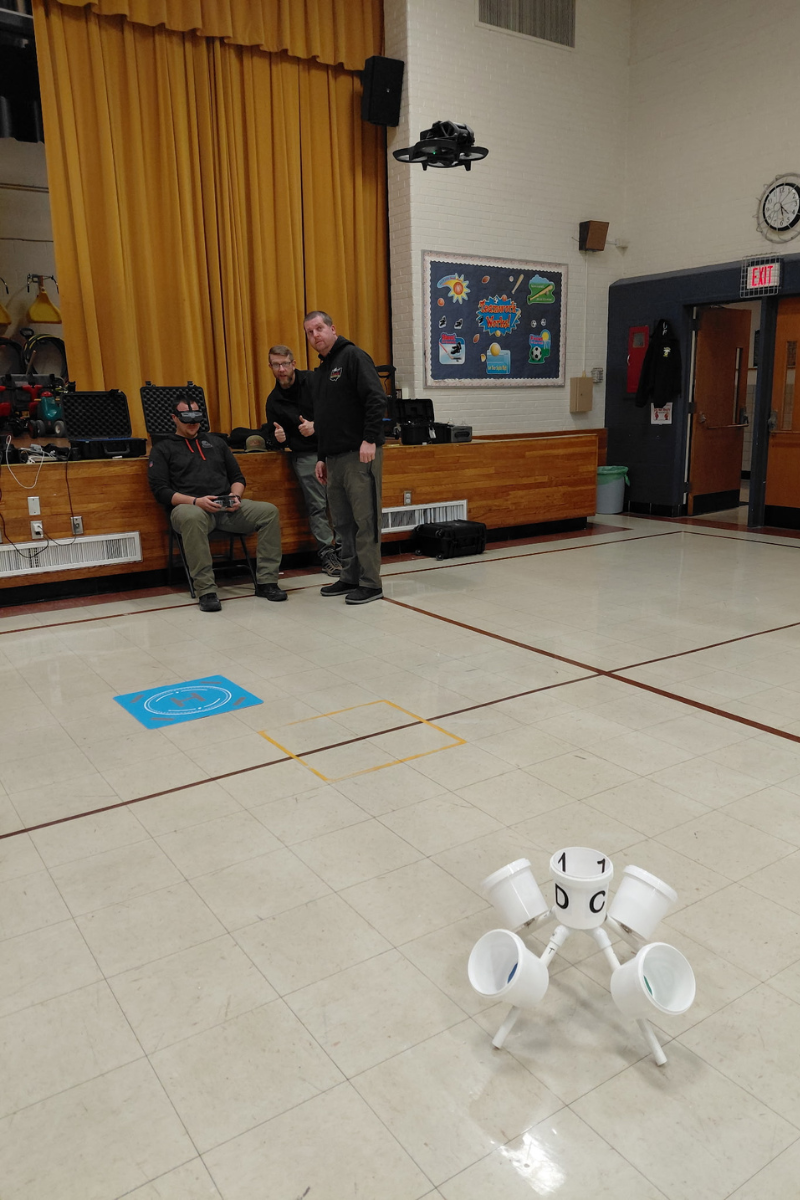
Police officers completing NIST-based drone flight training course
Building Mission-Ready Drone Programs Through Ongoing Training
For command staff and program managers, structured flight training is more than a technical exercise. It is a leadership decision that directly impacts safety, performance, and program credibility.
NIST-based training provides a defensible framework for both learning and refresher training, helping organizations maintain high standards over time rather than relying on ad-hoc flying.
Mission-ready drone programs are built through intentional, ongoing training — not last-minute preparation.
Related Resources for Public Safety UAS Leaders
DFR and Shielded Operations increase both capability and risk. Read Jason Damman’s Police1 article on why agencies should build aviation-level training, SOPs, risk management, crew coordination, and recurrent proficiency before scaling advanced drone operations.
If your organization is looking to strengthen flight proficiency, reinforce safety standards, or implement structured refresher training, we invite you to learn more about our Drone Operations & Flight Training (2-day class) or Request a Consultation to discuss your training needs.

Police Drone Training: Key Skills and Certification Requirements
The rise of drone technology has sparked a revolution in law enforcement, leading to an increased demand in drone pilots at law enforcement agencies across the United States. Police departments all over the United States are integrating unmanned aerial systems (UAS) into their operations. This shift has created a need for comprehensive training programs that equip officers with the skills to operate drones effectively and safely in various scenarios, including crash scene reconstruction, search and rescue missions, and evidence collection.
Police drone operator training goes beyond basic flight skills. It encompasses a wide range of competencies, from mastering standard flight maneuvers and aerial imagery to understanding specialized applications like aerial photogrammetry an even thermal imaging. This article delves into the key skills and certification requirements for police drone pilots, exploring the essential components of UAS training courses.
Regulatory FAA Compliance for First Responder Agencies
The Federal Aviation Administration (FAA) has established specific regulations to ensure safe and legal drone operations for individuals and organizations. Complying with these requirements is crucial for law enforcement agencies that want to integrate unmanned aerial systems (UAS) into their operations. Law enforcement agencies have two legal options for operating drones: they can fly as a government agency under Part 91 with an FAA-issued Certificate of Waiver (COW), training and self-certifying their pilots under that approval, or they can require each pilot to earn an FAA Part 107 Remote Pilot Certificate (commonly called a drone license) and operate under civil drone rules. Certificate of Waiver (COW) replaces Certificate of Authorization (COA) that was a 2nd path for regulatory compliance for first responder agencies up to 2026.
Part 107 – Remote Pilot Certification
The FAA’sPart 107 Certification (aka Drone License) serves as the foundational license for drone pilots working in commercial settings across various industries. To earn this certification, individuals must pass a knowledge test that evaluates their understanding of airspace classifications, aviation weather, drone operations, and safety procedures. Although originally intended for commercial use, many police and fire departments now use Part 107 as a practical framework for public safety missions.
COW - Certificate of Waiver (replaces COA as of 2026)
The regulatory landscape for public safety drone operations is changing fast. When we first published this blog post COA (Certificate of Authorization) was the path for FAA operational approval outside of its Part 107 regulations. As of late 2025 and now in 2026, FAA has streamlined their processes to introduce new Certificate of Waiver (COW) framework. A Certificate of Waiver (COW) is the new FAA’s approval pathway that allows public safety agencies—such as police and fire departments—to conduct advanced drone operations, including Beyond Visual Line of Sight (BVLOS), under Part 91. The COW framework replaces the older, more time-intensive COA application process and is now processed through FAA Flight Standards rather than the Air Traffic Organization.
Under the new system, many BVLOS operations—including Drone as First Responder (DFR) missions—can be approved in as little as 1–2 weeks, with some DFR waivers granted the same day. Waiver validity has been extended to four years, visual observers are no longer required in many cases (when equipped with approved detection technology such as ADS-B In), and monthly reporting requirements have been eliminated.
Obtaining a COW still requires operational planning, documented safety procedures, and coordination with the FAA. However, the administrative paperwork burden is significantly reduced compared to the legacy COA framework. Agencies that previously delayed BVLOS implementation due to long processing times now have a faster, more scalable pathway to launch or expand DFR programs and other advanced public safety drone capabilities.
COA - Certificate of Authorization (prior to 2026)
A Certificate of Authorization (COA) is an FAA approval that allowed public agencies—such as police and fire departments—to operate drones as public aircraft under Part 91 for official missions. However, a COA by itself does not authorize BVLOS (Beyond Visual Line of Sight) operations. Agencies that want to conduct BVLOS—fly a drone beyond visual line of sight during operations or for Drone as a First Responder (DFR) programs—must also obtain a specific Part 91 waiver (commonly known as Shielded Operations waiver).
Obtaining a COA and any associated BVLOS waivers requires detailed planning, operational documentation, and coordination with legal counsel and the FAA. Because of the paperwork and compliance requirements, this path is typically more administratively involved than operating under Part 107. Some agencies start under Part 107 to launch quickly, then pursue a COA and BVLOS waiver later to expand into more advanced capabilities.
All paths (Old COA, COW and Part 107) are a legal way to comply with FAA regulatory requirements for first responder agencies, but they differ significantly in strategic advantages, and all have some limitations. Here is a side by side comparison of the 3 approaches - Old COA vs. new COW vs. Part 107.
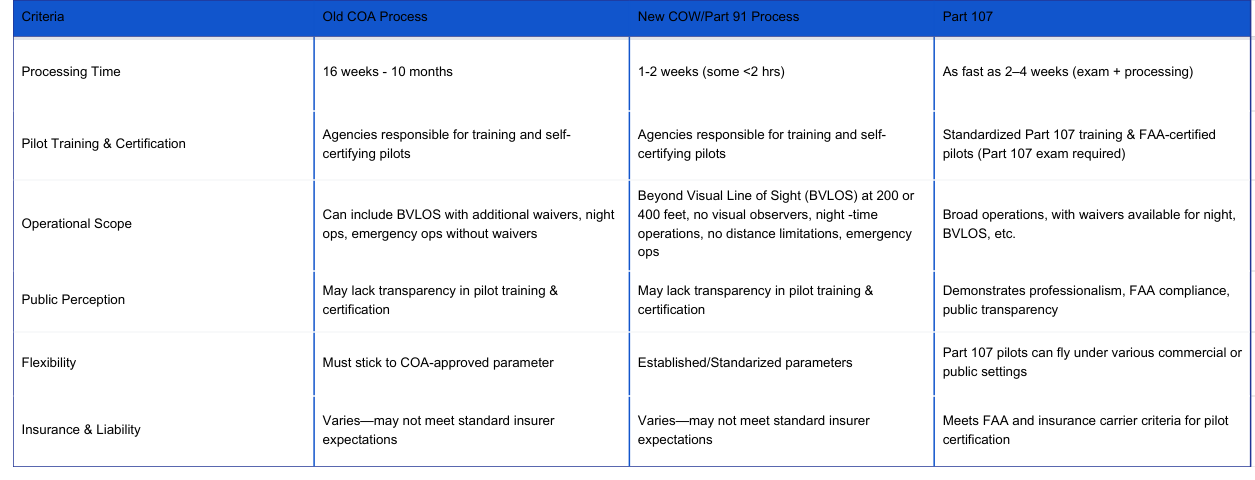
Side by Side Comparison of Old COA vs New COW vs Part 107 for First Responder Agencies
We recommend getting Part 107 Certification for drone pilots in your department first or in parallel with the Certificate of Waiver (COW). We recommend that path for many reasons, especially because Part 107 regulations are the established and acceptable FAA drone pilot training and operations standard regardless of whether you need the official certification or not, and not the last reason being that if an officer obtained their Part 107 Certification (aka Drone Pilot License), it is a professional certificate that upskills employees, boosts morale, stays with the individual if they choose to maintain it, and gives them opportunity to use their drone skills outside of work as a side or a retirement gig in the future, providing aerial videography and photography for real estate and other industries.
For law enforcement agencies, Part 107 certification is an important foundation, but it is not the same as mission readiness. Police drone teams also need hands-on proficiency, scenario-based training, SOPs, communications procedures, emergency response drills, and recurrent evaluation. Jason Damman, our Chief Pilot, expands on this point in his Police1 article about why DFR and advanced public safety drone programs require an aviation mindset.
For that reason we will only cover the what it takes to get Part 107 Remote Pilot Certificate (Drone Pilot License) for first responder officers in this blog post.
Explore First Responder Drone Training Programs
Part 107 Remote Pilot License
This certification applies to drones weighing 0.55 pounds to 55 pounds used for commercial purposes, including law enforcement activities. To obtain this license, police officers must meet several criteria:
1. Be able to read, speak, write, and understand English
2. Be in a physical and mental condition to safely operate a drone
3. Pass the initial aeronautical knowledge exam, known as the "Unmanned Aircraft General – Small (UAG)" test, also known as Part 107 Test.
The Part 107 certification allows first responder drone operators to fly their UAS at daylight or at twilight and nighttime hours with anti-collision lighting. If your team needs to operate beyond standard rules (like over people), you can request specific waivers from the FAA using the FAA Drone Zone (online process).
Studying for the FAA Part 107 Exam
Preparing for the Part 107 exam is a crucial step in police drone training. The exam covers a wide range of topics, including:
1. Applicable regulations for small UAS operations
2. Airspace classification and operating requirements
3. Aviation weather sources and effects on small UAS performance
4. Small UAS loading and performance
5. Emergency procedures
6. Crew resource management
7. Radio communication procedures
8. Determining the performance of small UAS
9. Physiological effects of drugs and alcohol
10. Aeronautical decision-making and judgment
11. Airport operations
12. Maintenance and preflight inspection procedures
Many police departments allocate between 15 to 20 hours of study time for officers to prepare for the test. Various resources are available, including online test prep courses and free materials provided by the FAA. It's essential for police drone training programs to incorporate comprehensive study materials and practice tests to ensure officers are well-prepared for the exam.
If you are a police officer looking to get your Part 107 drone pilot license, you can take an online course or take our regularly scheduled 2-day in person Part 107 Prep class in the Cleveland, Ohio, area and get your Part 107 certificate shortly thereafter by taking a proctored Part 107 Test.
If you are looking for group Part 107 drone training for your department, and/or hands-on drone flight training for your group, explore our drone training options for law enforcement which we bring directly to departments nationwide.
To support our Part 107 trainees in mastering the FAA knowledge requirements, every enrolled student will now have access to V1DroneMedia Part 107 Test Program— an interactive study and exam simulation platform designed specifically to prepare public safety professionals for success. The system features 300+ FAA-style practice questions, realistic 65-question timed exam simulations, detailed answer explanations with regulation references, built-in FAA charts and figures, and 10 comprehensive study guides covering every knowledge area. With progress tracking, weak-area targeting, and an Exam Readiness Tracker that helps candidates confidently exceed the 70% passing standard, officers know exactly when they’re prepared for test day.
If you are a first responder who is studying on their own, use our practice system to prepare you for the exam day. For a limited time, use SPRING26 coupon code to save on $10 on full practice program access.
Start with the FREE PRACTICEST test, then upgrade to full access when you are ready.
Part 107 Practice Test & Study System Video Overview
Practical Flight Experience
While the FAA does not mandate a specific number of flight hours for Part 107 certification or drone operations training under COA/COW, practical flight experience is crucial for police drone operators who want to be effective at this task. Law enforcement agencies often incorporate hands-on training into their UAS programs to ensure officers can effectively operate drones in various scenarios.
Key aspects of practical flight training for police drone operators include:
· Mastering basic flight controls and maneuvers
· Understanding drone capabilities and limitations
· Practicing emergency procedures
· Conducting simulated missions relevant to law enforcement, such as search and rescue or crash scene reconstruction
· Familiarizing officers with specific drone models used by their department
· Practicing a variety of flight scenarios to get more familiar with the controls
It's worth noting that an individual can obtain an FAA Remote Pilot Certificate without ever having flown a drone. However, for police drone training programs, incorporating practical flight experience is essential to develop competent and confident operators. There is a variety of ways to assess the competency of police drone pilots which can be built-in to police drone training programs. V1DroneMedia also offers drone operations and flight training for groups as part of our Basic Drone Training curriculum fir First Responders that we bring on-site that includes testing the drone pilot flight proficiency. We use NIST based flight courses to develop operational flight skills.
To maintain their certification, police drone pilots must complete an online recurrent training course every 24 calendar months. This ongoing training helps ensure that officers stay up-to-date with the latest regulations and best practices in UAS operations.
By adhering to these FAA certification requirements and incorporating comprehensive training programs, law enforcement agencies can develop skilled and compliant drone operators, enhancing their capabilities in various police operations.
Essential Flight Skills for Law Enforcement UAS Operations
Law enforcement agencies integrating unmanned aerial systems (UAS) into their operations require officers to develop a specific set of skills to operate drones effectively and safely. These skills are crucial for various applications, including traffic collision reconstruction, and aerial surveillance, and search and rescue missions.
Basic Maneuvers and Controls
Mastering is fundamental for police drone operators. This includes the ability to perform precise takeoffs and landings, maintain stable hovering, and execute controlled movements in various directions. The is an entry-level test method designed to assess these essential skills. It requires remote pilots to conduct climb to specified altitudes of 10 and 20 feet above ground level, perform yawing turns, and execute forward, reverse, and transverse flight maneuvers.
Accurate control and maneuverability of the UAS are critical for ensuring the safety of both the drone and individuals on the ground. Pilots must develop a solid understanding of their drone's capabilities and limitations, allowing them to fly smoothly and confidently in various scenarios and conditions.
Advanced Flight Techniques
As officers become more proficient, they must master advanced flight techniques to handle complex law enforcement operations. This includes skills such as:
· Aerial search tactics: Pilots should be adept at conducting efficient search patterns when looking for missing persons or suspects.
· Night operations: Operating drones in low-light conditions requires specialized skills and knowledge of thermal imaging technology.
· Precision flying: The ability to navigate through tight spaces and around obstacles is crucial for applications like building inspections or tactical operations
Test obstacle flight courses should be used to practice and test the pilots (NIST has developed some standardized courses that we at V1DroneMedia constructed and use in training - learn more in our NIST Based Drone Flight Training blog post)
· Data collection: Officers must be proficient in using various payloads, such as to gather crucial information during missions using high-resolution cameras and thermal sensors
· Learn to operate FPV drones that allow law enforcement survey and clear indoors areas without putting police officers in the line of fire for Tactical Operations (such as SWAT teams, etc.)
Advanced training should also cover mission planning, deployment preparations, and the use of specialized equipment like thermography. Check our V1DroneMedia Advanced Drone Training courses: SAR (Search and Rescue) and Tactical Drone Operations Training that we bring on site to department nationwide.
Emergency Procedures
Preparing for and responding to emergencies is a critical aspect of police drone training. Officers must be well-versed in handling various scenarios that may arise during UAS operations. Some key emergency procedures include:
· Loss of signal: Pilots should know how to activate the Return-to-Home (RTH) function and maintain visual line of sight with the drone.
· Low battery situations: Understanding how to monitor battery levels and execute safe landings when power is running low is essential.
· Adverse weather conditions: Officers must be prepared to adjust flight plans or execute emergency landings in case of sudden changes in weather.
· GPS signal loss: Pilots should be able to switch to manual mode and safely land the drone when GPS navigation is compromised.
· Obstacle avoidance system failure: Knowing how to manually navigate around obstacles and prioritize safe landings is crucial.
Regular practice of simulated emergency scenarios in controlled environments can help build confidence and improve response times.
By focusing on these essential flight skills, law enforcement agencies can ensure their drone operators are well-prepared to handle the challenges of UAS operations in various policing scenarios. Continuous training and assessment using standardized methods like the NIST sUAS Test Methods can help agencies maintain high levels of proficiency and readiness among their drone pilots.
Specialized Police Drone Applications and Training
Drones have evolved to encompass a wide range of specialized applications, equipping officers with the skills to leverage unmanned aerial systems (UAS) in various law enforcement scenarios. These specialized applications require tailored training to ensure officers can effectively utilize drones in critical situations.
Crime Scene Documentation
One of the most significant advancements in law enforcement drone use is in crime scene documentation. Drones have revolutionized how police capture and preserve evidence at crime scenes. They provide a comprehensive aerial perspective that was previously difficult or impossible to obtain. With drones, officers can quickly create detailed 3D models and renderings of crime scenes, allowing investigators to revisit the scene virtually at any time.
The ability of drones to collect photos from various heights and angles ensures complete coverage of an area. This capability is particularly valuable in complex or large-scale crime scenes where traditional methods might miss crucial details. The speed at which drones can move and collect an uninterrupted stream of data is unparalleled compared to traditional human forensics.
Training for crime scene documentation using drones focuses on teaching officers how to:
1. Operate drones to capture high-resolution imagery
2. Use specialized software to create 3D models and orthomosaic images
3. Analyze data collected by drones, such as determining impact force between objects
4. Confirm the precise location of evidence items in the field
Search and Rescue Operations
Search and rescue missions have been transformed by the integration of drones into law enforcement operations. Drones equipped with thermal imaging cameras have become indispensable tools for locating missing persons and animals, especially in challenging terrains or low-visibility conditions.
The efficiency of drones in search and rescue operations is remarkable. They can quickly acquire aerial data over large areas, allowing rescuers to map entire search areas and pinpoint potential locations of missing individuals. Compared to ground vehicles, drones can reach locations faster and access areas that might be inaccessible by other means.
Training for search and rescue drone operations typically covers:
1. Operating thermal imaging cameras and interpreting heat signatures
2. Conducting efficient search patterns over various terrains
3. Integrating drone data with ground team operations
4. Using drones to guide rescuers through optimal routes
Check out our Search and Rescue Operations Class and Request a Consultation if you are interested in bringing it to your department!
Tactical Surveillance
Drones have become invaluable assets in tactical surveillance operations, offering law enforcement agencies enhanced capabilities in monitoring and responding to high-risk situations. The ability of drones to provide real-time aerial data for situational awareness has transformed how police approach these situations, effectively increasing police and public safety.
In monitoring large gatherings and events, drone surveillance provides a broader view of crowd dynamics and transmits real-time data to crowd control teams. This capability allows officers to zoom in on areas of interest and make critical decisions based on detailed information about ground-level activities.
Training for tactical surveillance with drones typically includes:
· Mastering stealth flight techniques to maintain discreet observation
· Operating advanced camera systems for high-quality video and image capture
· Integrating drone surveillance with other security systems
· Understanding legal and ethical considerations in drone-based surveillance
As police drone training continues to evolve, these specialized applications demonstrate the growing importance of UAS in modern law enforcement. By mastering these skills, officers can enhance their effectiveness in crime scene documentation, search and rescue operations, and tactical surveillance, ultimately improving public safety and operational efficiency.
Tactical Operations for SWAT
Tactical drone operations give SWAT teams a decisive edge in high-risk, dynamic environments by delivering precise, real-time aerial intelligence while keeping officers out of direct danger. When used correctly, small UAS become force-multipliers for entry planning, suspect containment, dynamic overwatch, and rapid assessment of evolving threats — all while minimizing risk to both officers and the public.
In close-quarters and barricade scenarios, tactical drones provide immediate overhead and oblique perspectives that reveal suspect locations, entry points, rooflines, and potential hazards (e.g., victims, weapons, booby traps). This information improves decision speed and accuracy for incident commanders, enabling safer approach routes and better-coordinated team movements.
Training for SWAT tactical drone operations typically includes:
· FPV and small UAS setup, safety, and fundamentals
· NIST drone course for precision flying – standardized exercises to refine control, consistency, and maneuverability under operational conditions
· Scenario-based simulations: live mission exercises inside structures with low-visibility, precision flight skills for confined and GPS-denied environments
· Structure clearing techniques with drones
· Suspect location and reconnaissance
· Situational awareness enhancement for tactical entry teams
As SWAT drone capabilities mature, these focused operational skills help teams reduce exposure to harm, speed up containment and de-escalation, and improve post-incident intelligence gathering. Well-trained tactical operators increase mission safety and effectiveness — whether supporting high-risk warrants, active-shooter responses, hostage rescues, or complex building clearances. Check our Tactical Drone Operations Class and contact us to schedule with your department!
Conclusion
The integration of drones into law enforcement has brought about a significant shift in policing strategies and capabilities. From crime scene documentation to search and rescue missions, these unmanned aerial systems have proven to be invaluable tools to enhance operational efficiency. The comprehensive training programs developed to equip officers with the necessary skills and knowledge have a profound impact on the effectiveness of public safety agencies drone operations.
As drone technology continues to advance, it's crucial for law enforcement agencies to stay up-to-date with the latest developments and training methods. The combination of specialized flight skills, and application-specific training ensures that police drone operators are well-prepared to handle various scenarios they may encounter in the field. To take your department's drone capabilities to the next level, . By investing in quality training and embracing this technology, police departments can significantly improve their ability to serve and protect their communities.
If you are looking for a customized public safety drone training course for your police or fire department, request a consultation and we can design and teach a course that fits your specific needs. If you are an individual first responder that is looking to get their Part 107 certification or hands-on flight training, check out our Law Enforcement drone training courses and Part 107 upcoming classes that are regularly scheduled if you are able to travel to Cleveland, Ohio, area.
FAQs
Should my department get COA or Part 107 Certifications?
While both paths are a legal way to be compliant with the FAA drone operations regulations for first responder agencies, we recommend to start with Part 107 Remote Pilot Certificate training because this is the accepted standard in conducting drone operations under FAA, in which your employees will have to be trained in either way. The training requires understanding of rules, operational requirements, and safety procedures for drone flying regardless of whether they opt to get their Part 107 certificate or not. Read our detailed blog post COA vs. Part 107: Which Path Is Best for Police and Fire Drone Operations?
What training is required to become an FAA- licensed drone pilot?
To operate a drone under the FAA's Small UAS Rule (Part 107), you must earn a Remote Pilot Certificate from the FAA. This certification confirms your understanding of the rules, operational requirements, and safety procedures for drone flying.
Does V1DroneMedia bring its classes to law enforcement departments’ locations?
Yes, we now bring both Basic Drone Training (Part 107 and Drone Operations Training) and Advanced Drone Training (Search and Rescue & Tactical Drone Operations Training) to agencies nationwide. Fill out a Class Consultation Form with an inquiry.
Is it better to study online or in-person for the FAA Part 107 Exam?
It depends on your learning style, motivation, and the amount of time you have to devote to studying. We have broken down the pros and cons of both in our blog post FAA Part 107 Online Course vs In-Person: Which Actually Gets You Licensed?
Is the drone license examination difficult?
While the drone license test is somewhat more challenging than a typical driver's test, it is not excessively difficult. The Part 107 certification exam is manageable for most individuals, even those who have not engaged in formal study for some time.
How many questions does the drone certification test include?
The FAA Part 107 Airman Knowledge Test, which must be passed by aspiring commercial drone pilots, contains sixty questions. The test is conducted over two hours and resembles a condensed version of a private pilot ground school test.
What qualifications are required for a commercial drone operator?
To engage in commercial drone operations, you must obtain an FAA-issued Part 107 Certificate. This certification opens opportunities in the growing and profitable field of commercial drone operation.
Can you assist with Beyond Visual Line of Sight (BVLOS) waivers?
Yes, we offer Shielded Operations waiver consultation and filing assistance for law enforcement.
Can V1DroneMedia help with setting up Drone as a First Responder Program?
Yes, we help with Drone as a First Responder (DFR) program consultations, setup, and training.