
How Much Does a Part 107 Drone License Cost? (Full 2026 Breakdown)
If you're thinking about getting your FAA Part 107 drone license, one of the first questions is straightforward:
How much does it actually cost?
The short answer is that most people spend between $175 and $400 or more, depending on how they choose to prepare.
That range, however, doesn’t tell the full story.
Some people spend more than they need to on expensive courses. Others try to study entirely for free and end up failing the test, which costs more in the long run. And there’s another factor that rarely gets discussed but often matters just as much as money:
Time.
In many cases, especially for professionals, time is money. If you need your license for a new role, a promotion, a contract requirement, or to expand your services, the speed at which you can get certified becomes just as important as the cost itself.
This guide breaks down the real costs involved, what is required, what is optional, and how to choose the most efficient path to getting licensed.
Total Cost Breakdown (Quick Answer)
Here’s what most people can expect:
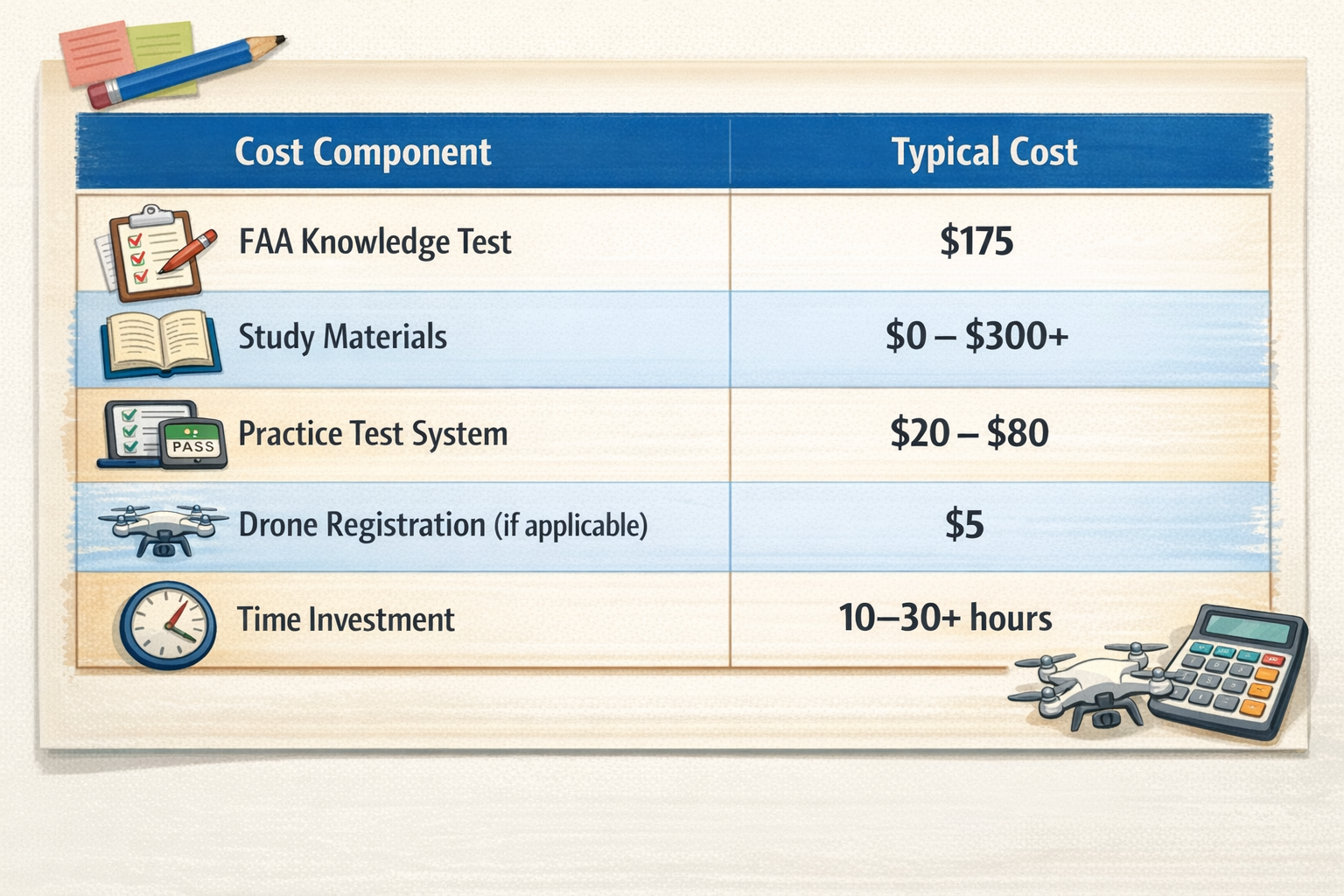
Cost Breakdown of Part 107 Test Prep
A realistic total falls between $175 and $400 or more, plus your time.
Reduce Your Part 107 Prep Cost
The FAA exam fee is only one part of the cost. The bigger risk is spending too much time studying inefficiently — or paying to retake the test if you are not ready.
Our Part 107 Practice Test & Study System helps you prepare more efficiently with realistic timed exams, 300+ FAA-style questions, weak-area tracking, study guides, and an Exam Readiness Tracker that shows when you are consistently scoring at a safer test-ready level.
Use code SPRING26 coupon code to save $10 on full access.
Unlock Full Access & Save $10 Now
Required Cost: FAA Part 107 Knowledge Test
The only mandatory cost to obtain your Part 107 license is the FAA knowledge test.
Cost: $175
Location: PSI testing centers
Format: 65 multiple-choice questions
Passing score: 70 percent
This test must be taken in person, and there is no way to bypass this requirement.
👉 If you are just getting started and want a step-by-step overview of the process, refer to our full licensing guide below
How to Get Your FAA Part 107 License (Complete 2026 Guide)
Where Costs Actually Vary: How You Prepare
The biggest differences in both cost and time come down to how you choose to study.
Free Self-Study (No Cost, Highest Time Investment)
It is entirely possible to prepare for the exam using free resources such as:
FAA Remote Pilot Study Guide
FAA Test Supplement (charts and figures)
YouTube videos
Free quizzes and flashcards
This approach works for some people, but it comes with tradeoffs. There is no structured learning path, no feedback on weak areas, and no clear way to know when you are ready to take the test. As a result, it often becomes the most time-intensive option.
Many candidates underestimate how much they need to understand topics like weather, airspace, and sectional charts until they begin practicing.
Online Part 107 Courses (Higher Cost, Moderate to High Time Commitment)
Online courses are one of the most common paid preparation options.
They typically provide structured video lessons and a guided curriculum, which can be helpful for those who prefer a step-by-step approach. However, they also come with some limitations.
The cost is usually between $150 and $300 or more. The learning is largely passive, and completing the course requires consistent time investment over days or weeks. Many students start but struggle to maintain the pace needed to finish efficiently.
While these courses can provide a solid foundation, they do not always translate directly into test readiness.
👉 If you’re comparing formats, this breakdown is helpful:
FAA Part 107 Online Course vs In-Person: Which Actually Gets You Licensed?
In-Person Part 107 Training (Higher Cost, Faster Timeline)
In-person training offers a different approach, especially for those who want to move quickly and learn in a more interactive setting.
This format is often preferred by beginners, hands-on learners, and organizations training multiple team members. It allows for direct instruction, real-time questions, and a more focused learning environment.
It is particularly effective for professionals such as first responders, construction teams, inspectors, and others who need to become certified on a defined timeline.
The tradeoff is a higher upfront cost and the need to attend scheduled sessions, but it often reduces total study time significantly.
👉 Explore available options:
Drone Training Programs
Public Safety Drone Training
Practice-Based Test Preparation (Lower Cost, Most Efficient Use of Time)
An alternative approach focuses on active learning through practice.
Instead of primarily consuming content, this method emphasizes taking realistic practice exams, reviewing detailed explanations, identifying weak areas, and tracking performance over time.
This type of preparation is typically more efficient because it concentrates effort on the areas that need improvement, rather than re-covering material that is already understood.
For many aspiring drone pilots, this becomes the fastest path to building confidence and reaching test readiness.
If you want to keep prep costs low while still getting structured feedback, use code SPRING26 for $10 off full access to our Part 107 Practice Test & Study System.
You can start with the free practice test first, then upgrade when you are ready for full timed simulations, weak-area practice, score tracking, and study guides.
👉 Try a realistic practice test and see how you score:
Part 107 Practice Test & Study System
A More Efficient Study Approach
A practical strategy for many students combines free learning with targeted practice.
Start by using free FAA materials and free videos (YouTube) to understand the core concepts. Then transition to practice-based preparation to test knowledge, identify gaps, and simulate the actual exam.
This approach keeps costs low while significantly improving efficiency and reducing overall study time.
Cost and Time Comparison
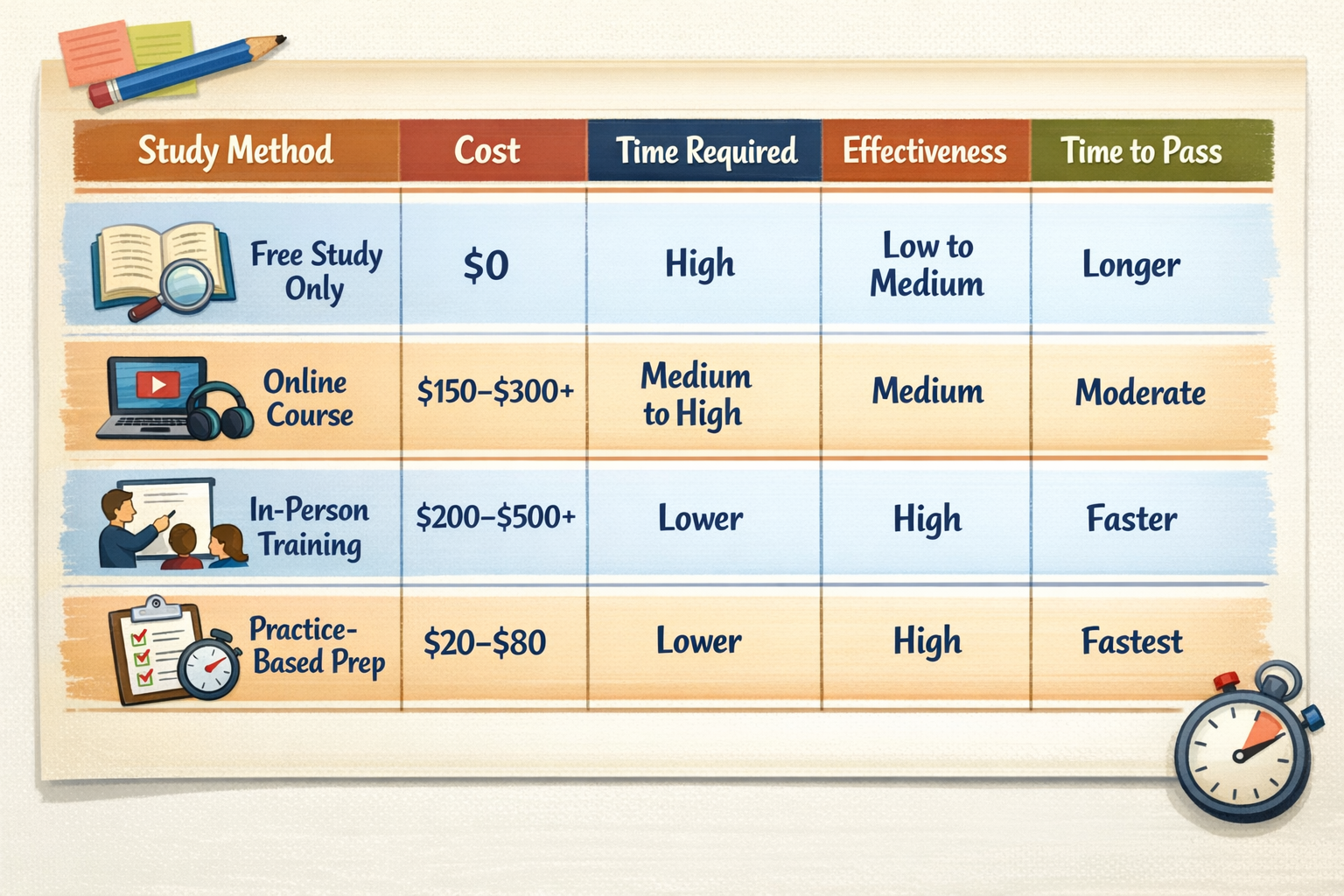
Part 107 Study Method Cost Comparison
For most people, time becomes the deciding factor. A lower-cost option that takes significantly longer may not actually be the most efficient path.
The Lowest-Cost Path Is Usually the One That Gets You Ready Faster
The FAA knowledge test costs real money, but your time matters too. Studying randomly for weeks, guessing when you are ready, or failing and having to retest can make the process more expensive than it needs to be.
Start with the free Part 107 practice test and see where you stand.
If you decide to continue, use code SPRING26 to save $10 on the full Part 107 Practice Test & Study System.
Who This Matters Most For
The importance of time and efficiency increases for those pursuing certification for professional use.
This includes:
media and content creators
construction and project management teams
surveyors and inspectors
agriculture and mapping professionals
marketing and production teams
public safety and first responders
In these cases, delaying certification can mean delayed revenue, missed opportunities, or slower project timelines.
How to Know You’re Ready
The FAA requires a score of 70 percent to pass. In practice, most instructors (us included) recommend consistently scoring in the 80 to 85 percent range on practice exams before scheduling the real test.
This provides a buffer for variations in question wording and difficulty, and it increases confidence on test day.
👉 You can test your readiness here - Free Demo Available:
Part 107 Practice Test & Study System
Additional Costs to Consider
There are a few smaller costs that may apply depending on your situation.
Drone registration is required for commercial use and costs $5. If you do not pass the test on your first attempt, retesting requires paying the $175 exam fee again.
These factors reinforce the importance of preparing efficiently and avoiding unnecessary delays.
How Long Is the License Valid?
The Part 107 certificate itself does not expire. However, pilots must complete recurrent training every 24 months to remain current.
This recurrent training is completed online and does not require paying for another in-person test.
What Should You Expect to Spend on Part 107 Test Prep and Exam?
At a minimum, you will spend $175 for the FAA test.
From there, the total depends on how you choose to prepare and how quickly you want to become certified.
A cost-conscious and efficient path often combines self-guided free materials with targeted practice, resulting in a total cost of roughly $200 to $250.
A more structured path, such as an online or in-person course, may bring the total closer to $300 to $500 or more.
Final Takeaway
The cost of getting a Part 107 license is not just about dollars. It is also about time.
The longer it takes to prepare and pass the test, the longer it takes to begin using your certification for work or business.
An efficient approach focuses on understanding key concepts, identifying weak areas, and confirming readiness before scheduling the exam.
Next Step
If you want to understand where you stand before booking your test, the most useful step is to take a realistic practice exam, review your performance, and identify the areas that need improvement.
👉 Start here:
Part 107 Practice Test & Study System
How to Get Your FAA Part 107 License (2026 Complete Guide)
If you want to fly a drone commercially in the United States, you need an FAA Part 107 license.
That includes real estate photography, construction progress, inspections, marketing videos, public safety operations, and any situation where money is involved, even if you are flying the drone to promote your business or your blog. The drone industry is all the buzz right now, as the opportunities are abundant - you can learn more about it in our blog post Careers in the Drone Industry.
We teach Part 107 prep in person in Cleveland, Ohio, to general public and train public safety agencies nationwide. After working with hundreds of students, we can tell you this clearly:
The Part 107 test is very passable. But it requires structured preparation.
Here is exactly how the FAA Part 107 test works and how to pass it the first time.
What Is the FAA Part 107 License?
The Part 107 Remote Pilot Certificate (aka drone license) is issued by the Federal Aviation Administration (FAA). It allows you to operate a drone for commercial purposes under 14 CFR Part 107 regulations.
There is no online version of the actual FAA exam. You must take the test in person at an approved PSI testing center.
Once you pass the knowledge test, you apply for your Remote Pilot Certificate through the FAA system.
Where Do You Schedule the FAA Part 107 Test?
The FAA Part 107 exam is a proctored, in-person test. That means it is supervised at an official testing center. You cannot take it at home.
All Part 107 knowledge tests are administered through PSI, the FAA’s approved testing provider.
To schedule your exam, you will:
Create an FAA Tracking Number (FTN) through the Integrated Airman Certification and Rating Application system (often referred to as IACRA).
Visit the PSI testing website.
Search for a testing center near you.
Select a date and pay the testing fee, which is typically around $175.
Testing centers are located throughout the United States, often inside small airports, aviation schools, or professional testing facilities.
If you are ready to schedule, you can find official testing locations and register directly through the PSI FAA Airman Knowledge Testing page.
It is important to schedule only after you are consistently scoring well on full-length practice exams. The exam fee is non-refundable, and rescheduling can delay your certification.
What Is on the Part 107 Test?
The FAA Part 107 test includes:
60 multiple choice questions
2 hours to complete the exam
A minimum passing score of 70 percent
The exam covers several core knowledge areas:
Airspace classification
Sectional charts, which are aviation maps that show controlled and uncontrolled airspace
Weather reports including METAR (Meteorological Aerodrome Report, which shows current airport weather conditions)
TAF (Terminal Aerodrome Forecast, which provides forecasted weather conditions)
FAA regulations
Airport operations
Loading and performance
Emergency procedures
Aeronautical Decision Making, often shortened to ADM
Many students find the airspace classifications and weather sections the most technical. You are expected to interpret real aviation charts and decode real weather reports, not just memorize definitions. The FAA states, "Unless you have been flying drones for some time or have previously taken the knowledge test, you will need to spend time studying for the exam”. Aviation knowledge isn't something most people use daily, so you face a steep learning curve.

Example of an aviation sectional chart you will have to learn to read and answer questions on
Is the Part 107 Test Hard?
Part 107 Test is similar to a private pilot aeronautical exam for manned aviation. The difficulty depends entirely on how you prepare, and if you have any prior aeronautical knowledge.
Students who struggle usually rely only on videos or passive reading without realistic practice tests. Others practice random questions without ever taking a full-length timed simulation.
The FAA exam does not just test knowledge. It tests your ability to apply regulations, interpret sectional charts, and decode weather reports under time pressure.
That is why studying these complex topics is important, and realistic practice exams matter. The mode you choose to study and practice is completely up to you, but each available method (self-study, online course or in-person) has different pros and cons, as well as the costs associated with it.
👉 For a full breakdown of study study options, read:
FAA Part 107 Online Course vs In-Person: Which Actually Gets You Licensed?
How Many Times Can You Take the Part 107 Test?
If you fail the Part 107 test, you must wait 14 days before retaking it.
Each attempt costs approximately $175 depending on your testing center.
Failing is not catastrophic, but it is expensive and frustrating. It can also affect confidence. The better approach is to confirm you are ready before scheduling your exam.
What Score Should You Aim for Before Booking the Exam?
The FAA requires 70 percent to pass. But 70 percent should not be your goal.
We recommend students consistently score at least 85 percent on full-length Part 107 practice exams before scheduling the real test. That number comes from real classroom experience. Students who score in the mid 80s or higher walk into the testing center calm and prepared. Students sitting around 70 percent often second guess themselves.
Seventy percent means you barely passed. Eighty five percent means you understand the material.
That is why we built the 85 percent benchmark directly into our Part 107 Practice Test system. The Exam Readiness Tracker monitors your full-length test scores and confirms when you are consistently performing at or above that level. Instead of guessing when you are ready, you have measurable proof.
Save $10 on Full Part 107 Practice Test Access
Before you spend around $175 on the real FAA exam, make sure you are actually ready.
Use code SPRING26 to save $10 off any plan on the full Part 107 Practice Test system, including timed exam simulations, 300+ FAA-style practice questions, weak-area tracking, study guides, and the Exam Readiness Tracker.
Start with the free 15-question demo, or use the coupon when you are ready to unlock the full system.
Unlock Full Access & Save $10 Now
There is a big difference in how confident you feel walking into a PSI testing center when you know your scores are consistently strong.
How Much Does It Cost to Get a Part 107 License?
Before you move forward, it’s important to understand the total cost involved.
At a minimum, you’ll need to pay for the FAA knowledge test: FAA Test Fee: approximately $175
Beyond that, your total cost depends on how you choose to prepare.
Some candidates spend nothing on study materials and rely entirely on free resources. Others invest in online courses or in-person training programs, which can range from $150 to $500 or more.
There is also a factor many people overlook: time.
If you are getting certified for professional use — whether in media, construction, inspections, or public safety — the time it takes to prepare can directly impact your ability to start working or take on new opportunities.
A more efficient study approach can reduce both cost and time to certification.
👉 For a full breakdown of all costs, study options, and the most efficient way to prepare, read:
How Much Does a Part 107 Drone License Cost? (Full Breakdown)
The Best Way to Study for the FAA Part 107 Test
After teaching individual students and public safety agencies, here is what works consistently:
Learn the material in structured categories.
Practice with realistic FAA style questions.
Take full 60 question timed exams.
Identify weak areas and focus study time there.
There are several well-known Part 107 online courses available, including Pilot Institute, Sporty’s, and King Schools. These programs are primarily video-based training courses that walk you through the required knowledge areas and typically include practice quizzes or sample tests.
For many students, a structured video course is a helpful starting point. If you are disciplined with self-study and comfortable learning independently, that format can work well. But not everyone learns best by watching videos alone.
Some students realize partway through self-study that they need more interaction, clearer explanations, or the ability to ask questions in real time. That is where in-person instruction can make a real difference. We run live Part 107 prep classes in Cleveland three to four times per year for students who prefer classroom learning and direct guidance through charts, weather interpretation, and regulations. If you want live instruction are willing to travel to Northeast Ohio, you can check our upcoming class dates .
Regardless of how you learn the material, there is still a separate skill that determines success on test day: performing under exam conditions.
That is why we built our Part 107 Practice Test system specifically around realistic simulation and performance improvement. Instead of just offering additional practice questions, the system identifies weak categories, builds focused practice sessions around those areas, and links directly to targeted study guides tied to the exact topics you are missing.
Students can:
Take realistic 60 question timed simulations that mirror the FAA format
Take advantage of 300+ randomized FAA-style questions in practice and in test mode
See category breakdowns to identify weak topics
Use a Focus on Weak Areas feature that automatically builds practice sessions around categories below 70 percent
Jump directly from missed questions into the relevant study material
View sectional charts and official FAA figures directly inside the testing interface
Track score trends over time and confirm consistent 85 percent readiness
The goal is not just to consume information. It is to practice in a way that measurably improves your score.
When students combine structured learning with focused exam simulation, their readiness becomes clear. And that clarity is what leads to confident performance at the testing center.
Try a Free 15 Question Part 107 Practice Test
If you are not ready to commit to a full practice exam, start with our free 15 question demo.
It works like a scaled-down version of the full simulator. You will experience FAA-style questions, view sectional charts and official FAA figures directly inside the test interface, and receive immediate explanations for each answer.
The demo allows you to:
Understand how Part 107 exam questions are structured
See how aviation charts are presented and interpreted
Get instant feedback on your performance
After finishing, you will see your score and topic breakdown.
If you decide to continue, the full system includes complete 65 question timed simulations, focused practice sessions built around weak categories, integrated study guides, and the Exam Readiness Tracker that confirms consistent 85 percent performance.
You do not need to commit immediately.
Start with the 15 question test drive.
See where you stand.
Then decide your next step.
👉 Try the Free 15 Question Part 107 Practice Test
For First Responders and Agencies
Departments training multiple drone pilots need more than just exam prep.
They often require structured classroom instruction, clear regulatory understanding, scenario-based discussion, and operational readiness guidance.
We provide nationwide Public Safety Agencies group instruction for Part 107 certification, DFR & Shielded Ops program consultation & documentation help, as well as basic and advanced scenario-based first responder drone training and program development support.
If you are coordinating drone training for a department, contact us directly to discuss group training options.
Final Advice Before You Schedule Your FAA Part 107 Test
Do not schedule your exam based on how confident you feel.
Schedule it when:
You can complete 60 questions comfortably within two hours.
You consistently score above 85 percent on full-length practice exams.
You understand why answers are correct, not just which ones are correct.
That is when you are actually ready.
And if you are unsure where you stand today, start with the free 15 question demo and measure your readiness before you spend money on the real exam.
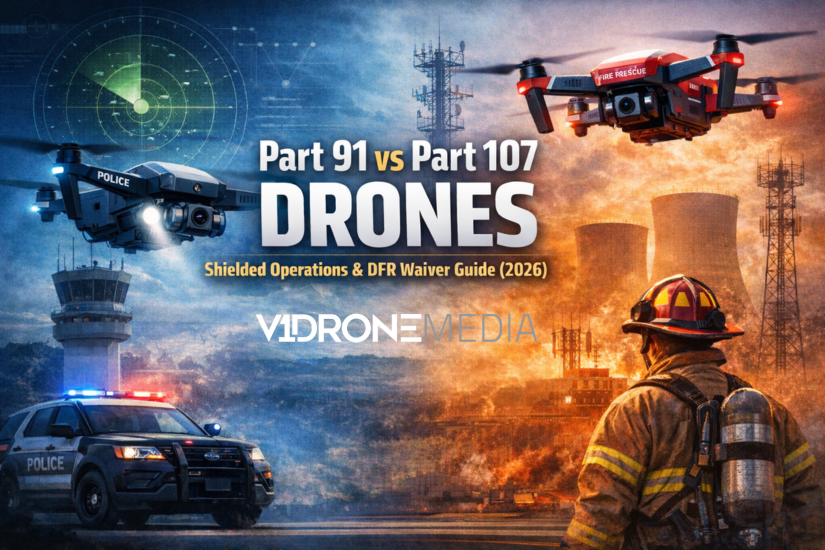
Part 91 COW vs. Part 107 for Public Safety Drones
Updated February 2026
This post replaces our June 2025 article “COA vs. Part 107: Which Path Is Best for Police and Fire Drone Operations?” to reflect major FAA regulatory changes.
How to Choose the Right Path for a DFR Program (2026 Guide)
If you're looking into launching a Drone as First Responder (DFR) program—or expanding one—you’re stepping into a regulatory landscape that has changed quickly.
Not long ago, public safety drone operations were built around two main paths:
Part 91 (Public Aircraft Operations), typically using the COA (Certificate of Authorization) framework
Part 107, where agencies could apply for waivers to expand beyond standard limitations
Both paths worked—but neither was simple when it came to scaling DFR.
If you wanted to fly beyond visual line of sight (BVLOS):
Under Part 91, you typically needed a COA with significant coordination and documentation
Under Part 107, you had to stack multiple waivers, often with long approval timelines
In most cases, approvals could take 6–10+ months, and operational flexibility was limited.
That system has now been replaced.
The FAA has shifted to a Certificate of Waiver (COW) framework, designed specifically to streamline public safety drone operations.
What that means in practice:
Approvals now often take weeks instead of months
Some DFR waivers are being approved in days—or even hours
Many operations no longer require visual observers
Agencies are scaling DFR programs much faster
👉 Bottom line:
DFR is no longer experimental—it’s operational.
Which brings us to the question most agencies are trying to answer now:
👉 Do we operate under Part 91 or Part 107—and which one is right for us?
The Two Paths (Without the Jargon)
At a high level, every public safety drone program falls into one of these two frameworks:
Part 107 (Where Most Agencies Start)
This is the most common entry point, especially for:
Volunteer fire departments
Nonprofits and search & rescue
EMS providers
Agencies working with contractors
You’re operating under FAA rules as a civil drone operator with a waiver.
In practice:
Pilots must hold a Part 107 certificate
You apply for a waiver (typically Shielded Operations for DFR)
It’s the fastest and most accessible way to launch
👉 If you’re just getting started, this is usually the path.
➡️ Learn more: How to get your Part 107 license
Do DFR pilots need a Part 107 certificate?
If you're operating under Part 107, yes—it’s required.
Under Part 91, technically no. But most agencies still require it anyway.
Why?
Because it:
Creates a standardized knowledge baseline
Reduces liability exposure
Makes your program more defensible
Part 91 (Public Aircraft Operations)
This is typically available to:
Police departments
Sheriff’s offices
Government agencies
Here, you’re operating as a public aircraft operator, which gives you more flexibility—but also shifts more responsibility to your agency.
Key difference:
The FAA does not require Part 107 certification
Your agency defines training, standards, and oversight
👉 More flexibility—but also more accountability.
Do volunteer fire departments qualify for Part 91?
In most cases, no.
Volunteer departments, nonprofits, and private EMS providers usually do not meet the federal definition of a public aircraft operator.
That means they operate under Part 107 instead.
Quick Reality Check
Not a government entity? → You’re almost certainly operating under Part 107
Government agency? → You may qualify for Part 91, depending on structure
Getting this classification right early is critical.
Where Advanced DFR Programs Fit: Shielded Operations
Most DFR programs today want to be structured around Shielded Operations.
That simply means:
Flying low (typically ≤200 ft)
Using buildings and terrain as natural separation from aircraft
The drone is being operated Beyond Visual Line of Sight (BVLOS)
This model is what makes DFR scalable:
Safer operations
Faster approvals
Lower equipment costs
👉 For most agencies, this is the practical starting point.
➡️ Read more:What are Shielded Operations?
Do we need a waiver to run a DFR program?
Yes.
DFR programs rely on BVLOS (Beyond Visual Line of Sight) operations—and those require a waiver under current FAA rules.
Does a waiver mean we can fly anywhere?
No.
A waiver allows how you operate—not where.
You may still need additional airspace authorization, especially near airports or controlled airspace.
Part 91 vs. Part 107 — What Actually Matters
Instead of getting buried in regulations, here’s what matters operationally:
Pilot Requirements
Part 107 → FAA-certified pilots required
Part 91 → Agency-defined training
Operational Flexibility
Part 107 → More structured
Part 91 → More flexible
Liability
Part 107 → FAA sets the standard
Part 91 → Your agency defines (and defends) the standard
That flexibility is powerful, but it also creates responsibility. Under Part 91, the agency is not just operating a drone program — it is building an aviation operation with its own training standards, SOPs, documentation, risk management, crew coordination, and recurrent proficiency expectations. Jason Damman, V1DroneMedia’s Chief Pilot who is also a former airline pilot, expands on this in his Police1 article, How an aviation mindset can strengthen Drone as First Responder programs, which explains why DFR and Shielded Operations programs need aviation-level structure before they scale.
👉 This is one of the biggest strategic differences between the two paths. However since there is no written standard, the agency needs to document and implement these standards. We now offer DFR Implementation Support for any first responder agency in the US to help you customize and define the operational standards.
Is DFR considered surveillance?
No—and it’s important to be clear about that.
DFR programs are designed for:
Emergency response
Real-time situational awareness
Officer and community safety
They are not intended for general surveillance.
That said, state laws still apply.
For example, in Ohio:
👉 House Bill 77 requires law enforcement to obtain a warrant for most drone-based surveillance activities.
➡️ Read more here: Ohio New Drone Law HB 77
What equipment is required for DFR and Shielded Operations?
At a high level:
Remote ID compliant aircraft
Anti-collision lighting
ADS-B detection capability
Reliable communications
Your exact setup depends on your waiver and program scale.
Where Most Agencies Should Start
For most departments, the best path is:
👉 Start with Part 107 → expand into Part 91 (if eligible)
How long does it take to launch a DFR program?
A realistic timeline:
Planning: 30–60 days
Waiver: a few weeks to a few months
Training + deployment: 30–90 days
👉 Most agencies can be operational in 2–4 months.
The Most Common Mistake
It’s not technical—it’s strategic.
👉 Agencies choose the wrong regulatory path at the beginning.
How do we know if DFR will work for our agency?
You need to evaluate:
Regulatory eligibility
Airspace complexity
Call volume
Staffing
Budget
👉 This is exactly what a DFR readiness assessment is designed to answer.
➡️ Start here: Request DFR Implementation Support
Final Takeaway
There isn’t one “best” path—only the right one for your agency.
Part 107 → fastest way to launch
Part 91 → expanded capability (if eligible)
The agencies that succeed with DFR:
Make the right decision early
Build training and policies correctly
Scale intentionally
🚀 Ready to Build Your DFR Program?
We help agencies:
Determine Part 91 vs Part 107 eligibility
Prepare waiver applications
Design scalable DFR programs
Train pilots for real-world operations
👉 Request a DFR Implementation Consultation
👉Explore Public Safety Drone Training Basic and Advanced Courses (Part 107, Hads-On Drone Operations, Search & Rescue, Tactical Operations)
Need Help Getting Trained?
Additional Public Safety Resources: :
Advanced Public Safety Drone Training: Search & Rescue and Tactical Drone Operations
For a deeper look at why waiver approval is only the beginning, read our Chief Pilot’s Police1 article, How an aviation mindset can strengthen Drone as First Responder programs. The article explains why DFR and Shielded Operations programs need structured training, SOPs, crew coordination, risk management, and recurrent proficiency before they scale.
Our instructors combine aviation and real-world police operational expertise
👉 Request Drone Training Consultation
👉 Subscribe to our First Responder Newsletter
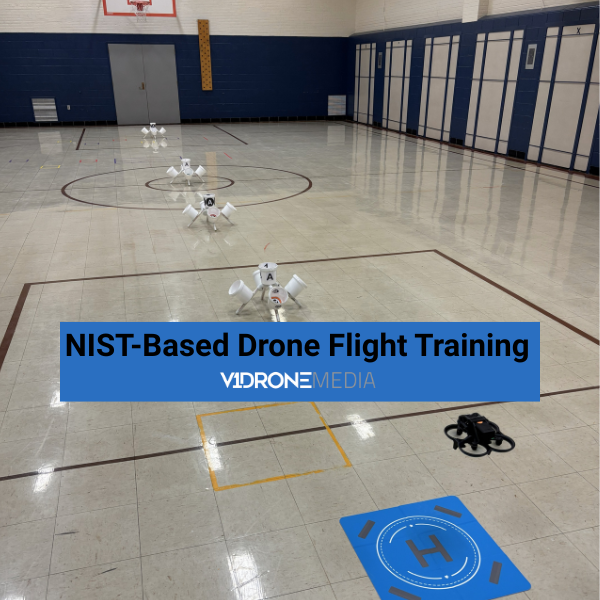
NIST-Based Drone Flight Training for Police & Public Safety
Why Professional Drone Programs Require Standards-Based Flight Training
Professional drone programs are expected to perform safely, consistently, and under pressure. Whether the mission involves search and rescue, scene documentation, tactical overwatch, or operational support, there is little margin for error when aircraft are deployed in real-world conditions.
One of the most common misconceptions in drone operations is that flight proficiency is permanent once certification is achieved. In reality, flight skills are perishable. Without structured practice and evaluation, even experienced pilots can see skill decay over time. That is why professional aviation — and increasingly professional drone programs — rely on initial and ongoing, standards-based flight training.
This is where NIST-based flight training plays a critical role.
What Is the NIST Drone Flight Training Course?
The NIST (National Institute of Standards and Technology) is an independent federal organization known for developing objective, repeatable standards across technical and operational domains. In the drone space, NIST has developed standardized flight courses designed to evaluate pilot proficiency through clearly defined tasks and measurable outcomes.
The NIST drone flight course is not a certification and it is not academic theory. It is a task-based, hands-on flight skills framework focused on how well a pilot can control an aircraft, maintain situational awareness, and execute precise maneuvers under defined conditions.
Because the course is standardized and repeatable, it allows organizations to evaluate flight performance objectively — something that resonates strongly with police departments, public safety agencies, and operational teams that need defensible training standards.
Borrowed Directly from Airline Recurrent Training Culture
The philosophy behind our drone flight training at V1DroneMedia is borrowed directly from airline recurrent training culture.
The owner and lead instructor of V1DroneMedia is a professionally trained airline pilot with more than 20 years of experience in airline operations (read Jason Damman’s story here). In that world, training does not end once a pilot is hired or certified. Airline pilots undergo mandatory recurrent training once or twice per year to maintain proficiency, reinforce safety standards, and integrate new knowledge.
Recurrent training in aviation includes:
Continuous evaluation of flight skills
Reinforcement of standard operating procedures
Incorporation of FAA guidance and regulatory updates
Lessons learned from accidents and incidents across the industry
This culture exists for one reason: repeatable performance and accident avoidance depend on structured, ongoing training. Pilots are trained not just to know what to do, but to develop automatic responses that hold up under stress.
That same philosophy translates directly to professional drone operations. NIST-based flight training helps agencies move beyond “the pilot has a certificate” and toward measurable proficiency. That distinction matters as agencies move into DFR, Shielded Operations, tactical response, and BVLOS use cases. In his Police1 article on aviation-minded DFR programs, Jason Damman explains why certification is only the starting point and why recurrent training, scenario-based evaluation, SOPs, and abnormal procedure practice are essential for public safety drone teams.
Training Flight “Muscles” and Automatic Responses
In aviation, pilots often talk about training their “flight muscles.” This refers to muscle memory, coordination, and instinctive control inputs that allow pilots to respond correctly without hesitation.
Under stress, cognitive bandwidth is limited. The more a pilot has to consciously think about basic aircraft control, the greater the risk of errors. Structured flight training builds automatic responses that reduce workload and improve safety when conditions are less than ideal.
For airline pilots, this training happens in simulators. For drone pilots, structured and repeatable flight courses like the NIST framework serve the same purpose.
Why This Model Applies Directly to Drone Operations
Many drone programs — particularly in policing and public safety — do not fly every day. Flights may be intermittent, mission-driven, and time-sensitive. When a call comes in, there is rarely time for a warm-up or refresher.
Without structured training, this creates risk:
Skill decay from infrequent flying
Overconfidence in basic maneuvers
Slower or incorrect responses under pressure
Structured flight training matters especially when pilots don’t fly every day — because missions don’t wait for skills to come back.
NIST-Based Drone Flight Training for Learning and Refresher Training
One of the strengths of the NIST flight course is that it works equally well for pilots learning professional flight skills and for experienced pilots who need refresher training.
For newer pilots, the course provides structured flight training beyond hobby-level flying. It introduces professional expectations around precision, control, and consistency in a way that builds a strong foundation for operational use.
For experienced pilots, the same course functions as a refresher. It reinforces fundamentals, identifies bad habits that can develop over time, and restores confidence before real-world missions.
In our classes, we regularly train mixed experience levels together. When group sizes allow, we adjust instruction in real time — breaking into smaller groups when needed — to ensure each pilot is challenged appropriately while still benefiting from a shared training standard.
This approach helps organizations build consistency across their teams rather than relying on individual flying styles.
How NIST-Based Training Improves Flight Skills
Precision and Aircraft Control
Pilots develop tighter control through defined maneuvers that emphasize smooth inputs, controlled altitude changes, and precise lateral movement — skills that directly translate to operational environments.
Situational Awareness
The course reinforces orientation management, aircraft positioning, and multi-axis control while performing tasks, helping pilots maintain awareness beyond simply keeping the drone airborne.
Consistency and Measurable Improvement
Because the course layout is standardized, pilots can repeat the same tasks over time and objectively see improvement. This removes guesswork from training and provides clear feedback for both pilots and leadership.
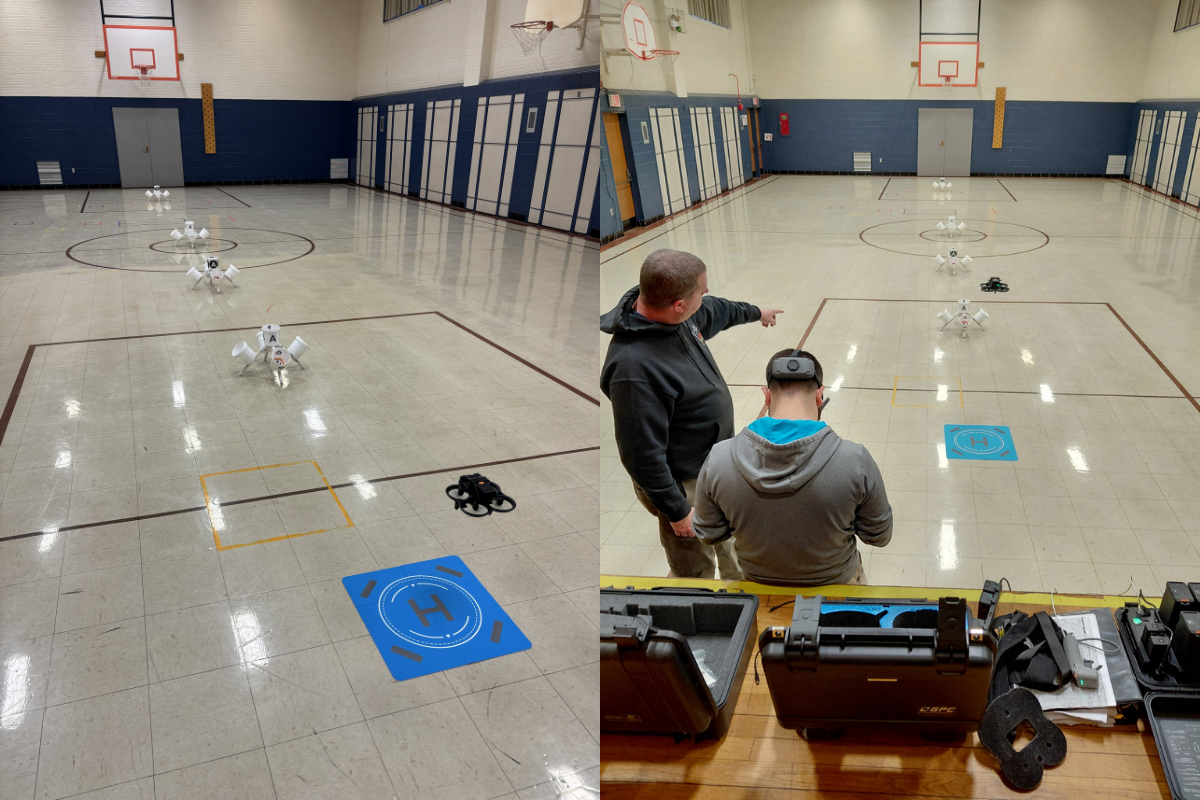
Public safety drone pilots flying standardized NIST flight course
How We Integrate NIST Training into Our 2-Day Drone Operations & Flight Training Class
NIST-based flight exercises are a core component of our Drone Operations & Flight Training (2-day class). The course balances operational context, safety considerations, and hands-on flight proficiency to ensure training is practical and applicable.
Pilots receive instructor-guided feedback throughout the course, with progressive skill building that mirrors real-world operational demands. The emphasis is on standards, repetition, and readiness — the same principles that underpin airline recurrent training.
This approach ensures pilots leave not only with improved skills, but with a clear understanding of what professional flight performance looks like.
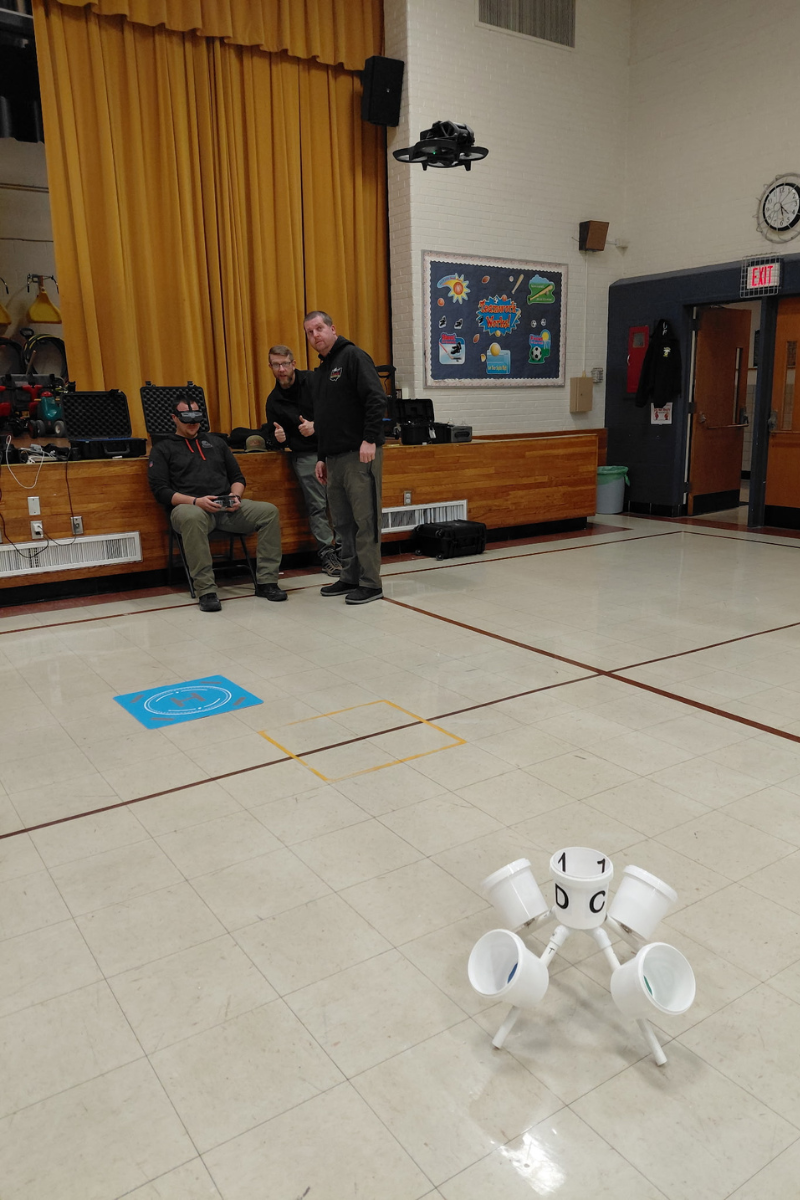
Police officers completing NIST-based drone flight training course
Building Mission-Ready Drone Programs Through Ongoing Training
For command staff and program managers, structured flight training is more than a technical exercise. It is a leadership decision that directly impacts safety, performance, and program credibility.
NIST-based training provides a defensible framework for both learning and refresher training, helping organizations maintain high standards over time rather than relying on ad-hoc flying.
Mission-ready drone programs are built through intentional, ongoing training — not last-minute preparation.
Related Resources for Public Safety UAS Leaders
DFR and Shielded Operations increase both capability and risk. Read Jason Damman’s Police1 article on why agencies should build aviation-level training, SOPs, risk management, crew coordination, and recurrent proficiency before scaling advanced drone operations.
If your organization is looking to strengthen flight proficiency, reinforce safety standards, or implement structured refresher training, we invite you to learn more about our Drone Operations & Flight Training (2-day class) or Request a Consultation to discuss your training needs.