

Drone as a First Responder: How Drones Are Changing Emergency Response
At a Glance
Drone‑as‑a‑First‑Responder (DFR) programs are reshaping public safety. By pre‑positioning drones at launch sites and dispatching them automatically after a 911 call, agencies can arrive on scene in minutes with real‑time video. The technology promises faster response times, improved situational awareness, greater officer and public safety, and lower operating costs than helicopters. Ohio cities like Cincinnati and Dublin are proving DFR works. As the FAA prepares to normalize BVLOS operations through Part 108, now is the time for agencies, businesses and organizations to understand the investment, regulatory and community considerations associated with starting a DFR program. This post dives into the mechanics, benefits, costs and future outlook of DFR.
Introduction
A drone‑as‑a‑first‑responder (DFR) program takes the idea of using drones for public safety to the next level. Instead of dispatching a small uncrewed aircraft system (UAS) only when a human operator arrives on scene, DFR programs pre‑position drones at launch stations across a city and deploy them automatically or remotely as soon as a 911 call is received. These drones travel to the incident in minutes and livestream video back to dispatch, giving officers or firefighters en route crucial intelligence about what is happening. DFR programs remain new, but departments in Ohio and across the United States are proving that this model can improve response times, increase safety and reduce costs.
This post explains how a DFR system works, outlines the benefits driving adoption, highlights examples from Ohio, and considers what the trend means for first responders, small businesses and organizations with in‑house drone programs.
What Is a Drone‑as‑a‑First‑Responder Program?
A DFR system consists of pre‑positioned drones, launch stations and integrated software that connects to existing 911 or computer‑aided dispatch (CAD) systems. When a call comes in, a remote pilot (or an autonomous system) launches the nearest drone and sends it directly to the coordinates of the incident. The drone’s onboard cameras – typically high‑resolution optical and infrared sensors – stream video back to incident command, allowing personnel to assess conditions before ground units arrive. Many DFR systems use rooftop docks that protect the aircraft from weather and keep batteries charged so the drones are always ready to fly. Sense‑and‑avoid sensors such as ADS‑B receivers or radar help the drone detect other aircraft and navigate safely, while geofencing software keeps the drone within approved boundaries.
Because the drone is deployed immediately, it often arrives within minutes of the call – sometimes before any human responder. In the Chula Vista Police Department’s pioneering DFR program, drones reached the scene in under 2.5 minutes on over 4,000 calls, and more than 1,000 deployments showed that no officer needed to be dispatched because the drone footage indicated the situation did not warrant a physical response. This model is still relatively new because it requires operations beyond visual line of sight (BVLOS), over people and at night – activities prohibited under the FAA’s standard Part 107 rules. Agencies must obtain a Certificate of Authorization or BVLOS waivers, and they need to demonstrate rigorous safety procedures and pilot training.
Why Departments Are Adopting DFR
DFR programs appeal to public safety agencies because they deliver tangible benefits:
1. Rapid response times. Drones can be dispatched within seconds and often arrive before ground units, enabling responders to make critical decisions faster.
2. Enhanced situational awareness. High‑resolution cameras and sensors provide real‑time aerial views so dispatchers and officers can see the layout of the scene, track suspects or locate victims.
3. Increased safety for officers and the public. Because drones act as a first set of eyes, officers can assess threats from a safe distance and even decide not to engage when a response is unnecessary.
4. Cost‑effective operations. Drones can cover large areas quickly, reducing the manpower needed for search operations, and their operating costs are much lower than crewed aircraft like helicopters.
5. Versatile functionality. Modern drones can carry infrared cameras, thermal sensors, two‑way communications, and even spotlight or loudspeaker systems, making them useful for search‑and‑rescue, firefighting, surveillance and negotiation scenarios.
6. Improved data collection and documentation. Recorded video streams are valuable for investigation, training and refining response strategies.
Examples from Ohio
Ohio has emerged as a leader in DFR adoption, with two cities piloting large‑scale programs in 2024–2025. These examples demonstrate how DFR can be tailored to local needs.
Cincinnati Police Department
In July 2024 the Cincinnati Police Department (CPD) launched a Drone‑as‑a‑First‑Responder program in partnership with Axon and Skydio. Police Chief Teresa Theetge described the technology as “game‑changing” and said it would allow the department to identify risks, respond faster and deploy resources more efficiently. CPD initially stationed drones in neighborhoods such as Price Hill, Over‑the‑Rhine, Queensgate, the West End, Downtown and the University of Cincinnati area, covering about 40 % of the city. By the end of 2025, the department plans to expand coverage to 90 %. Skydio executive Noreen Charlton called it the largest DFR deployment in the Midwest. CPD emphasizes that drones respond only to dispatched calls and are not used for random surveillance, addressing potential privacy concerns.
Dublin Police Department
Dublin, Ohio, implemented its own DFR program in 2024 using four DJI M30 drones housed in autonomous rooftop docks. The drones can be launched remotely by certified officers and reach an incident within 90 seconds, traveling up to 45 mph. Each drone carries infrared cameras and can stay aloft for 30–35 minutes. The program costs about $492,000 over three years and builds on Dublin’s initial drone program launched in 2019. Twenty‑two of the city’s 75 officers are currently certified pilots, and more are being trained. Dublin expects to deploy drones multiple times per day and may share them with neighboring jurisdictions. The program’s planners note that as drone technology and regulatory approvals mature, municipal DFR programs are becoming more practical and are no longer seen as experimental. Watch video below for more details on their program.
Implications for Different Entities
First Responders
For police, fire and EMS agencies, DFR offers a way to boost effectiveness without adding more personnel. Rapid aerial intelligence can help incident commanders allocate resources wisely, reduce officer exposure to dangerous situations and potentially de‑escalate encounters by giving officers a clearer picture of what awaits them. DFR footage can also document scenes for investigations or training purposes, aiding transparency and accountability. Departments considering DFR must invest in training, safety protocols and community engagement, and they should plan for FAA approval of BVLOS operations.
Faster response is only one part of a successful DFR program. Agencies also need the operational structure to support that speed: trained personnel, written SOPs, risk assessment, communications procedures, abnormal/emergency procedures, and recurrent proficiency. Jason Damman, V1DroneMedia’s Chief Pilot and an airline pilot with over 20 years of flight experience discusses this aviation-based approach in his Police1 article on strengthening Drone as First Responder programs.
NEW: Ohio Launches New Statewide Drone-as-a-First-Responder Pilot Program (2025–2027)
Ohio recently became the first state in the country to launch a state-supported Drone-as-a-First-Responder (DFR) Pilot Program, created under HB 96 and administered by ODOT’s DriveOhio UAS Center. The program will provide selected police, fire, EMS, and sheriff agencies with a fully reimbursed, turnkey DFR capability, including a Drone-in-a-Box system (an automated station for drone housing, launch, landing, and charging), NDAA-compliant aircraft, software, DFR training, FAA support, and standardized operational templates.
Selected agencies will participate in a two-year evaluation to measure how rapid aerial response improves situational awareness, response times, and safety outcomes across urban, suburban, and rural regions.
The application window for the first cohort closed on November 26, 2025.
Small Business Owners
DFR programs create opportunities and challenges for small businesses. On the supply side, drone service providers can partner with local governments to set up launch docks, maintain fleets, operate flights or process data. Companies that specialize in inspection, security or event management can adopt similar rapid‑response models for private clients, using drones to monitor property, infrastructure or large venues. On the demand side, small businesses may benefit indirectly when police and fire departments use DFR to improve public safety and reduce property damage. Entrepreneurs should keep abreast of local privacy policies and procurement rules, especially in states that restrict the purchase of drones from certain foreign manufacturers.
Organizations with In‑House Drone Departments
Corporations, utilities and large institutions often maintain their own drone programs for inspections, security and logistics. The DFR model illustrates how remote operations and autonomy can increase efficiency: by pre‑positioning drones at strategic points, organizations can respond to alarms or hazards without sending personnel, reducing downtime and exposure to risk. Integrating drones with existing incident management software and automating launch and return cycles can streamline operations. However, organizations must evaluate whether the increased investment in docking stations, sensing technology and regulatory compliance is justified by their operational needs.
Considerations and Challenges
While DFR programs offer many benefits, agencies must navigate regulatory and practical hurdles. BVLOS operations, flights over people and night operations require FAA waivers and rigorous safety cases. Public trust and privacy are essential; the Department of Homeland Security suggests publishing flight logs and encrypting data to address privacy concerns. Agencies must also budget for hardware, maintenance, training and compliance costs. Additionally, the National Defense Authorization Act of 2024 restricts federal funding for drones made with components from certain foreign entities, which may influence equipment choices. One common mistake is treating DFR as a technology upgrade instead of an operational shift. A waiver may authorize the operation, but it does not automatically create the training program, SOPs, crew coordination model, safety culture, or recurrent proficiency system needed to run it well. For more on that distinction, read Jason Damman’s Police1 article on why DFR programs need an aviation mindset.
Part 91, Part 108 and the Future of BVLOS
As of late 2025 and now effective in 2026 FAA has released new regulatory standard for public safety programs - Certificate of Waiver under Part 91, which replaces Certificate of Authorization, and comes with built-in Beyond Visual Line of Sight operational capability once approved and the law enforcement pilots are trained. Learn more about Part 91 COW operations and application process in our blog post Part 91 COW vs. Part 107: Understanding the New Regulatory Standard for Police and Fire Drone Programs
In spring 2025 the FAA released draft rules for a new Part 108 that will normalize routine BVLOS operations for highly automated drones beyond first responder programs. The Notice of Proposed Rulemaking states that Part 108 will cover operating rules for BVLOS flights of highly automated drone systems—including aircraft over 55 pounds—and set requirements for the design and manufacture of BVLOS‑capable drones. The proposed rules introduce several important changes:
Operator certification. Organizations wanting to fly BVLOS at scale will need to become Certified Operators and document their safety management systems, roles and procedures.
No new pilot certificate. Instead of requiring a new license, Part 108 creates operational roles such as Operations Supervisor and Flight Coordinator; qualified personnel must be trained by their organization[.
Drones must declare compliance. Unlike the waiver process under Part 107 and Part 91, Part 108 requires drones to have a “declaration of compliance” demonstrating they meet technical safety standards for automated BVLOS flight.
Right‑of‑way in shielded areas and multi‑drone operations. Under Part 108, drones operating in shielded areas near fixed infrastructure have right‑of‑way over manned aircraft, while operators must use Electronic Conspicuity (EC) to detect aircraft outside shielded areas. The rules also explicitly allow one operator to manage a fleet of highly automated drones, enabling larger area coverage and opening the door to continuous DFR patrols.
The proposed rules include a 60‑day public comment period, after which the FAA will finalize the rule, with an executive order targeting a March 2026 completion. During this transition, existing Part 107/Part 91 waivers remain valid. For public safety agencies, Part 108 could streamline DFR programs to scale up rapidly. However, the requirement for highly automated, compliant drones means agencies must evaluate whether their current equipment will qualify or whether upgrades are needed. DFR programs that invest now in automated platforms and robust safety documentation will be well positioned to transition to Part 108 when it becomes law.
Costs and Resources
Hardware, software and staffing
Implementing a DFR program requires significant up‑front investment in drones, docking stations and software. MITRE’s analysis of the Chula Vista program found that each drone—including high‑resolution cameras, sensors and software—costs about $35,000 and that staffing remote pilots at four launch locations costs about $400,000 per year. These expenses provide 98 % coverage of the city’s 52 square miles. Dublin, Ohio’s program illustrates a mid‑size investment: four drones, docks and support infrastructure cost roughly $492,000 over three years.
Commercial providers offer packaged solutions with leasing options. For example, a DFR bundle including a drone dock, sensor payload and service plan can cost $16,599, while annual software subscriptions like DroneSense may be $8,970. Agencies can also lease hardware; a DJI Dock 2 may cost $20,000 and a ground‑based detect‑and‑avoid (DAA) system another $25,000, with software and regulatory costs around $10,000. Remote drone pilots can be hired on contract at about $60 per hour. Costs vary widely depending on the number of drones, sensors, launch sites and staffing model.
First Responder agencies must consider organization of their DFR programs, such as who controls and directs the automated drone release, monitors its video feed and coordinates operations with the officers on the scene. All of the program participants also have to be trained to utilize the hardware, understand program limitations, and conduct field communications.
Ongoing maintenance and other expenses
Running a DFR program also entails recurring costs: battery replacements, dock maintenance, software licensing, data storage and cybersecurity. Agencies must invest into pilot training and recurrent certifications, and may need to hire technical staff to integrate drone feeds with dispatch systems. The Department of Homeland Security notes that agencies must plan for equipment, infrastructure, maintenance and training costs as well as the expense of complying with regulations such as remote ID and NDAA purchase restrictions. Typical cost categories include purchasing drones and hardware, software licensing, personnel training, obtaining regulatory approvals, ongoing maintenance and operations, and community engagement and data management solutions.
Despite these costs, DFR remains cheaper than traditional air support. A single police helicopter can cost millions of dollars to purchase, and fuel costs alone can run hundreds of dollars per hour. DFR systems provide similar overwatch capability at a fraction of the price, delivering multiple perspectives by deploying several drones simultaneously.
V1Dronemedia provides assistance with every type of drone program setup for first responder agencies, including Shielded Operations & Drone as a First Responder regulatory training and program setup: program consultations, application for Certificate of Waiver under Part 91, operational drone training (FAA regulatory & hands-on pilot training), and hardware purchase assistance. Request a free consultation today. We also provide Part 107 Regulatory Training
Community and Stakeholder Considerations
Public acceptance and privacy
DFR programs will succeed only if the community accepts them. MITRE’s report notes that organizations like the ACLU and Electronic Frontier Foundation worry that drones could gradually expand from emergency response into routine surveillance. Past missteps—such as the Seattle Police Department’s aborted drone program following public protests—highlight the risk of launching without community support. Transparency is critical: publishing policies, procedures and flight logs and engaging the public before deployment. The DHS TechNote echoes this, advising agencies to encrypt data, comply with privacy frameworks like HIPAA and CJIS, and plan data retention policies carefully.
Facilities and partnerships
Launching a DFR program requires physical space for launch stations, often on rooftops of police stations, firehouses or community facilities. Agencies should coordinate with local governments and property owners to site docks strategically and ensure safe flight paths. Collaboration with fire departments and emergency medical services can broaden the benefits; MITRE notes that many police departments share drone livestreams with fire departments to improve coordination during fires or vehicle accidents. Partnerships with universities or technology vendors can provide expertise in software integration, data analytics and maintenance.
Stakeholder engagement
Stakeholders include elected officials, community leaders, civil liberties organizations, and the broader public. Agencies should hold informational sessions, demonstrate the technology, and solicit feedback to address concerns. Clear policies limiting drone use to dispatched calls—as Cincinnati and Chula Vista do—can help assuage fears of unwarranted surveillance. Agencies should also develop communications plans to explain how DFR can improve response times, protect officers and save money compared to helicopters.
Conclusion
Drone‑as‑a‑first‑responder programs are reshaping public safety by delivering rapid aerial intelligence to emergency responders. By stationing drones across a jurisdiction and integrating them with dispatch systems, agencies like Cincinnati and Dublin are improving response times, enhancing situational awareness and reducing risk to officers and the public. The model is still maturing, but advances in autonomy, sense‑and‑avoid technology and regulatory frameworks are making widespread adoption more feasible. Whether you’re a public safety official, a small‑business owner looking to leverage drone services, or an organization running an internal drone program, understanding the DFR concept will help you plan for the future of uncrewed aviation.
Currently most police departments operate their drone programs under Part 107 or COA, both of which require special BVLOS waivers to set up DFR programs or to fly Beyond Visual Line of Sight. As of 2026, if an agency is considering setting up their Drone as a First Responder program, they will have to apply for Certificate of Waiver (COW) under Part 91, which includes BVLOS operations. If an agency wants to fly Beyond Visual Line of Sight with Part 107 pilots, then they will need to apply for Shielded Operations Waiver. V1Dronemedia can assist with COW & Shielded Ops Waiver applications, as well as DFR program training and setup. Request a consultation about which drone program is right for you, and we will provide a clear path for your agency. Stay informed about regulatory and other drone industry changes that effect law enforcement by signing up for our Drone Newsletter for First Responders. Check out our Basic and Advanced Training Programs for First Responders, and DFR & Shielded Ops programs.

Police Drone Training: Key Skills and Certification Requirements
The rise of drone technology has sparked a revolution in law enforcement, leading to an increased demand in drone pilots at law enforcement agencies across the United States. Police departments all over the United States are integrating unmanned aerial systems (UAS) into their operations. This shift has created a need for comprehensive training programs that equip officers with the skills to operate drones effectively and safely in various scenarios, including crash scene reconstruction, search and rescue missions, and evidence collection.
Police drone operator training goes beyond basic flight skills. It encompasses a wide range of competencies, from mastering standard flight maneuvers and aerial imagery to understanding specialized applications like aerial photogrammetry an even thermal imaging. This article delves into the key skills and certification requirements for police drone pilots, exploring the essential components of UAS training courses.
What Training Do Police Drone Pilots Need?
Police drone pilots need more than basic drone flight skills. A well-prepared law enforcement UAS team should understand FAA operating requirements, develop hands-on flight proficiency, practice emergency procedures, and complete training specific to its missions.
For agencies operating under FAA Part 107, pilots must obtain a Remote Pilot Certificate. Eligible public agencies may also operate under a public aircraft framework with appropriate FAA authorization. Regardless of the regulatory pathway, departments should establish standard operating procedures, evaluate pilot proficiency, and provide recurrent training.
Depending on their missions, departments may also need specialized instruction in search and rescue, thermal imaging, tactical operations, or Drone as First Responder (DFR) programs.
Regulatory FAA Compliance for First Responder Agencies
The Federal Aviation Administration (FAA) has established specific regulations to ensure safe and legal drone operations for individuals and organizations. Complying with these requirements is crucial for law enforcement agencies that want to integrate unmanned aerial systems (UAS) into their operations.
Police departments and other public safety agencies can operate drones under FAA Part 107 or, when eligible, as public aircraft operators under a Certificate of Authorization (COA) or under a Certificate of Waiver. The appropriate operating framework depends on the agency's mission, aircraft, and operational requirements.
Certificate of Waiver (COW) has been introduced in addition to Certificate of Authorization (COA) in late 2025 to streamline the application process.
Part 107 – Remote Pilot Certification
The FAA’s Part 107 Certification (aka Drone License) serves as the foundational license for drone pilots working in commercial settings across various industries. To earn this certification, individuals must pass a knowledge test that evaluates their understanding of airspace classifications, aviation weather, drone operations, and safety procedures. Although originally intended for commercial use, many police and fire departments now use Part 107 as a practical framework for public safety missions.
FAA Authorization and Waiver Requirements for Police Drone Operations
COA - Certificate of Authorization (prior to 2026)
A Certificate of Authorization (COA) is an FAA approval that allowed public agencies—such as police and fire departments—to operate drones as public aircraft under Part 91 for official missions. However, a COA by itself does not authorize BVLOS (Beyond Visual Line of Sight) operations. Agencies that want to conduct BVLOS—fly a drone beyond visual line of sight during operations or for Drone as a First Responder (DFR) programs— have had to also obtain a specific Part 91 waiver (commonly known as Shielded Operations waiver) if they went the COA route for implementing their drone operations.
Obtaining a COA and any associated BVLOS waivers requires detailed planning, operational documentation, and coordination with legal counsel and the FAA. Because of the paperwork and compliance requirements, this path is typically more administratively involved than operating under Part 107. Some agencies started under Part 107 to launch quickly, then pursued a COA and BVLOS waiver later to expand into more advanced capabilities. However with the introduction of COW/Part 91 waiver, the application process for public agency drone operations with BVLOS authorization became a lot more streamlined.
COW - Certificate of Waiver (since late 2025)
The regulatory landscape for public safety drone operations is changing fast. When we first published this blog post COA (Certificate of Authorization) was the path for FAA operational approval outside of its Part 107 regulations. As of late 2025 and now in 2026, FAA has streamlined their processes to introduce new Certificate of Waiver (COW) framework. A Certificate of Waiver (COW) is the new FAA’s approval pathway that allows public safety agencies—such as police and fire departments—to conduct advanced drone operations, including Beyond Visual Line of Sight (BVLOS), under Part 91. The COW framework now exists in addition to the older, more time-intensive COA application process and is now processed through FAA Flight Standards rather than the Air Traffic Organization.
Under the new system, many BVLOS operations—including Drone as First Responder (DFR) missions—can be approved in as little as 1–2 weeks, with some DFR waivers granted the same day. Waiver validity has been extended to four years, visual observers are no longer required in many cases (when equipped with approved detection technology such as ADS-B In), and monthly reporting requirements have been eliminated.
Obtaining a COW still requires operational planning, documented safety procedures, and coordination with the FAA. However, the administrative paperwork burden is significantly reduced compared to the legacy COA framework. Agencies that previously delayed BVLOS implementation due to long processing times now have a faster, more scalable pathway to launch or expand DFR programs and other advanced public safety drone capabilities.
All paths (COA, COW and Part 107) are a legal way to comply with FAA regulatory requirements for first responder agencies, but they differ significantly in strategic advantages, and all have some limitations. V1DroneMedia helps public safety agencies understand their operational options and prepare their teams through Part 107 instruction, hands-on flight training, and specialized public safety drone training. Submit your department request for a regulatory consultation.
Here is a side by side comparison of the 3 approaches - Old COA vs. new COW vs. Part 107.
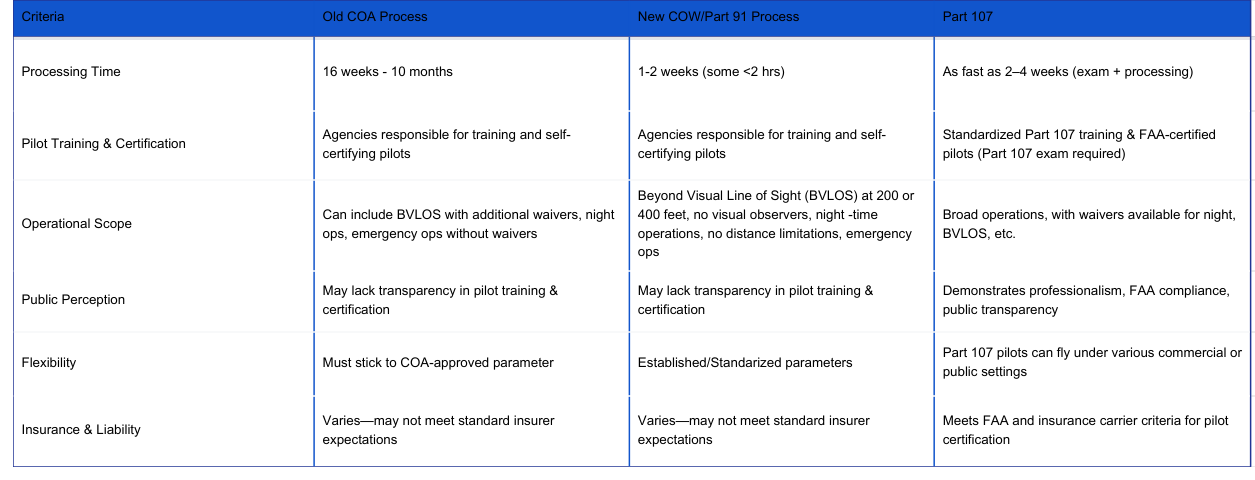
Side by Side Comparison of Old COA vs New COW vs Part 107 for First Responder Agencies
We recommend getting Part 107 Certification for drone pilots in your department first or in parallel with the Certificate of Waiver (COW). We recommend that path for many reasons, especially because Part 107 regulations are the established and acceptable FAA drone pilot training and operations standard regardless of whether you need the official certification or not, and not the last reason being that if an officer obtained their Part 107 Certification (aka Drone Pilot License), it is a professional certificate that upskills employees, boosts morale, stays with the individual if they choose to maintain it, and gives them opportunity to use their drone skills outside of work as a side or a retirement gig in the future, providing aerial videography and photography for real estate and other industries. For that reason we will only cover what it takes to get Part 107 Remote Pilot Certificate (Drone Pilot License) for first responder officers in this blog post.
Part 107 certification provides an important foundation, but passing the FAA knowledge test does not automatically make an officer mission-ready. Police drone teams also need hands-on proficiency, scenario-based training, standard operating procedures, emergency response drills, and recurrent evaluation.
Jason Damman, V1DroneMedia's Chief Pilot, brings experience as an airline captain and public safety drone instructor to this approach. In his Police1 article, How an Aviation Mindset Can Strengthen Drone as First Responder Programs, he explains why aviation safety practices, crew coordination, and operational discipline are essential to successful DFR programs.
Explore V1DroneMedia First Responder Drone Training Programs
Part 107 Remote Pilot License
This certification applies to drones weighing 0.55 pounds to 55 pounds used for commercial purposes, including law enforcement activities. To obtain this license, police officers must meet several criteria:
1. Be able to read, speak, write, and understand English
2. Be in a physical and mental condition to safely operate a drone
3. Pass the initial aeronautical knowledge exam, known as the "Unmanned Aircraft General – Small (UAG)" test, also known as Part 107 Test.
The Part 107 certification allows first responder drone operators to fly their UAS at daylight or at twilight and nighttime hours with anti-collision lighting. If your team needs to operate beyond standard rules (like over people), you can request specific waivers from the FAA using the FAA Drone Zone (online process).
Studying for the FAA Part 107 Exam
Preparing for the Part 107 exam is a crucial step in police drone training. The exam covers a wide range of topics, including:
1. Applicable regulations for small UAS operations
2. Airspace classification and operating requirements
3. Aviation weather sources and effects on small UAS performance
4. Small UAS loading and performance
5. Emergency procedures
6. Crew resource management
7. Radio communication procedures
8. Determining the performance of small UAS
9. Physiological effects of drugs and alcohol
10. Aeronautical decision-making and judgment
11. Airport operations
12. Maintenance and preflight inspection procedures
Many police departments allocate between 15 to 20 hours of study time for officers to prepare for the test. Various resources are available, including online test prep courses and free materials provided by the FAA. It's essential for police drone training programs to incorporate comprehensive study materials and practice tests to ensure officers are well-prepared for the exam.
If you are a police officer looking to get your Part 107 drone pilot license, you can take an online course or take our regularly scheduled 2-day in person Part 107 Prep class in the Cleveland, Ohio, area and get your Part 107 certificate shortly thereafter by taking a proctored Part 107 Test.
If you are looking for group Part 107 drone training for your department, and/or hands-on drone flight training for your group, explore our drone training options for law enforcement which we bring directly to departments nationwide.
To support our Part 107 trainees in mastering the FAA knowledge requirements, every enrolled student will now have access to V1DroneMedia Part 107 Test Program— an interactive study and exam simulation platform designed specifically to prepare public safety professionals for success. The system features 300+ FAA-style practice questions, realistic 65-question timed exam simulations, detailed answer explanations with regulation references, built-in FAA charts and figures, and 10 comprehensive study guides covering every knowledge area. With progress tracking, weak-area targeting, and an Exam Readiness Tracker that helps candidates confidently exceed the 70% passing standard, officers know exactly when they’re prepared for test day.
If you are a first responder who is studying on their own, use our practice system to prepare you for the exam day.
Start with the FREE PRACTICEST test, then upgrade to full access when you are ready.
Part 107 Practice Test & Study System Video Overview
Practical Flight Experience
While the FAA does not mandate a specific number of flight hours for Part 107 certification or drone operations training under COA/COW, practical flight experience is crucial for police drone operators who want to be effective at this task. Law enforcement agencies often incorporate hands-on training into their UAS programs to ensure officers can effectively operate drones in various scenarios.
Key aspects of practical flight training for police drone operators include:
· Mastering basic flight controls and maneuvers
· Understanding drone capabilities and limitations
· Practicing emergency procedures
· Conducting simulated missions relevant to law enforcement, such as search and rescue or crash scene reconstruction
· Familiarizing officers with specific drone models used by their department
· Practicing a variety of flight scenarios to get more familiar with the controls
It's worth noting that an individual can obtain an FAA Remote Pilot Certificate without ever having flown a drone. However, for police drone training programs, incorporating practical flight experience is essential to develop competent and confident operators. There is a variety of ways to assess the competency of police drone pilots which can be built-in to police drone training programs. V1DroneMedia also offers drone operations and flight training for groups as part of our Basic Drone Training curriculum fir First Responders that we bring on-site that includes testing the drone pilot flight proficiency. We use NIST based flight courses to develop operational flight skills.
To maintain their certification, police drone pilots must complete an online recurrent training course every 24 calendar months. This ongoing training helps ensure that officers stay up-to-date with the latest regulations and best practices in UAS operations.
By adhering to these FAA certification requirements and incorporating comprehensive training programs, law enforcement agencies can develop skilled and compliant drone operators, enhancing their capabilities in various police operations.
Essential Flight Skills for Law Enforcement UAS Operations
Law enforcement agencies integrating unmanned aerial systems (UAS) into their operations require officers to develop a specific set of skills to operate drones effectively and safely. These skills are crucial for various applications, including traffic collision reconstruction, and aerial surveillance, and search and rescue missions.
Basic Maneuvers and Controls
Mastering basic drone flight controls and maneuvers is fundamental for police drone operators. These skills include performing precise takeoffs and landings, maintaining a stable hover, and executing controlled movements in different directions. The National Institute of Standards and Technology (NIST) has developed standardized small UAS test methods (NIST Drone Flight Training Course) to evaluate essential flight skills. These exercises include ascending to specified heights, performing controlled yaw turns, and demonstrating forward, reverse, and lateral flight maneuvers.
Accurate aircraft control and maneuverability are critical to safe and effective law enforcement drone operations. Pilots must understand their drone's capabilities and limitations, maintain situational awareness, and respond confidently to changing conditions. Regular hands-on practice and proficiency evaluations help officers develop the skills needed for search and rescue, crime scene documentation, and other public safety missions.
Advanced Flight Techniques
As officers become more proficient, they must master advanced flight techniques to handle complex law enforcement operations. This includes skills such as:
· Aerial search tactics: Pilots should be adept at conducting efficient search patterns when looking for missing persons or suspects.
· Night operations: Operating drones in low-light conditions requires specialized skills and knowledge of thermal imaging technology.
· Precision flying: The ability to navigate through tight spaces and around obstacles is crucial for applications like building inspections or tactical operations
· Test obstacle flight courses should be used to practice and test the pilots (NIST has developed some standardized courses that we at V1DroneMedia constructed and use in training - learn more in our NIST Based Drone Flight Training blog post)
· Data collection: Officers must be proficient in using various payloads, such as to gather crucial information during missions using high-resolution cameras and thermal sensors
· Learn to operate FPV drones that allow law enforcement survey and clear indoors areas without putting police officers in the line of fire for Tactical Operations (such as SWAT teams, etc.)
Advanced training should also cover mission planning, deployment preparations, and the use of specialized equipment like thermography. Check our V1DroneMedia Advanced Drone Training courses: SAR (Search and Rescue) and Tactical Drone Operations Training that we bring on site to department nationwide.
Emergency Procedures
Preparing for and responding to emergencies is a critical aspect of police drone training. Officers must be well-versed in handling various scenarios that may arise during UAS operations. Some key emergency procedures include:
· Loss of signal: Pilots should know how to activate the Return-to-Home (RTH) function and maintain visual line of sight with the drone.
· Low battery situations: Understanding how to monitor battery levels and execute safe landings when power is running low is essential.
· Adverse weather conditions: Officers must be prepared to adjust flight plans or execute emergency landings in case of sudden changes in weather.
· GPS signal loss: Pilots should be able to switch to manual mode and safely land the drone when GPS navigation is compromised.
· Obstacle avoidance system failure: Knowing how to manually navigate around obstacles and prioritize safe landings is crucial.
Regular practice of simulated emergency scenarios in controlled environments can help build confidence and improve response times.
By focusing on these essential flight skills, law enforcement agencies can ensure their drone operators are well-prepared to handle the challenges of UAS operations in various policing scenarios. Continuous training and assessment using standardized methods like the NIST sUAS Test Methods can help agencies maintain high levels of proficiency and readiness among their drone pilots.
Specialized Police Drone Applications and Training
Drones have evolved to encompass a wide range of specialized applications, equipping officers with the skills to leverage unmanned aerial systems (UAS) in various law enforcement scenarios. These specialized applications require tailored training to ensure officers can effectively utilize drones in critical situations.
Crime Scene Documentation
One of the most significant advancements in law enforcement drone use is in crime scene documentation. Drones have revolutionized how police capture and preserve evidence at crime scenes. They provide a comprehensive aerial perspective that was previously difficult or impossible to obtain. With drones, officers can quickly create detailed 3D models and renderings of crime scenes, allowing investigators to revisit the scene virtually at any time.
The ability of drones to collect photos from various heights and angles ensures complete coverage of an area. This capability is particularly valuable in complex or large-scale crime scenes where traditional methods might miss crucial details. The speed at which drones can move and collect an uninterrupted stream of data is unparalleled compared to traditional human forensics.
Training for crime scene documentation using drones focuses on teaching officers how to:
1. Operate drones to capture high-resolution imagery
2. Use specialized software to create 3D models and orthomosaic images
3. Analyze data collected by drones, such as determining impact force between objects
4. Confirm the precise location of evidence items in the field
Search and Rescue Operations
Search and rescue missions have been transformed by the integration of drones into law enforcement operations. Drones equipped with thermal imaging cameras have become indispensable tools for locating missing persons and animals, especially in challenging terrains or low-visibility conditions.
The efficiency of drones in search and rescue operations is remarkable. They can quickly acquire aerial data over large areas, allowing rescuers to map entire search areas and pinpoint potential locations of missing individuals. Compared to ground vehicles, drones can reach locations faster and access areas that might be inaccessible by other means.
Training for search and rescue drone operations typically covers:
1. Operating thermal imaging cameras and interpreting heat signatures
2. Conducting efficient search patterns over various terrains
3. Integrating drone data with ground team operations
4. Using drones to guide rescuers through optimal routes
Check out our Search and Rescue Operations Class and Request a Consultation if you are interested in bringing it to your department!
Tactical Surveillance
Drones have become invaluable assets in tactical surveillance operations, offering law enforcement agencies enhanced capabilities in monitoring and responding to high-risk situations. The ability of drones to provide real-time aerial data for situational awareness has transformed how police approach these situations, effectively increasing police and public safety.
In monitoring large gatherings and events, drone surveillance provides a broader view of crowd dynamics and transmits real-time data to crowd control teams. This capability allows officers to zoom in on areas of interest and make critical decisions based on detailed information about ground-level activities.
Training for tactical surveillance with drones typically includes:
· Mastering stealth flight techniques to maintain discreet observation
· Operating advanced camera systems for high-quality video and image capture
· Integrating drone surveillance with other security systems
· Understanding legal and ethical considerations in drone-based surveillance
As police drone training continues to evolve, these specialized applications demonstrate the growing importance of UAS in modern law enforcement. By mastering these skills, officers can enhance their effectiveness in crime scene documentation, search and rescue operations, and tactical surveillance, ultimately improving public safety and operational efficiency.
Tactical Operations for SWAT
Tactical drone operations give SWAT teams a decisive edge in high-risk, dynamic environments by delivering precise, real-time aerial intelligence while keeping officers out of direct danger. When used correctly, small UAS become force-multipliers for entry planning, suspect containment, dynamic overwatch, and rapid assessment of evolving threats — all while minimizing risk to both officers and the public.
In close-quarters and barricade scenarios, tactical drones provide immediate overhead and oblique perspectives that reveal suspect locations, entry points, rooflines, and potential hazards (e.g., victims, weapons, booby traps). This information improves decision speed and accuracy for incident commanders, enabling safer approach routes and better-coordinated team movements.
Training for SWAT tactical drone operations typically includes:
· FPV and small UAS setup, safety, and fundamentals
· NIST drone course for precision flying – standardized exercises to refine control, consistency, and maneuverability under operational conditions
· Scenario-based simulations: live mission exercises inside structures with low-visibility, precision flight skills for confined and GPS-denied environments
· Structure clearing techniques with drones
· Suspect location and reconnaissance
· Situational awareness enhancement for tactical entry teams
As SWAT drone capabilities mature, these focused operational skills help teams reduce exposure to harm, speed up containment and de-escalation, and improve post-incident intelligence gathering. Well-trained tactical operators increase mission safety and effectiveness — whether supporting high-risk warrants, active-shooter responses, hostage rescues, or complex building clearances. Check our Tactical Drone Operations Class and contact us to schedule with your department!
Conclusion
Effective police drone programs combine FAA regulatory knowledge, practical flight proficiency, and mission-specific training. From search and rescue to tactical operations and DFR programs, departments need pilots who can operate safely and confidently under real-world conditions.
V1DroneMedia provides in-person Part 107 preparation, hands-on flight training, and specialized public safety drone instruction for police, fire, and other first responder agencies. We bring customized training to departments nationwide.
Planning or expanding your department's drone program? Explore our Public Safety Drone Training programs or request a consultation with V1DroneMedia to discuss training options for your team.
If you are an individual first responder that is looking to get their Part 107 certification or hands-on flight training in our Cleveland-area open-enrollment courses, check out our upcoming classes that are regularly scheduled in the Cleveland/Akron, Ohio, area.
FAQs
Should our police or fire department operate under a COA or Part 107?
Both FAA Part 107 and public aircraft operations under a Certificate of Authorization (COA), as well as Part 91 COW can provide regulatory pathways for eligible public safety agencies. The appropriate choice depends on the department's missions, operational requirements, and aircraft.
We generally recommend starting with Part 107 training because it provides a strong foundation in FAA regulations, airspace, weather, and safe drone operations. However, individual pilots operating exclusively under an eligible public aircraft COA are not necessarily required to hold a Part 107 Remote Pilot Certificate.
Departments should evaluate both options before deciding how to structure their drone programs. Read our detailed blog post Part 91 COW vs. Part 107 for Public Safety Drones.
What training is required to become an FAA-certified drone pilot?
To obtain an FAA Remote Pilot Certificate under Part 107, first-time applicants generally must be at least 16 years old, be able to read, speak, write, and understand English, be physically and mentally capable of safely operating a drone, and pass the FAA's Unmanned Aircraft General – Small (UAG) knowledge test.
Part 107 certification establishes regulatory knowledge, but police drone pilots should also complete hands-on flight training, emergency procedures, and mission-specific instruction before conducting operational flights.
Does V1DroneMedia provide on-site drone training for law enforcement departments?
Yes. V1DroneMedia provides customized, in-person drone training for police, fire, and other public safety agencies nationwide.
Our programs include FAA Part 107 preparation, hands-on flight operations, search and rescue, and tactical drone training. We can tailor instruction to an agency's experience level, equipment, and operational goals.
Contact us through our Class Consultation Form to discuss training for your department.
Is online or in-person training better for the FAA Part 107 exam?
Both approaches can prepare students for the FAA Part 107 knowledge test. Online courses offer flexibility and self-paced learning, while instructor-led classes provide opportunities to ask questions, discuss real-world scenarios, and receive immediate clarification.
For public safety agencies training multiple officers, in-person instruction can also support consistent foundational knowledge across the team.
Read our comparison: FAA Part 107 Online Course vs In-Person: Which Actually Gets You Licensed?
How difficult is the FAA Part 107 exam?
The FAA Part 107 knowledge test covers regulations, airspace, weather, aircraft performance, and operational safety. It can be challenging for students unfamiliar with aviation concepts, but it is manageable with structured preparation and practice.
Students must achieve a score of at least 70% to pass.
How many questions are on the FAA Part 107 exam?
The FAA Unmanned Aircraft General – Small (UAG) knowledge test contains 60 multiple-choice questions, with two hours allowed for completion.
The exam evaluates knowledge of FAA regulations, airspace classifications, weather, aircraft operations, and safety procedures.
What qualifications are required to operate a drone commercially?
Most non-recreational civil drone operations in the United States fall under FAA Part 107. Remote pilots operating under Part 107 must hold a valid FAA Remote Pilot Certificate and meet applicable operating requirements.
Additional authorizations or waivers may be necessary depending on the mission. Eligible government agencies may also have a public aircraft operating pathway.
Can V1DroneMedia assist with Beyond Visual Line of Sight (BVLOS) operations?
Yes. V1DroneMedia provides consultation for public safety agencies exploring Beyond Visual Line of Sight (BVLOS) operations, including Drone as First Responder programs and shielded operations.
We help agencies evaluate operational requirements, develop procedures, and prepare for applicable FAA authorization or waiver processes. Approval requirements depend on the proposed operation and current FAA rules. Learn more details about Shielded Operations.
Can V1DroneMedia help establish a Drone as First Responder (DFR) program?
Yes. V1DroneMedia helps law enforcement and other public safety agencies plan, develop, and implement Drone as First Responder (DFR) programs.
Our consulting and training services can address operational planning, FAA regulatory considerations, pilot training, standard operating procedures, and safe integration of drones into emergency response workflows.